
Pegboards are everywhere. You see them in workshops, garages, kitchens, craft rooms, and even retail stores. They make organizing tools, supplies, and equipment much easier. But one big question always comes up: how much weight can a pegboard hold? This is not just a small detail. If you overload your pegboard, you risk falling tools, broken boards, and even injury. That’s why it’s important to understand the weight limits, the factors that affect them, and how you can safely maximize your pegboard’s strength.
In this article, you’ll discover the real load limits of different pegboards, what changes their strength, and how to mount and use them correctly. Whether you’re a homeowner, DIY enthusiast, or business owner, you’ll learn what you need to safely get the most from your pegboard system.
What Is Pegboard And Why Does Weight Matter?
A pegboard is a flat board with evenly spaced holes. You hang hooks, bins, or shelves on it to organize items. Pegboards come in various materials, sizes, and thicknesses. The most common types are:
- Wood fiber (MDF or HDF) pegboards
- Metal pegboards
- Plastic pegboards
Each type has its own strengths and weaknesses. The weight a pegboard can hold is a key factor in choosing the right one for your needs. Overloading a pegboard can cause it to crack, sag, or pull off the wall.
For safety and long-term use, always pay attention to weight ratings.
Key Factors That Affect Pegboard Weight Capacity
There’s no single answer to “how much weight can a pegboard hold? ” because it depends on several factors. Understanding these will help you make safe decisions.
1. Material Of The Pegboard
The material is the foundation of weight capacity.
- Wood fiber pegboards (often called Masonite) are common in home garages. They’re affordable but have the lowest weight capacity. They can warp if overloaded or if they get wet.
- Metal pegboards are much stronger. They resist bending and warping, and can handle heavy tools. They’re also resistant to moisture.
- Plastic pegboards are lightweight and don’t rust, but their strength can vary widely depending on the plastic used.
2. Thickness Of The Board
A thicker board is generally stronger. Standard pegboard thicknesses are:
- 1/8 inch (3 mm): Usually for light-duty use.
- 1/4 inch (6 mm): Medium-duty, more common for garages and workshops.
- 3/8 inch (9 mm) or more: Heavy-duty use, often seen in commercial settings.
3. Size Of The Pegboard
The bigger the pegboard, the more total weight it can hold. But large boards can also sag in the middle if not supported well. The weight limit is usually per hook or per square foot, not for the entire board.
4. Type Of Mounting And Wall Anchors
How you mount the pegboard makes a huge difference. If you screw it directly into wall studs, it can hold much more weight. Using drywall anchors or only screwing into drywall is less safe for heavy loads.
5. Quality And Type Of Hooks
Cheap hooks can bend or break under weight. High-quality steel hooks are much safer for heavy tools. Also, the size and shape of the hook affect how much it can safely hold.
6. Distribution Of Weight
All the weight should not be in one spot. If you spread items across the board and use several hooks, the board can handle more total weight. Hanging everything on one hook or in one area increases the risk of failure.
7. Environmental Conditions
Moisture, temperature changes, and exposure to sunlight can weaken some pegboard materials, especially wood fiber boards. Wet or humid conditions can cause swelling, warping, or mold.
Non-obvious insight: Many people forget that even a strong pegboard is only as strong as the wall and fasteners behind it. If the wall or anchors fail, the pegboard will come down, no matter how strong it is.

Typical Weight Limits For Different Pegboard Types
Now, let’s look at the average weight capacities for the most common pegboard types. These are general guidelines; always check the manufacturer’s specifications for your exact product.
| Pegboard Type | Typical Thickness | Weight Capacity (per hook) | Weight Capacity (per sq. ft.) |
|---|---|---|---|
| Wood Fiber (MDF) | 1/8″–1/4″ | 5–10 lbs (2–4.5 kg) | 30–50 lbs (13–22 kg) |
| Metal | 1/4″ or thicker | 25–50 lbs (11–22 kg) | 100+ lbs (45+ kg) |
| Plastic | 1/4″–3/8″ | 10–25 lbs (4.5–11 kg) | 50–75 lbs (22–34 kg) |
These numbers assume the pegboard is properly mounted to wall studs and weight is distributed evenly. For heavy-duty needs, metal pegboards are the safest choice.
How To Calculate The Safe Load For Your Pegboard
To avoid damage or accidents, you should know how much weight you can safely hang on your specific pegboard. Here’s how to estimate it:
- Check the manufacturer’s weight rating. If you have the packaging or can find the model online, this is the most accurate information.
- Check the material and thickness. Use the typical ranges above as a guide.
- Count the number of mounting points. More screws into studs means higher capacity.
- Estimate per-hook and total board limits. Don’t just look at the total board limit—each hook also has a max weight.
- Factor in wall material and anchors. Drywall alone can’t hold as much as studs or concrete.
Example calculation:
You have a 2×4 ft (60×120 cm) 1/4″ wood fiber pegboard, mounted with six screws into wall studs.
- Each hook can hold 10 lbs safely.
- The total board can hold about 50 lbs.
- If you hang 10 tools that are 5 lbs each, you’re at 50 lbs—right at the limit.
Non-obvious insight: Never add up the “max per hook” and assume the board can hold that total. The total board limit is usually lower than the sum of all hooks.
Real-world Examples: What Can You Hang?
It helps to see what these numbers mean in daily life. Here are some common pegboard uses and whether they are safe:
- Screwdrivers, pliers, and small hand tools: Safe for all types of pegboard if spaced out.
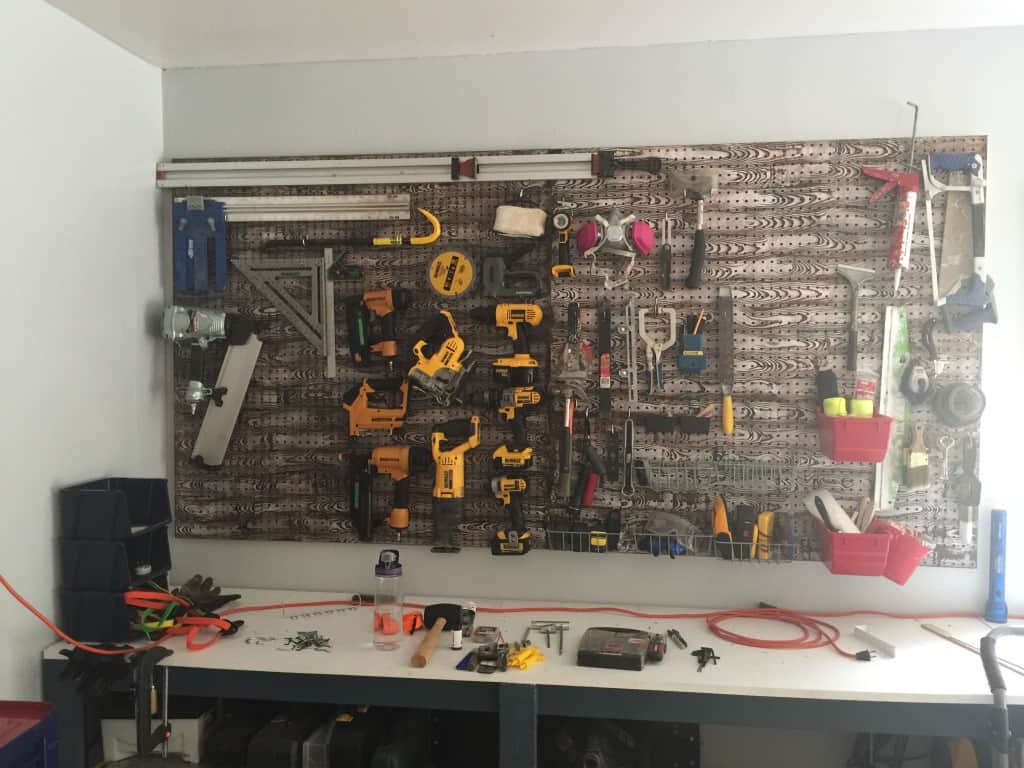
- Power tools (drills, sanders): Only safe on metal or thick, well-mounted wood pegboard.
- Paint cans or heavy toolboxes: Only safe on metal pegboard with strong hooks.
- Kitchen pots and pans: Fine for metal or thick plastic boards, but not for 1/8″ wood fiber.
- Craft supplies: Light items like scissors, thread, and tape are safe on any pegboard.
If you want to hang something heavy, use the strongest material and mount it securely.
Mounting Methods And Their Impact On Weight Capacity
The way you install your pegboard can change its weight capacity more than you might think. Here are the most common methods, with their pros and cons:
Direct Mount To Wall Studs
This is the strongest option. Screws go through the pegboard and directly into the wood studs behind the wall.
- Pros: Highest weight capacity, safest for heavy loads.
- Cons: Studs may not line up with pegboard holes, so you may need to drill extra holes.
Using Furring Strips
Furring strips are thin wood boards screwed horizontally across the studs. The pegboard attaches to these strips. This gives space behind the board for hooks.
- Pros: Good support, easy hook use.
- Cons: Slightly reduces usable wall space.
Drywall Anchors
If you can’t find studs, you might use wall anchors.
- Pros: Easier to install anywhere.
- Cons: Lower weight capacity. Never use for heavy tools.
French Cleat System
A French cleat is a special angled bracket that attaches to both the wall and the pegboard. It spreads weight evenly.
- Pros: Very secure, easy to remove board for cleaning.
- Cons: More complex to install.
Comparison Of Mounting Methods
Here’s how different mounting methods affect weight capacity:
| Mounting Method | Max Safe Weight (Per Sq. Ft.) | Best For |
|---|---|---|
| Direct to Studs | 50–100 lbs (22–45 kg) | Heavy tools, garages |
| Furring Strips | 40–75 lbs (18–34 kg) | Workshops, craft rooms |
| Drywall Anchors | 10–25 lbs (4.5–11 kg) | Light items only |
| French Cleat | 75–150 lbs (34–68 kg) | Commercial, high load |
Pro tip: Even with strong mounting, never hang more than your weakest link can handle—be it the pegboard, the anchors, or the wall.
How To Maximize The Weight Your Pegboard Can Hold
You can safely increase your pegboard’s holding power with a few smart steps:
- Use the thickest pegboard you can. Thicker boards are much stronger.
- Choose metal pegboard for heavy-duty needs. It costs more but lasts longer and holds more.
- Mount directly to studs with long screws. This gives maximum support.
- Use high-quality hooks and accessories. Cheap hooks can fail even if the board is strong.
- Spread weight evenly. Don’t overload one area.
- Check all fasteners regularly. Tighten screws and replace any weak hooks.
- Avoid moisture and extreme temperatures. Especially important for wood fiber boards.
- Add extra support for heavy items. For example, a shelf bracket under a heavy toolbox.
Non-obvious insight: Many people try to hang bins or shelves on their pegboard. These can put a lot of stress on the holes. Use extra anchors or brackets to support these loads.
Common Mistakes That Lead To Pegboard Failure
Sometimes, small mistakes can lead to big problems. Watch out for these:
- Using too few screws or anchors. This causes sagging or falling boards.
- Overloading one hook or area. Even a strong board can fail if weight is not spread out.
- Using the wrong size hooks. Too small, and they bend; too big, and they damage the holes.
- Ignoring manufacturer instructions. Always check the specific weight limits for your product.
- Letting wood fiber boards get wet. This can ruin them quickly.
- Mounting only to drywall. Drywall is weak—always try to hit a stud or use special anchors.
- Placing heavy items high up. If they fall, they can injure someone.
Metal Vs. Wood Vs. Plastic Pegboards: In-depth Comparison
Let’s take a closer look at the strengths and weaknesses of each pegboard material.
Metal Pegboard
Strengths:
- Highest weight capacity
- Won’t warp or swell if wet
- Fire-resistant
- Long-lasting
Weaknesses:
- More expensive
- Heavier (harder to install alone)
- May scratch tools or surfaces if not careful
Best for: Heavy tools, workshops, commercial use
Wood Fiber Pegboard
Strengths:
- Inexpensive
- Easy to cut and customize
- Widely available
Weaknesses:
- Low weight capacity
- Damaged by water or humidity
- Can warp or break under heavy load
Best for: Light hand tools, craft rooms, dry locations
Plastic Pegboard
Strengths:
- Lightweight
- Won’t rust or rot
- Good for humid areas (like bathrooms)
Weaknesses:
- Mid-range weight capacity
- Some plastics are brittle
Best for: Kids’ rooms, kitchens, light storage
Key tip: Even the best material fails if installed poorly. Focus on both quality pegboard and strong mounting.
How Manufacturers Test And Rate Pegboard Weight Limits
Ever wonder how companies decide those weight ratings? Here’s what happens:
- Load testing: Manufacturers hang standard weights from hooks and measure when the board bends, cracks, or fails.
- Real-world simulations: Some brands test with actual tools and accessories.
- Safety margins: Most companies set the official limit below the actual breaking point for safety.
Why this matters: Always use the published weight limit as your maximum, not the point where it actually breaks. Safety first!
For more technical standards on wall-mounted storage, you can check resources like Wikipedia.
How To Choose The Right Pegboard For Your Needs
Choosing the right pegboard is about more than just weight. Here’s how to decide:
- List what you want to hang. Be realistic—heavier tools need stronger boards.
- Choose the best material. Metal for heavy loads, plastic or thick wood for lighter items.
- Measure your wall space. Make sure the board fits and you can reach everything.
- Check your wall type. Concrete, wood studs, or just drywall? This affects mounting options.
- Plan your hook layout. Buy the right hooks for your tools or supplies.
- Think about future needs. Leave space for more items if you plan to expand.
Common mistake: Many people buy a cheap, thin pegboard, only to replace it later when it fails. Invest in quality upfront if you want lasting results.
How To Safely Install A Pegboard For Maximum Strength
Here’s a step-by-step guide for a safe, strong installation:
- Find the wall studs. Use a stud finder. Mark them with a pencil.
- Cut furring strips (optional). Use 1×2 inch wood strips the width of your pegboard.
- Screw furring strips to the studs. Space them 12–18 inches apart vertically.
- Drill holes in your pegboard to match the furring strips or studs.
- Attach the pegboard to the strips with wood screws. Use at least one screw every 16 inches.
- Check for level before tightening all screws.
- Test by gently hanging a heavy item. If the board flexes or moves, add more screws or support.
Pro tip: Use washers under screw heads to avoid tearing the pegboard.
Maintenance And Safety Tips For Loaded Pegboards
To keep your pegboard safe and long-lasting:
- Inspect hooks and boards monthly. Look for bending, cracks, or loose screws.
- Don’t let items hang too far out. Heavy items should stay close to the wall.
- Replace damaged hooks or boards right away.
- Keep the area dry. Use a dehumidifier if needed in garages or basements.
- Don’t climb or lean on pegboard. It’s not a ladder or shelf.
Advanced Solutions For Heavy Loads
If you need to hang very heavy items (over 50 lbs per hook or 100+ lbs total), consider these solutions:
- Install a solid wood or metal panel behind the pegboard for extra support.
- Use specialty heavy-duty pegboard systems—some are rated for industrial use.
- Add shelf brackets or wall-mounted shelves for the heaviest items.
- Consider slatwall systems as an alternative; these can hold more weight than most pegboards.
Frequently Asked Questions
How Much Weight Can A 1/4″ Wood Pegboard Hold?
A 1/4″ wood (MDF) pegboard typically holds 10 lbs per hook and up to 50 lbs total per 2×4 ft section if mounted to wall studs. For best results, spread weight evenly and avoid overloading one area.
Can I Hang A Bicycle On A Pegboard?
Most standard pegboards, even metal ones, are not designed to hold a full-size bicycle (usually 20–40 lbs). For safety, use dedicated bike hooks mounted directly into wall studs, not just pegboard holes.
What Are The Best Hooks For Heavy Loads On Pegboard?
Heavy-duty steel hooks are the safest for large or heavy items. Always check their weight rating and make sure they fit tightly in the pegboard holes. For the heaviest loads, use special locking hooks.
Is It Safe To Use Pegboard In A Humid Area Like A Bathroom?
Metal or plastic pegboards are best for humid areas. Avoid wood fiber boards, as they can swell, warp, or grow mold in moisture. Even with metal or plastic, use stainless steel hooks to prevent rust.
Can I Install Pegboard On Drywall Without Hitting Studs?
You can, but the weight capacity will be much lower—often less than 10 lbs per hook. For anything heavier, always try to screw into studs or use strong drywall anchors designed for heavy loads.
A pegboard is a fantastic way to organize your space, but safety is key. Knowing your pegboard’s true weight limit, choosing the right materials, and mounting it correctly will give you years of reliable service—without any surprises. Whether you’re storing craft supplies or heavy power tools, a well-chosen and well-installed pegboard is a smart investment in both safety and order.