
An impact driver is a tool many people see in hardware stores, but not everyone knows what makes it special. If you build things, work with wood, or do home repairs, you may have heard of it. Still, you might wonder: what is an impact driver used for, and why do professionals and DIYers choose it over other tools? This guide will explain everything in simple English, so you can understand if you need one—and how to use it wisely.
Understanding The Impact Driver
An impact driver is a power tool designed for driving screws and bolts with high speed and force. Unlike a regular drill, it combines rotation with strong bursts of force (impacts). This makes it much easier to drive long screws or stubborn bolts into tough materials.
Impact drivers are smaller and lighter than most drills. They use a special mechanism inside that delivers quick, powerful twists. This action reduces the strain on your wrist and hand. It also makes the tool less likely to “cam out” (slip) when you’re working with tough screws.
Some people confuse an impact driver with a hammer drill. The key difference is that an impact driver applies force in the rotation direction, while a hammer drill applies force forward and back. This makes each tool better for different jobs.
Main Uses Of An Impact Driver
Impact drivers are not just for professionals. They are helpful for many tasks around the house and on the job site. Here are the main uses:
1. Driving Long Screws Into Wood
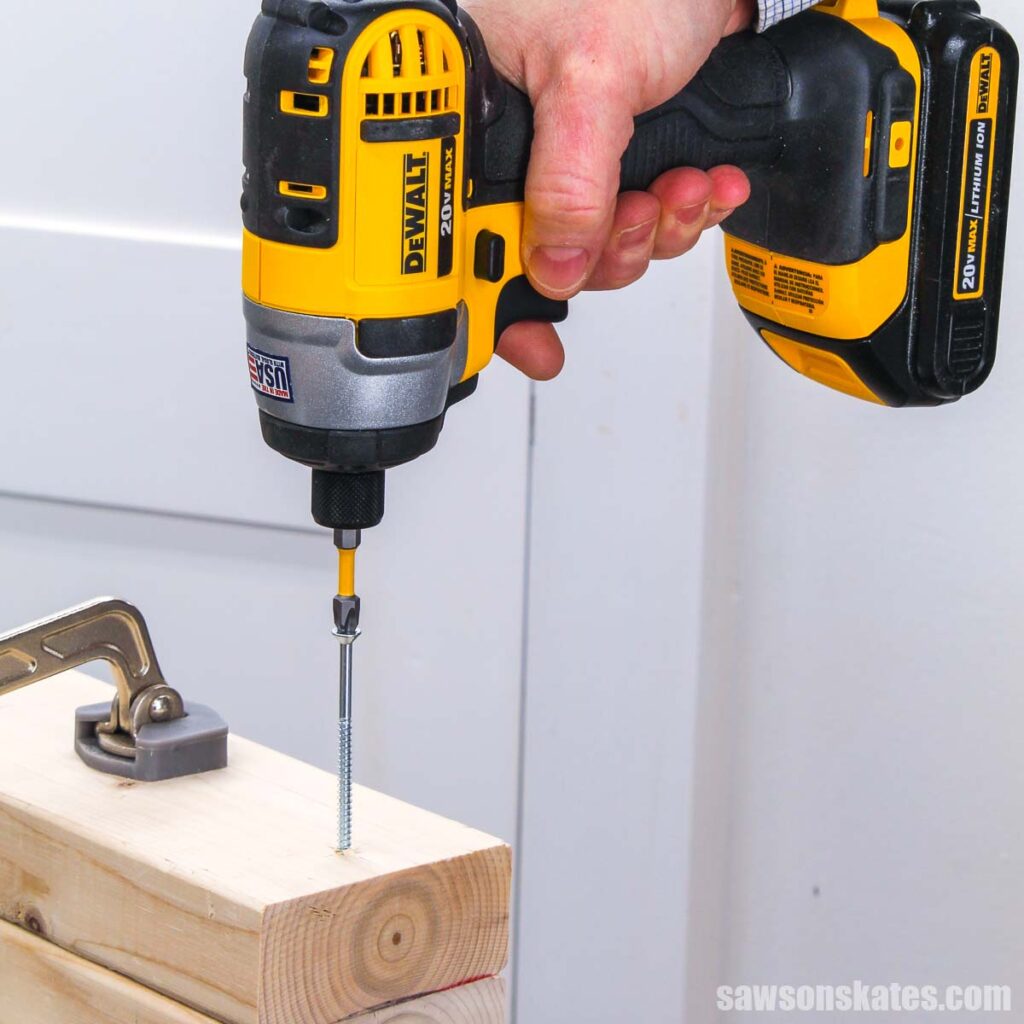
One of the most common uses is driving long screws into hardwood or treated lumber. Regular drills often struggle with these tasks, especially if the wood is thick or hard. The impact action of the driver makes this much easier, reducing the chance of stripping the screw head.
2. Fastening Lag Bolts And Large Fasteners
Lag bolts are thick, heavy-duty screws used in construction. Impact drivers can drive these bolts into wood, metal, or masonry with less effort. They are perfect for building decks, fences, and heavy frames.
3. Removing Stubborn Or Rusty Screws
Sometimes screws are stuck, rusted, or have been painted over. An impact driver’s quick twisting force can loosen them when a regular screwdriver or drill cannot.
4. Assembling Furniture And Cabinets
Impact drivers speed up furniture assembly. They can drive many screws quickly without the tool slipping out of the screw head. This is useful for flat-pack furniture or cabinet installation.
5. Working With Sheet Metal
When you need to install screws into thin metal sheets, an impact driver gives you control and power. The short bursts of force help avoid bending the metal or damaging the screw.
6. Automotive Repairs
Impact drivers are useful in automotive work, such as removing stuck screws and bolts from cars, bikes, or machinery. Their compact size helps reach tight spaces in engine bays.
7. Building Outdoor Structures
If you are building a deck, pergola, or shed, you will likely use hundreds of screws. An impact driver makes this work faster and less tiring.
8. Installing Drywall
Drywall installation involves many screws. With an impact driver, you can install them quickly and with the right depth, reducing the risk of overdriving or damaging the drywall surface.
9. Electrical And Plumbing Jobs
Electricians and plumbers often use impact drivers to fasten electrical boxes, conduit straps, or pipe clamps. The tool’s compact size is helpful in tight spaces.
10. Hanging Doors And Windows
Impact drivers allow for precise, strong fastening of door and window frames. This ensures secure installation and can help prevent future shifting or sagging.
How Does An Impact Driver Work?
Inside the tool, a spring-loaded hammer and anvil system stores energy and releases it in quick bursts. When resistance increases (for example, when the screw meets hard wood), the mechanism delivers a series of rotational impacts. This action is different from the steady rotation of a drill.
Here is a simple way to imagine it: Think about turning a stuck screw with a wrench. If it is hard to turn, you might tap the wrench with a hammer. The impact driver does this automatically, but very quickly and smoothly.
This design helps users in two important ways:
- Less wrist strain: The tool absorbs most of the twisting force.
- Better grip: The impact action keeps the bit in the screw head, so it is less likely to slip or strip the screw.
Common Features Of Impact Drivers
Modern impact drivers come with useful features that make them versatile and safe:
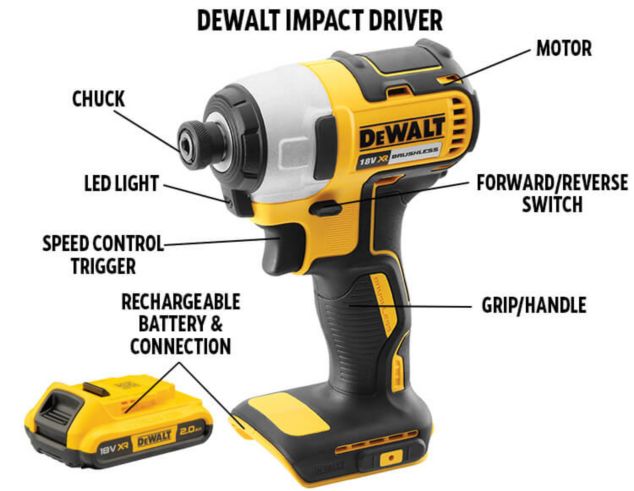
- Variable speed trigger: Allows you to control how fast the tool spins.
- LED light: Illuminates dark work areas.
- Quick-change chuck: Lets you swap bits quickly, often with one hand.
- Compact design: Fits into tight spaces where a drill may not fit.
- Brushless motors: Newer models have brushless motors, which last longer and require less maintenance.
Impact Driver Vs. Drill: What’s The Difference?
Many beginners wonder if they need both a drill and an impact driver. The answer depends on your projects. Here is a side-by-side comparison:
| Feature | Impact Driver | Drill/Driver |
|---|---|---|
| Main Use | Driving screws and bolts | Drilling holes, general fastening |
| Torque (Power) | High | Medium |
| Chuck Type | 1/4″ hex quick change | 3-jaw, fits round bits |
| Impacts Per Minute | Yes | No |
| Size | Compact | Usually larger |
| Best For | Long screws, tough materials | Drilling holes, light screws |
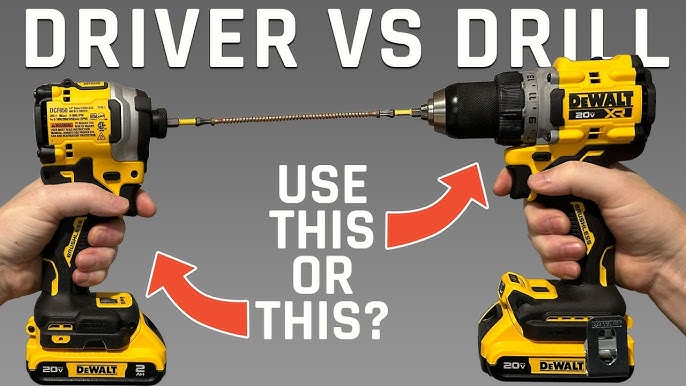
A drill is better for drilling holes, while an impact driver is better for driving screws and bolts, especially in tough jobs.
Types Of Impact Drivers
There are three main types of impact drivers, each with its own strengths:
1. Cordless Impact Drivers
Cordless models use rechargeable batteries (usually 18V or 20V). They are very popular because they are portable and easy to use anywhere.
2. Corded Impact Drivers
These plug into an electrical outlet. They offer unlimited power and are usually lighter because they do not have a battery. The downside is you need access to electricity and may be limited by the cord length.
3. Manual Impact Drivers
A manual impact driver is a hand tool. You hit it with a hammer, and it delivers a strong twisting force to loosen stuck screws or bolts. These are less common but can be very useful for removing rusted screws in cars or machines.
Which Jobs Need An Impact Driver?
Not every project needs an impact driver, but here are tasks where it makes a big difference:
- Building decks: Hundreds of long screws into hardwood
- Framing walls: Fastening thick lumber together
- Installing subfloor: Driving screws into plywood or OSB
- Fencing: Attaching pickets or rails with exterior screws
- Automotive repairs: Removing brake rotors, stuck bolts
- Outdoor furniture: Assembling benches, tables, or pergolas
- Remodeling kitchens: Securing cabinets to walls
- Mounting TVs or shelves: Driving lag bolts into studs
- Metal roofing: Attaching metal sheets with self-tapping screws
- Large woodworking projects: Building planters, beds, or playsets
For these jobs, an impact driver saves time and reduces fatigue.
How To Use An Impact Driver Safely
Although impact drivers are simple to use, safety should always come first. Here’s how to use one safely:
- Wear eye protection: Screws can break or bits can slip.
- Check your bits: Use only impact-rated bits. Regular bits can break under high force.
- Keep hands clear: The tool delivers sudden force; keep fingers away from the bit.
- Start slow: Use the variable speed trigger to start gently, then increase speed as needed.
- Let the tool do the work: Do not force the tool. If the screw is not moving, check for problems.
- Secure your material: Clamp wood or metal before driving screws.
What Bits And Accessories Do You Need?
Impact drivers use 1/4-inch hex shank bits. These snap into the quick-change chuck. Not all bits are the same—impact-rated bits are made from tougher steel and are less likely to break.
Essential accessories include:
- Screwdriver bits: Phillips, Torx, square, and slotted
- Nut drivers: For bolts and hex-head screws
- Socket adapters: Allow you to use sockets for automotive bolts
- Drill bit adapters: You can drill small holes, but use special impact-ready drill bits
Some beginners make the mistake of using regular bits from a drill. These wear out or break quickly in an impact driver.
Pros And Cons Of Using An Impact Driver
Like any tool, impact drivers have strengths and weaknesses. Understanding them helps you choose the right tool for your needs.
| Pros | Cons |
|---|---|
| High torque for tough jobs | Not ideal for drilling large holes |
| Reduces wrist strain | Loud operation (noise) |
| Less likely to strip screws | Only uses hex bits |
| Compact and lightweight | Less control for delicate work |
| Fast screw driving | Can overdrive small screws |
Key Differences: Impact Driver Vs. Hammer Drill
Many people confuse impact drivers with hammer drills. Here’s a quick comparison:
| Feature | Impact Driver | Hammer Drill |
|---|---|---|
| Force direction | Rotational (twisting) | Axial (forward/back) |
| Main use | Driving screws/bolts | Drilling into concrete/brick |
| Bit type | 1/4″ hex shank | Round or SDS bits |
| Noise | Loud | Very loud |
| Control | High for driving | Best for drilling masonry |
If you need to drill into brick or concrete, use a hammer drill. For driving screws, an impact driver is the clear winner.
Mistakes To Avoid With An Impact Driver
Even experienced users can make mistakes. Here are some common pitfalls and how to avoid them:
- Using non-impact bits: These can break or wear out quickly. Always use bits made for impact drivers.
- Overdriving screws: The high power can bury screws too deep. Practice using the trigger gently.
- Using for drilling large holes: Impact drivers are not made for big holes in wood or metal. Use a drill for this.
- Not charging batteries: Cordless models run out of power fast during heavy use. Have a spare battery ready.
- Ignoring noise: Impact drivers are loud. Use ear protection in enclosed spaces.
Non-obvious Tips And Insights
Some helpful tips are not always found in manuals or guides:
- Choose the right bit length: Short bits give better control, but long bits are needed for hard-to-reach places.
- Work in bursts: Let the tool pulse a few times, then check your screw depth. This gives better results than holding the trigger constantly.
- Use magnetic bit holders: These help keep screws on the bit, especially when working overhead or one-handed.
- Check your screws: Not all screws are strong enough for impact drivers. Cheap screws can snap under high torque.
- Mind the material: When working with softwoods or drywall, reduce pressure to avoid damaging the surface.
When Should You Choose A Drill Instead?
You do not always need an impact driver. A regular drill is better when:
- Drilling holes: Especially large holes in wood, metal, or masonry.
- Working with small screws: For delicate projects, such as electronics or small hinges.
- Needing more bit options: Drills accept many kinds of bits, not just hex-shank ones.
If you do a lot of driving and fastening, an impact driver is a good investment. For all-in-one tasks, a drill/driver may be enough.
Popular Brands And Models
Some brands are known for making reliable impact drivers. Here are a few popular choices:
- DeWalt 20V MAX: Known for strong performance and long battery life.
- Makita LXT 18V: Lightweight and compact, with many tool options.
- Milwaukee M18 Fuel: High torque, brushless motors, and sturdy build.
- Bosch 18V: Good balance of power and price.
- Ryobi ONE+ 18V: Affordable and fits a wide range of tools.
These brands offer both entry-level and professional-grade models. Compare features like battery life, torque, and weight before buying.
Impact Driver Maintenance
Caring for your impact driver helps it last longer and perform better:
- Clean regularly: Dust and debris can enter the vents. Wipe the tool and check for blockages.
- Check the chuck: Make sure the quick-change mechanism is free of dirt.
- Charge batteries fully: Store batteries in a cool, dry place.
- Replace worn bits: Dull or bent bits can damage screws and make work harder.
- Store safely: Keep the tool in its case when not in use.
A little maintenance goes a long way in keeping your tool ready for the next project.
Environmental Impact: Cordless Vs. Corded
Cordless impact drivers use lithium-ion batteries. These are powerful but must be recycled properly. Corded drivers use less battery waste, but they draw power from the grid.
If you want to be more eco-friendly:
- Use high-quality batteries and recharge them fully.
- Recycle old batteries at authorized centers.
- Choose efficient models that need less power for the same job.
How To Choose The Right Impact Driver
If you are buying your first impact driver, consider these factors:
- Power (Voltage): 18V or 20V models offer the best mix of power and weight.
- Torque rating: More torque means more force, which is better for tough jobs.
- Battery system: If you already own tools from a brand, choose the same battery system.
- Size and weight: Lighter models are easier to use overhead or in tight spaces.
- Features: Look for LED lights, belt clips, and variable speed triggers.
- Price: You can find good models at various prices; do not buy the cheapest if you plan to use it often.
Check reviews and ask for advice at your local store if you are unsure.
Impact Drivers In Professional Trades
Professionals in carpentry, construction, plumbing, and electrical work rely on impact drivers every day. Here’s why:
- Speed: Jobs get done faster, which saves money and time.
- Consistency: Each screw or bolt is driven with the same force.
- Durability: Less wear on bits and screws means fewer replacements.
- Reach: Compact size allows work in small spaces, such as inside cabinets or under sinks.
For big projects, having both an impact driver and a drill/driver is common. This allows switching between drilling and fastening without changing bits.
Real-world Examples
Let’s look at some real situations where an impact driver shines:
- Deck building: You need to drive 300 screws into hardwood planks. A regular drill would take much longer and might overheat, while an impact driver handles it with ease.
- Automotive repair: You find a rusty screw holding a brake rotor. A manual screwdriver slips, but an impact driver removes it in seconds.
- Cabinet installation: You must fasten cabinets to a wall stud. The impact driver’s short size fits inside the cabinet, and the high torque ensures a tight fit.
These examples show why many people consider an impact driver a must-have tool.
When Not To Use An Impact Driver
Sometimes, an impact driver is not the right tool. Avoid using it when:
- You need precise, gentle control: For example, installing small hinges on a jewelry box.
- Drilling large holes: Impact drivers are not designed for large-diameter drilling.
- Working with delicate materials: High torque can damage fragile surfaces.
In these cases, choose a regular drill or a hand screwdriver for more control.
The Future Of Impact Drivers
Technology is making impact drivers smarter and more efficient. Some trends include:
- Brushless motors: These offer longer life and less maintenance.
- Smart electronics: Some models adjust power automatically to match the screw or material.
- Better batteries: New batteries last longer and charge faster.
- Compact designs: Tools are becoming smaller without losing power.
Manufacturers are also focusing on ergonomics and safety, making the tools easier to handle for everyone.
Where To Learn More
If you want to see impact drivers in action, many hardware stores offer demonstrations. You can also find helpful videos and tips from professional builders online. For more technical information, check out resources like Wikipedia.
Frequently Asked Questions
What Is The Main Advantage Of An Impact Driver Over A Regular Drill?
The main advantage is high torque for driving screws and bolts. Impact drivers deliver quick bursts of force, making it easier to drive long or stubborn screws, especially in tough materials.
Can You Use An Impact Driver To Drill Holes?
Yes, but only for small holes and with special impact-rated drill bits. For larger holes or precise drilling, a regular drill is better.
Do You Need Special Bits For An Impact Driver?
You need impact-rated bits with a 1/4-inch hex shank. These are made from tougher steel to handle the high force. Regular bits may break.
Is An Impact Driver Good For Beginners?
Yes, impact drivers are easy to use and reduce wrist strain. Beginners should practice controlling the trigger to avoid overdriving screws.
What Should I Look For When Buying An Impact Driver?
Look for power (voltage), torque rating, battery system, size, and features like LED lights. Choose a trusted brand and make sure it feels comfortable in your hand.
An impact driver is a powerful addition to any toolbox. If you work with wood, metal, or do home repairs, it can save you time and effort. Understanding when and how to use it helps you get better results and work more safely.
Whether you are a beginner or a professional, the right impact driver can make tough jobs much easier.