
When you look inside a wall or open an electrical panel, you’ll see wires in many colors. These colors aren’t just for looks—they are a universal language for electricians and anyone working with electricity. Knowing what each color means can prevent dangerous mistakes, protect your equipment, and even save lives.
But with so many wire colors and different standards around the world, understanding them can feel confusing. This guide will help you clearly understand electrical wire color codes, their meanings, and how to use them safely, whether you are fixing a plug at home or planning a bigger project.
Why Electrical Wire Color Codes Matter
Wire colors are not chosen at random. Each color tells you something important about the wire’s purpose. For example, one color might mean “live” or “hot,” while another means “neutral” or “ground. ” Using the wrong color can cause accidents, create code violations, and make future repairs much harder.
In some situations, mixing up wire colors can even be deadly. That’s why understanding these codes is a must for homeowners, DIYers, and professionals alike.
Over time, color codes have been created and updated by national and international groups. In the United States, the National Electrical Code (NEC) sets the standard. Other countries have their own codes, such as the International Electrotechnical Commission (IEC) for Europe and much of the world.
It’s important to know which code applies where you live or work.
Basic Electrical Wire Colors And Their Meanings
Let’s start with the most common wire colors and what they usually mean. Keep in mind, local regulations or older buildings might use different colors, so always double-check before starting work.
Black Wires
Black wires are almost always used for hot or live connections. These wires carry current from the power source to outlets, lights, and appliances. Never use black wires for grounding or neutral—doing so can create a serious hazard.
Red Wires
Red wires are also used as hot wires, especially in 220-volt circuits or for the second “hot” wire in a switch leg. You’ll often see red wires in three-way switch setups, smoke detectors, or when connecting hardwired appliances.
White Wires
White wires are usually neutral. They complete the electrical circuit by carrying current back to the panel after it passes through a device. In rare cases, white wires might be used as hot—if so, they should be marked with black tape. Never assume a white wire is always safe to touch.
Green Wires
Green wires are for grounding. They connect your electrical system to the earth, which helps protect you from shock. If a device malfunctions, the green wire provides a safe path for the electricity to escape.
Bare Copper Wires
You might see wires without any insulation—these are bare copper wires. Like green wires, they are used for grounding only. Never use bare copper as a hot or neutral conductor.
Blue And Yellow Wires
Blue and yellow wires are less common in homes but play important roles. They’re used as hot wires in special circuits, like travelers in three-way and four-way switches, or for lighting and fans in commercial settings.
Gray Wires
Gray wires can also be used as neutral in some codes, especially in newer wiring systems. Always check the code for your country or region.
Orange Wires
Orange wires are sometimes used as hot wires, especially for 277-volt lighting circuits in commercial settings. They aren’t usually found in homes.
Electrical Wire Color Codes In The United States (nec)
The United States has a clear system for wire colors, set by the NEC. Let’s break it down for residential and commercial wiring.
Standard Us Wire Colors
| Wire Color | Function | Typical Use |
|---|---|---|
| Black | Hot | Main power, switches, outlets |
| Red | Hot (secondary) | Three-way switches, smoke detectors |
| White | Neutral | Return path to panel |
| Green or Bare Copper | Ground | Safety grounding |
| Blue/Yellow | Hot (traveler, switch legs) | Multi-way switches, lighting |
| Gray | Neutral (alternative) | Newer systems |
How Us Codes Are Used
In a standard home circuit, you’ll usually see black (hot), white (neutral), and green or bare copper (ground). For more complex setups, like three-way switches or split outlets, red and sometimes blue/yellow wires appear.
A common mistake is to assume all white wires are neutral. Sometimes, electricians wrap black tape around a white wire to show it is being used as hot—always watch for this sign.
Pro tip: If you see a wire color that doesn’t match its job, stop and investigate. It could be a sign of an old repair, a code violation, or a hidden danger.
Electrical Wire Color Codes In Europe And Other Countries (iec)
Many countries outside the US follow the IEC standard. The color codes are different, and using US rules in Europe (or vice versa) can cause major confusion.
Iec/european Wire Colors
| Wire Color | Function | Typical Use |
|---|---|---|
| Brown | Live/Hot | Main power |
| Blue | Neutral | Return path |
| Green/Yellow striped | Earth/Ground | Safety grounding |
| Black/Gray | Phase (multi-phase) | Three-phase systems |
For single-phase wiring (most homes), brown is live, blue is neutral, and green/yellow is ground.
Three-phase Wiring In Europe
In industrial or commercial buildings, you might see three-phase wiring. Here, brown, black, and gray are used for the three live wires, blue is neutral, and green/yellow is ground.
Insider tip: In older European buildings, red, yellow, and green were sometimes used for phases. Always check the building’s age and look for updated labeling.
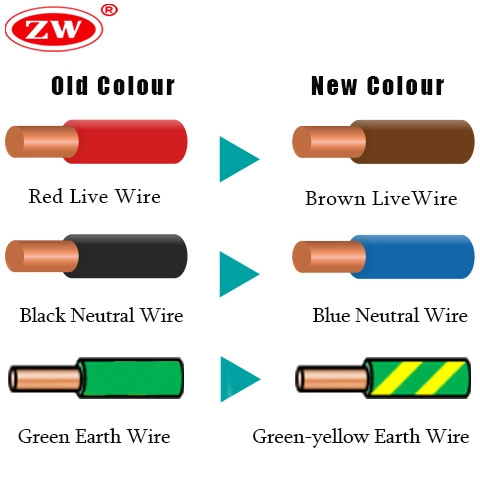
Electrical Wire Color Codes In Canada, Uk, Australia, And India
Different countries use their own systems, which sometimes match the US or IEC, but often have unique features.
Canada
Canada mostly follows US NEC rules, but sometimes allows different markings for switch legs and travelers.
United Kingdom
The UK uses brown for live, blue for neutral, and green/yellow for earth (ground), similar to the IEC. In older homes, red and black might appear—red was live, black was neutral.
Australia And New Zealand
These countries use the same colors as the UK for new installations. Older homes might use red (active/live), black (neutral), and green (earth).
India
India follows the IEC system for new wiring (brown, blue, green/yellow). Older buildings may use red, black, and green.
Key insight: If you are working on an older building, always test the wires before touching them. Color codes may have changed over time, and previous repairs might not follow modern standards.
Special Cases: Multi-wire And High-voltage Systems
Not all circuits are simple. When you have more than one hot wire, or when dealing with high-voltage or three-phase power, extra colors are used to keep things clear and safe.
Three-phase Power
In three-phase power, used in factories or large buildings, each phase gets a unique color. This helps prevent crossed connections that can damage equipment or cause fires.
For example, in the US:
- Black: Phase 1 (L1)
- Red: Phase 2 (L2)
- Blue: Phase 3 (L3)
- White: Neutral
- Green or bare: Ground
In Europe:
- Brown: Phase 1
- Black: Phase 2
- Gray: Phase 3
- Blue: Neutral
- Green/yellow: Ground
High-voltage Circuits
For very high voltage (above 600V), special markings and sometimes unique colors are required. Always refer to local codes for these situations. Never assume color meanings are the same as for standard wiring.
Markings And Tapes: When Color Is Not Enough
Sometimes, wires are painted, covered in dust, or replaced with non-standard colors. In these cases, electricians use colored tape or markers to label wires.
For example:
- Wrapping black tape around a white wire to show it is being used as hot.
- Using colored heat-shrink tubing on bare or odd-colored wires.
Always look for these extra markings. If you are unsure, use a voltage tester before touching any wire.
Special Uses: What Some Colors Mean In Unique Situations
Wire colors can have different meanings in special cases. Here are some examples:
- Orange: In the US, orange wires are sometimes used for the high leg in a three-phase “delta” system.
- Pink, Purple, or Other Colors: Rarely used, but may be assigned for specific signals, control circuits, or alarm systems in large buildings.
- White with Red or Black Stripe: Sometimes used for switched neutrals or specific control circuits.
Common mistake: Don’t rely only on color. Always check with a tester and inspect for extra markings or labels.
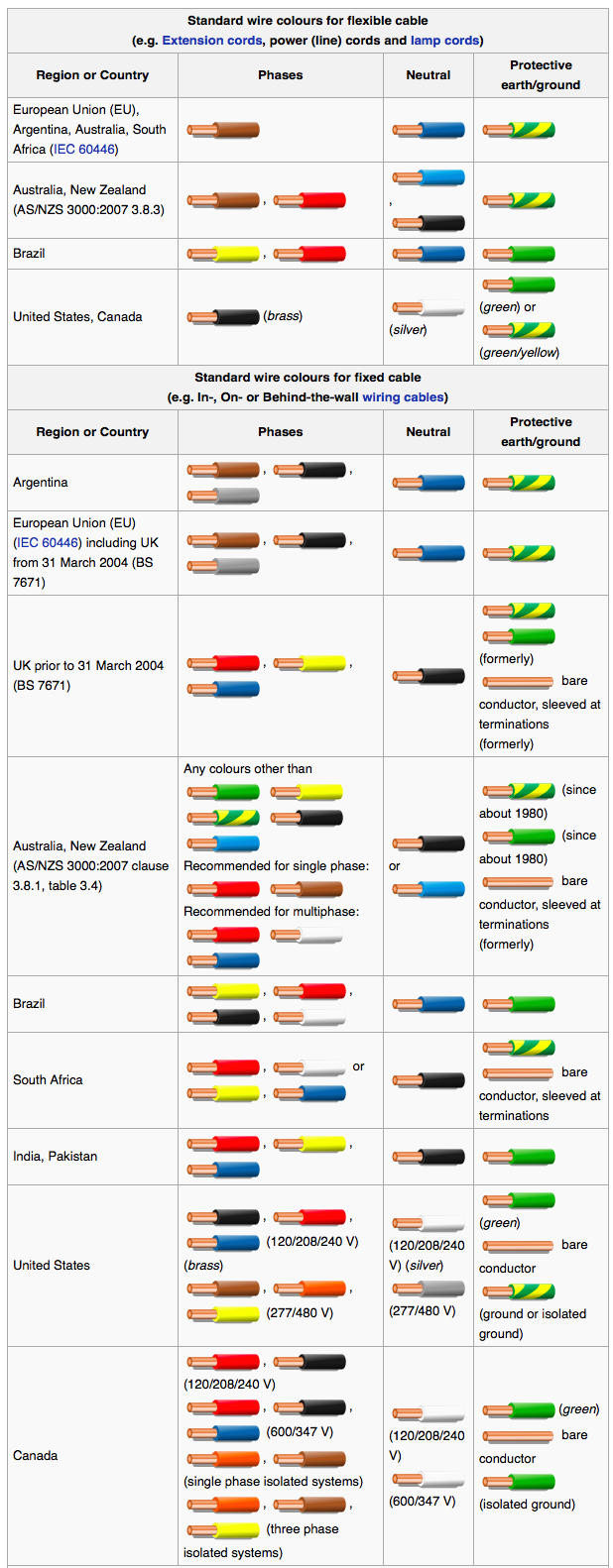
How To Identify And Follow The Right Wire Color Codes
Here’s a step-by-step approach to safely identify and follow wire color codes:
- Find out which code applies: Are you in the US (NEC), UK, IEC country, or elsewhere? Check the age of the building.
- Turn off power: Always shut off the circuit at the breaker before working.
- Visually check wire colors: Compare them to the code for your area.
- Look for tape or labels: These may change the wire’s purpose.
- Test with a voltage tester: Never assume a wire is safe to touch just because of its color.
- Mark new wires correctly: When adding or repairing wiring, always use the correct color or tape.
- Keep a wiring diagram: Draw or photograph connections before making changes.
Practical Examples: Reading Wire Colors In Real-life Situations
Let’s look at some examples to make this clearer.
Example 1: Replacing A Light Switch (us Home)
You open the switch box and see:
- One black wire: This is the hot wire bringing power from the panel.
- One white wire: This returns the power to the panel (neutral).
- One green wire: This connects to the metal box (ground).
Simply match the new switch terminals to these colors.
Example 2: Installing A Ceiling Fan (europe)
In a European home, you see:
- Brown wire: Connects to live (L).
- Blue wire: Connects to neutral (N).
- Green/yellow striped wire: Connects to earth (E).
These are the standard IEC colors.
Example 3: Working With Three-way Switches
In the US, you may see:
- Black wire: Common terminal (hot).
- Red and white wires: Travelers (may be hot in some positions).
- Ground wire: Green or bare copper.
Always check which traveler is hot before connecting.
Common Mistakes And How To Avoid Them
Even experienced people can make mistakes with wire colors. Here are some errors to watch for:
- Mixing up neutral and ground: They are not the same! Connecting them together can create a shock hazard.
- Assuming old color codes are still correct: Codes change over time. Test every wire, especially in older homes.
- Ignoring tape markings: A white wire with black tape is not neutral anymore—it’s hot.
- Using the wrong color for a repair: If you must use a non-standard color, always label it clearly with colored tape or a marker.
Expert tip: Keep extra colors of electrical tape and wire markers in your toolbox. This helps you stay organized and safe.
Data Table: Color Codes In Major Regions At A Glance
Here’s a quick reference for the most common wire color codes around the world.
| Country/Region | Live/Hot | Neutral | Ground/Earth |
|---|---|---|---|
| USA (NEC) | Black, Red, Blue | White, Gray | Green, Bare Copper |
| UK | Brown | Blue | Green/Yellow |
| Europe (IEC) | Brown, Black, Gray | Blue | Green/Yellow |
| Australia/New Zealand | Brown | Blue | Green/Yellow |
| India | Brown (old: Red) | Blue (old: Black) | Green/Yellow (old: Green) |
Color Codes For Cables (sheathing)
Sometimes, the cable itself (the outer sheath) is colored to indicate its purpose. For example, in the US:
- White sheathing: 14-gauge wire (typically for 15-amp circuits)
- Yellow sheathing: 12-gauge wire (typically for 20-amp circuits)
- Orange sheathing: 10-gauge wire (typically for 30-amp circuits)
- Black sheathing: 6- or 8-gauge wire (typically for large appliances)
This is an extra way to tell what’s inside a cable without stripping it.
The Importance Of Consistency And Documentation
Keeping to the correct wire color codes isn’t just about safety—it also makes repairs and upgrades much easier in the future. When every wire is the right color and clearly marked, anyone can quickly understand the system.
Insider insight: Many electrical fires and accidents happen because someone guessed about a wire’s purpose. Good documentation, clear markings, and following color codes are your best defense.
:max_bytes(150000):strip_icc()/electrical-wire-color-coding-1152863-1885f3461ba9443f8bcf14a1f9236a2d.png)
Special Considerations For Diyers And Homeowners
If you’re doing your own electrical work, always check your local codes before starting. Some areas require permits or inspections, even for small jobs. Never try to save money by using the wrong color wire or ignoring safety practices.
A smart tip: If you must use a wire color that doesn’t match the code (for example, if you run out of one color), always label both ends of the wire with colored tape or a marker. Make a note in your home’s electrical panel or wiring diagram.
When To Call A Professional
If you ever feel unsure about what a wire color means, or if you find wires that don’t match any code, call a qualified electrician. Electricity is dangerous, and mistakes can be costly—or deadly.
Did you know? According to the National Fire Protection Association, faulty wiring is one of the leading causes of home fires in the United States. Don’t take unnecessary risks with electrical work.
How Wire Colors Relate To Electrical Safety
Wire colors are a first line of defense, but they are just one part of a safe electrical system. Always:
- Turn off power before working.
- Use a voltage tester to confirm wires are dead.
- Wear insulated gloves when in doubt.
- Use properly rated tools for electrical work.
- Label wires clearly if you make changes.
Additional Resources
For further learning or to double-check the latest codes, consult your local building authority or visit trusted sites like the Wikipedia Electrical Wiring page.
Frequently Asked Questions
What Happens If I Connect Wires With The Wrong Colors?
Connecting wires with the wrong color codes can cause short circuits, shocks, or fires. It also makes future repairs harder and may violate local building codes. Always follow the correct color codes and double-check before connecting.
Can I Use A White Wire As A Hot Wire?
Yes, but only if it is clearly marked with black or red tape at both ends to show it is being used as hot. This is allowed in some switch legs, but never use a white wire as hot without marking—it can be very dangerous.
Do Wire Colors Mean The Same Thing In Every Country?
No, wire colors are different in different countries. For example, blue is neutral in Europe but can be a hot wire in the US. Always check the local code for your area and the age of the installation.
Is It Safe To Work On Wires If The Power Is Turned Off?
Turning off the power is the first step, but always use a voltage tester to confirm there is no electricity in the wires before touching them. Some circuits might be mislabeled or have multiple power sources.
How Do I Know Which Color Codes Are Used In My Home?
Check the age of your home and look for the wire colors inside outlets or switches. Compare them to local codes or ask a licensed electrician. If you see a mix of old and new colors, be extra careful and test every wire.
With this guide, you should feel more confident understanding and identifying electrical wire color codes. Remember, safety always comes first—if you are ever in doubt, ask a professional. Good wiring practices today can prevent problems for years to come.