
Choosing between a corded and cordless circular saw can be confusing, especially if you’re not sure how each type will fit your work style. Whether you are a professional contractor or a DIY enthusiast, the right saw makes a huge difference in your results and safety.
Each design—corded or cordless—comes with its own strengths, weaknesses, and best-use scenarios. Understanding these differences is key to making the best choice for your projects, budget, and work environment.
In this guide, we’ll go deep into the details of corded vs cordless circular saws. You’ll learn how each one works, where it excels, and where it falls short. We’ll compare power, runtime, cost, safety, and maintenance. You’ll see real-world examples and get advice based on practical experience, not just theory. By the end, you’ll be ready to choose the saw that truly fits your needs and avoid common mistakes that cost time and money.
What Is A Circular Saw?
A circular saw is a handheld power tool with a rotating round blade designed to cut wood, metal, plastic, or masonry. It’s one of the most popular tools for construction and woodworking because it delivers straight, fast cuts with ease. You can use it for framing a house, making furniture, or even quick repairs around the home.
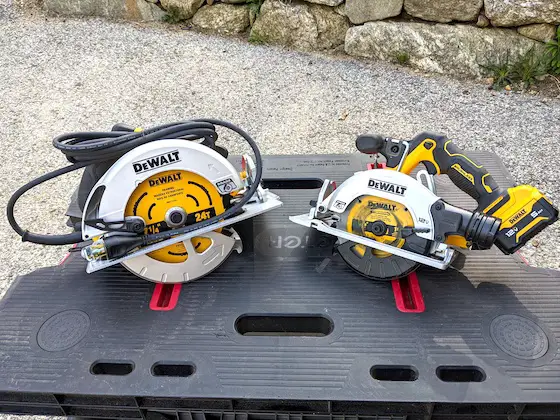
Circular saws come in two main types: corded and cordless. Both work on the same basic principle: a motor spins the blade, and you guide the saw along the material you want to cut. The main difference is in how the motor gets its power—either from a wall outlet (corded) or a battery (cordless).
Corded Circular Saws
Corded circular saws have been a mainstay in construction and woodworking for decades. They plug directly into a wall outlet, usually with a 120-volt power source. Their biggest advantage is their consistent, high power.
Key Features Of Corded Circular Saws
- Unlimited runtime: As long as the saw is plugged in, it keeps working. There’s no battery to run out.
- Higher power output: Corded models typically have motors ranging from 13 to 15 amps, which means more cutting force.
- Heavier build: They tend to be slightly heavier because of the motor size, but the weight is balanced by the need to push through dense materials.
When Corded Saws Are The Best Choice
- Large-scale construction jobs
- Repeated heavy-duty cuts, like framing lumber or cutting thick plywood
- Workshop settings where a power outlet is always nearby
Common Limitations
- Mobility is limited by the length of the cord.
- You always need access to a power outlet.
- The cord can get tangled or caught, which can be a safety risk.
Cordless Circular Saws
Cordless circular saws are powered by rechargeable batteries—usually lithium-ion packs. They offer the freedom to cut anywhere, even on remote job sites or outdoors where there’s no electricity.
Key Features Of Cordless Circular Saws
- Portability: No cord means you can move easily and cut in tight spaces or on ladders.
- Lightweight design: Many cordless models are lighter, making them easier to handle for overhead or vertical cuts.
- Quick setup: You don’t need to find an outlet or extension cord—just snap in the battery and start cutting.
When Cordless Saws Are The Best Choice
- Outdoor projects, like decking or fencing
- Quick repair jobs around the house
- Working at heights or in awkward spots
- Contractors who need to move from room to room
Common Limitations
- Limited runtime: Batteries last 15–50 minutes, depending on the size and material.
- Lower cutting power: Most cordless saws have motors in the 18–20 volt range, which can struggle with thick hardwood or long cuts.
- Extra cost for batteries: Spare batteries and chargers can add to the total price.
Power And Performance Comparison
Power and performance are two of the most important factors when choosing a circular saw. Let’s see how corded and cordless models compare.
| Feature | Corded Saw | Cordless Saw |
|---|---|---|
| Motor Power | 13–15 amps (120V) | 18–60V batteries |
| Max RPM | 5,000–6,000 RPM | 3,500–5,500 RPM |
| Cutting Depth | 2.5 inches (average) | 2 inches (average) |
| Consistency | Constant power | Power drops as battery drains |
Corded saws usually have more cutting force and can handle tough materials like hardwood, thick plywood, or even metal with the right blade. The power is steady, so you don’t need to worry about slowing down in the middle of a cut.
Cordless saws are getting better thanks to advances in battery and motor technology. High-end models can now compete with corded ones for short jobs, but most still fall a bit short for heavy-duty use. If you regularly cut thick or dense materials, a corded saw is still the safer bet.
Battery Life And Charging
Battery life is the biggest difference between corded and cordless saws. Cordless saws run on batteries, which means you need to plan your work around charging and swapping batteries.
How Long Do Cordless Batteries Last?
A standard 18V or 20V battery will last 20–40 minutes of continuous cutting in wood. If you use a more powerful 60V model, you might get an hour, but these batteries are heavy and expensive.
Pro tip: Battery runtime drops quickly if you’re cutting thick lumber, making lots of cuts, or working in cold weather.
Charging Time
Most batteries take 30–90 minutes to recharge. Having a second (or third) battery is essential for big projects. Some high-end chargers offer “fast charge” that can refill a battery in 30 minutes or less.
Managing Battery Packs
- Always keep a spare battery charged.
- Store batteries in a cool, dry place.
- Never leave batteries in the sun or in freezing temperatures.
- Use only the charger and batteries recommended by the saw’s manufacturer to avoid damage.
Real-world Example
A professional contractor working on a deck might need 3–4 batteries to finish the job in one day without waiting. For a weekend DIY project, one battery might be enough if you plan your cuts and recharge during breaks.
Mobility And Convenience
Mobility is where cordless saws shine. You can take them anywhere—up ladders, across a job site, or even into the backyard.
When Mobility Matters
- Cutting roof rafters or trusses
- Working on new construction sites with no electricity yet
- Repairing fences far from the house
- Making quick, one-off cuts without dragging out a cord
Corded saws can be a hassle in tight spaces, as you need to manage the cord, which can snag on objects or limit your reach. Using a heavy-duty extension cord helps, but it’s still a limitation.
Non-obvious insight: Many professionals keep both types on hand—using a cordless saw for mobility and a corded saw for long, tough jobs.
Accuracy And Control
A common belief is that corded saws are always more accurate, but the truth is more nuanced. Both corded and cordless saws can make precise cuts if you use quality blades and proper technique.
What Affects Accuracy?
- Blade quality: Cheap blades can cause rough cuts and wandering.
- Base plate (shoe): A sturdy, flat base gives better control.
- Weight and balance: Heavier saws can be more stable, but harder to maneuver for beginners.
Corded saws often have a solid, heavier base plate, which helps with long, straight cuts. Cordless models are sometimes lighter, which makes them easier to handle for quick, freehand cuts but can be less stable for long rip cuts.
Experience tip: Use a clamped straightedge or guide rail for accurate cuts, no matter which saw you use.
Durability And Maintenance
Durability is a strong point for both saw types, but their maintenance needs differ.
Corded Saws
- Simple design means fewer parts to fail.
- No batteries to replace.
- Only basic maintenance: Keep the blade sharp, blow out dust, check the cord for damage.
Cordless Saws
- Batteries wear out after 2–3 years or 300–500 charge cycles.
- Chargers can fail over time.
- Keep battery contacts clean and dry.
- Store batteries properly to extend life.
Non-obvious insight: Battery replacement is a hidden cost with cordless saws. Always check the price of spare batteries before buying a cordless model.
Cost Comparison
Cost is more than just the sticker price. You need to consider the price of the saw, blades, batteries, chargers, and even extension cords.
Here’s a look at typical costs:
| Item | Corded Saw | Cordless Saw |
|---|---|---|
| Tool Only | $60–$200 | $90–$350 |
| Blades | $10–$40 | $10–$40 |
| Battery + Charger | Not needed | $60–$200 |
| Extension Cord | $20–$50 | Not needed |
| Total Startup Cost | $90–$290 | $150–$590 |
Cordless saws cost more upfront, especially if you need extra batteries. Over time, you’ll need to replace batteries every few years, which adds to the total cost.
Safety Considerations
Both types of saws can be dangerous if used incorrectly. However, each has unique safety risks.
Corded Saw Safety
- Watch for the cord getting in the way or underfoot—this can cause trips or accidental cuts.
- Always check the cord for damage before use.
- Extension cords must be rated for the saw’s amperage to avoid overheating or electrical fires.
Cordless Saw Safety
- Make sure batteries are fully clicked in before starting.
- Remove the battery when changing the blade or making adjustments.
- Batteries can overheat if used non-stop—let them cool if they get hot.
Universal Safety Tips
- Always wear safety glasses and hearing protection.
- Never disable the blade guard.
- Use two hands to control the saw.
- Let the blade stop spinning before setting the saw down.
Pro insight: Many accidents happen during blade changes or when clearing jams. Always unplug or remove the battery first.
Best Use Cases For Each Type
Choosing between corded and cordless comes down to your main use case.
Corded Saws Are Best For:
- Professional carpenters who need to cut all day without stopping for batteries.
- Workshop setups where mobility isn’t needed.
- Heavy-duty jobs that require maximum power, like framing houses or cutting thick hardwood.
Cordless Saws Are Best For:
- DIYers who need quick, convenient cutting without setup.
- Contractors working in new construction, far from outlets.
- Small jobs or punch-list work where speed matters more than power.
Non-obvious insight: If your work mixes heavy-duty and mobile jobs, consider buying a saw that shares batteries with your other cordless tools. This saves money and weight.
Noise And Vibration
Noise and vibration can affect comfort, cut quality, and even your health.
- Corded saws tend to be slightly louder and vibrate more, especially with large motors.
- Cordless saws are often quieter and smoother, making them more comfortable for small jobs or indoor work.
Tip: Always wear hearing protection—most circular saws produce over 100 decibels, enough to damage hearing in minutes.
Blade Options And Compatibility
Both saw types use standard circular saw blades, but there are a few differences to watch for.
- Cordless saws often use smaller blades (6-1/2” or 7-1/4”) to save power and weight.
- Corded saws usually accept full-size 7-1/4” blades, which cut deeper and last longer.
- Always check the arbor size (the hole in the center of the blade) to match your saw.
Experience-based tip: Invest in high-quality blades. A good blade makes more difference than the saw’s brand when it comes to cut quality.
Environmental Impact
Cordless saws use rechargeable batteries, which are better for the environment than disposable batteries but still have a carbon footprint. Most batteries contain lithium, cobalt, and other minerals that require energy-intensive mining. Proper recycling is a must—never throw batteries in the trash.
Corded saws use electricity but have no batteries to replace. Over a decade, a corded saw will likely have a smaller environmental impact, especially if you use renewable electricity.

Real-world Scenarios
Let’s look at a few scenarios to see how the choice plays out.
Building A Deck
You’ll make hundreds of cuts in pressure-treated lumber, far from the nearest power outlet. A cordless saw shines here, but you’ll need 2–4 batteries and a fast charger to keep working all day.
Home Renovation
You’re cutting plywood, trim, and studs in a house with easy access to outlets. A corded saw is ideal—no battery worries, unlimited runtime, and full power for every cut.
Roofing
You’re up on a roof, making quick cuts in rafters. A cordless saw’s light weight and cord-free design make it safer and more convenient, even if you sacrifice a bit of power.
Workshop Furniture
You’re building cabinets or shelves in a garage or shop. A corded saw gives you the power and precision you need, with no downtime.
Common Mistakes When Choosing
- Underestimating battery needs: Many buyers get just one battery, only to find they need two or more for real projects.
- Ignoring cord quality: Cheap extension cords can rob power from corded saws and overheat.
- Overpaying for extra features: Laser guides, LED lights, or Wi-Fi are nice, but blade quality and motor power matter more.
- Buying based on brand alone: Test the saw in your hand if possible. Weight and balance are personal.
- Forgetting about blade compatibility: Make sure the saw uses blades you can find locally.
Latest Technology And Trends
Modern circular saws are smarter and more efficient than ever.
- Brushless motors in cordless saws deliver more power and longer battery life.
- Smart batteries track charge cycles and warn you when they need replacement.
- Integrated dust blowers keep the cut line clear.
- Cordless power is now available in 36V and 60V models, matching some corded saws for short bursts of heavy work.
Manufacturers are also working to make batteries compatible across whole tool lines, so you can use one battery for your saw, drill, and other tools.
Making Your Final Choice
When deciding between a corded and cordless circular saw, ask yourself:
- How often will I use the saw?
- Where will I use it—indoors, outdoors, or both?
- Do I need maximum power, or is convenience more important?
- Am I willing to invest in extra batteries and chargers?
- Do I already own tools that share batteries?
If you do mostly workshop or home renovation work with easy access to outlets, a corded saw is usually the best value. If you work on job sites, outdoors, or want maximum convenience, a cordless saw is hard to beat—just be ready to manage your batteries.
Frequently Asked Questions
What Is The Main Advantage Of A Corded Circular Saw?
The main advantage is constant, high power without worrying about battery life. This makes corded saws ideal for heavy-duty jobs and long work sessions.
Are Cordless Circular Saws Powerful Enough For Professional Use?
Yes, modern cordless saws with brushless motors and high-voltage batteries (36V, 60V) can match corded models for most tasks. However, for all-day, heavy cutting, corded saws still have the edge.
How Long Do Cordless Batteries Last Before Needing Replacement?
Most lithium-ion batteries last 2–3 years or about 300–500 charge cycles. Battery life depends on usage, storage, and care. Always recycle old batteries properly.
Can I Use The Same Blades For Both Corded And Cordless Saws?
Often yes, if the blade size and arbor hole match. Cordless saws sometimes use smaller blades to save power, so always check your saw’s manual for compatibility.
Where Can I Find More Information About Circular Saws?
You can visit Wikipedia’s Circular Saw page for more technical details and history.
Choosing the right circular saw is about more than just price or brand. Focus on how, where, and how often you’ll use the tool. With the right information and a clear understanding of your needs, you’ll invest in a saw that works hard for you, project after project.