
The Ford Transit is one of the world’s most popular vans, known for its reliability and adaptability. Owners and fleet managers often focus on engine care, and for good reason: regular oil changes are the foundation of a healthy engine. But one detail often overlooked is the exact oil capacity. Using the correct amount and type of oil is crucial for the Transit’s performance, efficiency, and longevity. It’s not as simple as “just add oil.” Different Transit models, engines, and years all have unique requirements. For people new to maintaining vehicles, or for those who want to avoid mistakes, understanding Ford Transit oil capacity is essential. This guide explains everything you need to know in clear, simple English.
Why Oil Capacity Matters For Your Ford Transit
Engine oil is more than just a lubricant; it’s the lifeblood of your vehicle’s engine. The right oil capacity ensures:
- Proper lubrication: Prevents metal parts from grinding.
- Correct oil pressure: Too much or too little oil changes how oil flows.
- Engine cooling: Oil helps remove heat.
- Contaminant removal: Oil traps dirt and particles.
If you use too little oil, the engine parts can wear out faster. Too much oil can also cause problems, like increased pressure, oil leaks, or damage to seals. Both situations can lead to expensive repairs. That’s why knowing the exact oil capacity is not just a technical detail—it’s a basic need for keeping your Transit running well.
How Oil Capacity Differs By Engine And Model Year
Ford Transit vans have a wide range of engines. Some are diesel, others are gasoline. Over the years, Ford has made many changes to its engines, which means oil capacity can vary even between two Transits parked side by side. Here’s how the main factors affect oil capacity:
- Engine type: Diesel engines usually need more oil than gasoline engines.
- Engine size: Larger engines generally require more oil.
- Model year: Changes in engine design over the years affect oil capacity.
- Oil filter size: Some filters hold extra oil.
If you are unsure about your model, check your vehicle manual or the engine code stamped on the engine.
Ford Transit Oil Capacity By Engine (all Major Models)
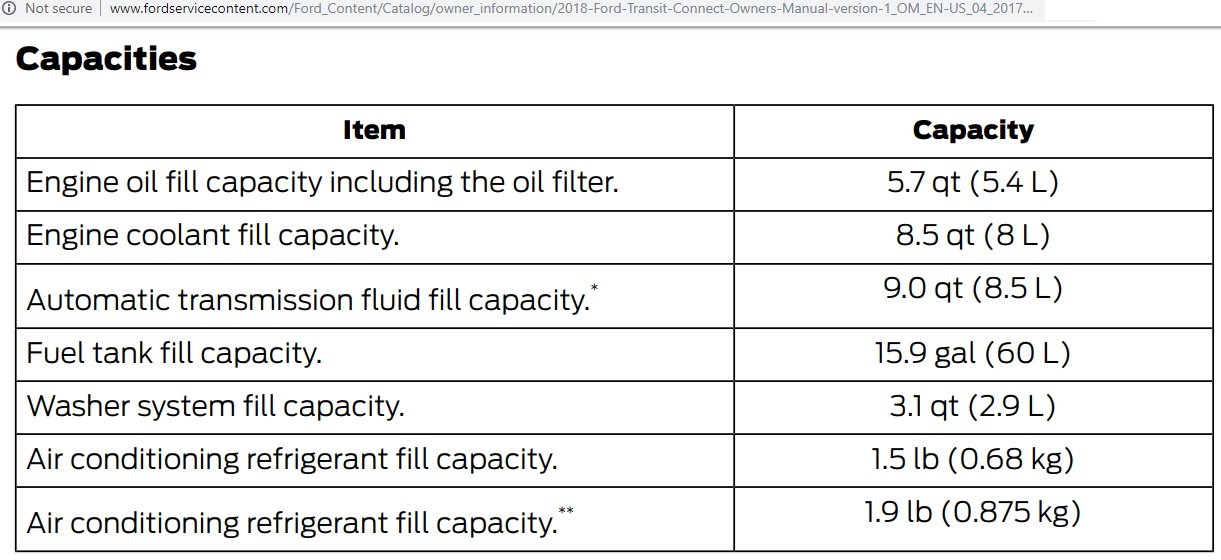
To make it easy, here are the most common Ford Transit engines and their typical oil capacities. This covers both US and European models, from older TDi diesels to the latest EcoBlue and EcoBoost engines.
| Model Year | Engine | Fuel Type | Oil Capacity (with filter) |
|---|---|---|---|
| 2015–2024 | 3.5L EcoBoost V6 | Gasoline | 6.0 quarts (5.7 liters) |
| 2015–2024 | 3.7L Ti-VCT V6 | Gasoline | 6.0 quarts (5.7 liters) |
| 2020–2024 | 2.0L EcoBlue I4 | Diesel | 11.2 quarts (10.6 liters) |
| 2014–2019 | 2.2L Duratorq TDCi | Diesel | 7.0 quarts (6.6 liters) |
| 2014–2019 | 2.4L Duratorq TDCi | Diesel | 7.4 quarts (7.0 liters) |
| 2000–2013 | 2.2L TDCi | Diesel | 6.0 quarts (5.7 liters) |
| 2000–2013 | 2.4L TDCi | Diesel | 7.4 quarts (7.0 liters) |
| 1995–2000 | 2.5L DI/TD | Diesel | 7.0 quarts (6.6 liters) |
| Various | 2.0L I4 EcoBoost | Gasoline | 5.7 quarts (5.4 liters) |
Important: Always check your specific Transit’s manual before adding oil. There may be small differences based on trim or region.
How To Find Your Ford Transit’s Engine Type
If you’re unsure which engine your Ford Transit has, here are some easy ways to find out:
- Owner’s manual: Usually lists the engine code and size.
- Under the hood: Look for a sticker or plate with engine details.
- Vehicle identification number (VIN): You can use online tools or ask a Ford dealer to decode your VIN.
- Service records: Previous oil changes or repairs may list the engine type.
If you can’t find the information, it’s always safest to ask a professional mechanic.
The Correct Oil For Ford Transit Engines
Knowing the oil capacity is only half of the story. Using the right oil type is just as important. Ford recommends specific oils based on engine design, temperature range, and local regulations.
Popular Oil Types For Ford Transit
- 5W-30: Common for most modern Transit engines, especially diesels in Europe.
- 0W-20: Required for some EcoBoost gasoline engines in newer models.
- 5W-20: Used in some gasoline engines for North America.
- 10W-40: Sometimes used for older diesels, but less common today.
Always use oil that meets Ford’s WSS-M2C913-D or WSS-M2C948-B specifications, depending on your engine.
Synthetic Vs. Conventional Oil
Most modern Transits need full synthetic oil. Synthetic oil resists breakdown, cleans better, and protects the engine during cold starts or heavy loads. Older engines may allow semi-synthetic or conventional oil, but synthetic is usually best for protection.
What Happens If You Use The Wrong Oil?
Using the wrong oil type or grade can result in:
- Increased engine wear
- Higher oil consumption
- Poor fuel economy
- Harder starting in cold weather
- Potential engine damage in extreme cases
Many owners don’t realize that even a small difference in viscosity (like using 10W-40 instead of 5W-30) can lead to long-term engine issues, especially in modern engines with tight tolerances.
Step-by-step: Checking And Changing Ford Transit Oil
Changing your own oil saves money and teaches you more about your vehicle. Here’s a clear guide for beginners, which works for most Ford Transit models.
What You’ll Need
- The correct amount of oil (see previous table)
- The recommended oil type
- New oil filter
- Oil filter wrench
- Socket set (usually 13mm or 15mm for the drain plug)
- Drain pan (at least 8 liters/quarts)
- Funnel
- Rags or paper towels
- Gloves
Step 1: Warm Up The Engine
Start the engine and let it run for 2–3 minutes. Warm oil drains faster and carries more dirt out.
Step 2: Secure The Vehicle
Park on a level surface. Apply the parking brake. If possible, use wheel chocks. If you need more room, use ramps.
Step 3: Remove The Oil Filler Cap
This allows air to enter and helps oil flow out more easily.
Step 4: Drain The Old Oil
- Place the drain pan under the engine oil pan.
- Use the socket to unscrew the drain plug.
- Let oil drain completely (usually 5–10 minutes).
- Inspect the drain plug for metal bits or damage.
Step 5: Replace The Oil Filter
- Use the oil filter wrench to loosen the old filter.
- Before installing the new filter, rub a bit of new oil on the gasket.
- Screw on the new filter by hand—do not overtighten.
Step 6: Reinstall The Drain Plug
- Wipe the area clean.
- Reinstall and tighten the drain plug to the specified torque (usually 25–30 Nm, but check your manual).
Step 7: Add New Oil
- Use a funnel to add about 90% of the recommended oil capacity.
- Wait a few minutes, then check the oil level with the dipstick.
- Add oil slowly until the level is just below the “MAX” mark.
Step 8: Check For Leaks And Final Level
- Start the engine and let it run for 30 seconds.
- Turn off the engine, wait 2 minutes, then check the dipstick again.
- Add more oil if needed.
Step 9: Dispose Of Old Oil Responsibly
Take used oil to a recycling center. Never pour it down the drain.
Practical Tip
Many people overfill by pouring in the entire bottle. Always pour slowly and check the dipstick often. Overfilling is a common mistake, especially for new DIYers.
Oil Capacity Differences: European Vs. North American Ford Transits
Ford builds the Transit for many markets. There are real differences between European and North American models, especially for engines and oil capacity.
| Market | Common Engines | Typical Oil Capacity | Oil Spec |
|---|---|---|---|
| Europe | 2.0L EcoBlue, 2.2L/2.4L TDCi | 6.0–11.2 quarts (5.7–10.6 liters) | 5W-30, Ford WSS-M2C913-D |
| North America | 3.5L EcoBoost, 3.7L Ti-VCT | 6.0 quarts (5.7 liters) | 5W-20 or 0W-20, Ford WSS-M2C930-A |
Some European diesels have much larger oil sumps. This is partly for longer service intervals and to handle extra turbo heat.
How Often Should You Change The Oil In A Ford Transit?
Oil change intervals depend on:
- Engine type: Diesels often need oil changes less often than gasoline engines.
- Driving conditions: Stop-start driving, heavy loads, or short trips can require more frequent changes.
- Oil quality: Synthetic oils last longer.
General Guidelines
- Modern gasoline engines: 7,500–10,000 miles (12,000–16,000 km) or once a year
- Modern diesels: 10,000–15,000 miles (16,000–24,000 km) or once a year
- Older engines: Every 5,000 miles (8,000 km) or six months
Always follow the schedule in your vehicle manual. For heavy-duty use (like delivery vans), change oil more often.
Hidden Insight
Many Transit owners only look at mileage, but time is just as important. Oil breaks down over months, even if you drive little. Don’t skip an annual change just because you haven’t hit the mileage.
Signs Your Ford Transit Needs An Oil Change (beyond Mileage)
Sometimes, your van tells you it needs fresh oil even before the official schedule. Look for:
- Oil light: Warning on the dashboard.
- Noisy engine: Louder ticking or knocking.
- Dirty oil: Check the dipstick. If oil is black and gritty, it’s time.
- Exhaust smoke: Blue or gray smoke can mean oil is burning.
- Oil level drops quickly: Needing to top up often.
If you see any of these, change the oil even if you haven’t reached the usual interval.
Common Mistakes When Checking Or Filling Oil
Even experienced drivers sometimes make these errors:
- Checking oil on a slope: Always park on level ground for an accurate reading.
- Not waiting after shutting off engine: Wait at least 2 minutes before checking the dipstick.
- Forgetting to change the oil filter: Reusing old filters leaves dirt in the system.
- Overfilling or underfilling: Both are bad. Use the dipstick, not just the bottle’s label.
- Ignoring oil leaks: Small drips can become big problems.
A less-known issue is that some oil filters are slightly different in height. Always use the exact filter for your engine; a taller filter can change the oil level reading and cause confusion.
Credit: www.fordtransitusaforum.com
How Oil Capacity Changes With Oil Filter Replacement
When you change your oil filter, you remove some old oil that stays trapped inside. That’s why oil capacity is usually listed as “with filter” and “without filter. ” Always change the filter with the oil for best results.
Example
- With filter: 6.0 quarts (5.7 liters)
- Without filter: 5.5 quarts (5.2 liters)
If you forget the filter, you might underfill the engine.
Ford Transit Oil Capacity: Older Vs. Newer Models
Older Transits (1990s–early 2000s) often had simpler engines and smaller sumps. Newer models, especially diesels, have larger capacities due to stricter emissions and longer service intervals.
| Generation | Year Range | Engine Examples | Oil Capacity |
|---|---|---|---|
| First Gen | 1965–1978 | 1.7–2.0L Gas, 2.5L Diesel | 4.5–5.5 quarts (4.3–5.2 liters) |
| Second Gen | 1978–1986 | 1.6–2.0L Gas, 2.4L Diesel | 4.5–6.0 quarts (4.3–5.7 liters) |
| Third Gen | 1986–2000 | 2.0–2.9L Gas, 2.5L Diesel | 5.5–7.0 quarts (5.2–6.6 liters) |
| Fourth Gen | 2000–2013 | 2.2L/2.4L TDCi Diesel | 6.0–7.4 quarts (5.7–7.0 liters) |
| Fifth Gen | 2014–present | 2.0L EcoBlue, 3.5L EcoBoost | 6.0–11.2 quarts (5.7–10.6 liters) |
As engines became more complex, oil capacity increased to support turbochargers and emission systems.
Credit: fordtransitconnectforum.com
Choosing The Best Oil Brand For Your Ford Transit
While Ford recommends oil that meets its standards, you can choose from many reputable brands. Popular choices include:
- Motorcraft (Ford’s own brand)
- Mobil 1
- Castrol
- Shell Helix
- Total Quartz
Always look for the WSS-M2C913-D or similar approval. Don’t just buy the cheapest oil—quality matters for long engine life.
How Oil Capacity Affects Fuel Economy And Emissions
Many people don’t realize that oil capacity can impact more than engine life. Too much or too little oil can:
- Lower fuel economy (engine works harder)
- Increase emissions (oil can get into exhaust)
- Cause the engine to run hotter
Modern engines are very sensitive to oil levels. Even being 0. 5 quart/liter off can change how your Transit drives.
Can You Use High Mileage Or Additive Oils In A Ford Transit?
If your Transit has over 100,000 miles (160,000 km), you might see “high mileage” oils or oil additives in stores. These products claim to reduce leaks and protect old seals. In most cases, a high-quality synthetic oil is better than using additives.
Only use additives if your mechanic recommends them. The wrong additive can harm modern emissions systems.
How To Reset The Ford Transit Oil Change Light
After changing the oil, you should reset the oil change reminder light. This process depends on your model year.
For Most 2015+ Ford Transits:
- Turn the ignition to “on” but don’t start the engine.
- Press both the brake and accelerator pedals down fully.
- Hold both pedals for about 20–30 seconds.
- The oil light will flash and reset.
If this doesn’t work, check your manual or look up your exact year on the Ford website.
What If You Overfill Or Underfill The Oil?
Mistakes happen. Here’s what to do:
- Overfill: If you’ve gone over the “MAX” mark, drain some oil out. Too much oil can foam up, starving the engine of lubrication.
- Underfill: If you’re below “MIN,” add oil immediately. Running low can destroy the engine.
Even a small overfill can cause damage in turbocharged engines, as excess oil can get sucked into the intake.
Professional Vs. Diy Oil Changes: Which Is Best For Your Transit?
Doing your own oil change can save money and teach you about your van. However, professional shops:
- Dispose of oil safely
- Inspect for leaks or other problems
- Use the correct parts and torque settings
If you’re not comfortable or your van is under warranty, professional service is a good choice.

Credit: us.haynes.com
The Role Of Oil Capacity In Ford Transit Reliability
Many Ford Transits are used for business, delivery, or shuttle work. High mileage is normal. Sticking to the correct oil capacity:
- Reduces breakdowns
- Lowers repair costs
- Increases resale value
Fleet managers often track oil use closely. Even small mistakes can cost thousands if a van is out of service.
Two Non-obvious Insights For Ford Transit Owners
- Oil capacity may change after engine repairs. If you’ve had a major engine repair (like a new oil pan or head gasket), the oil capacity can change slightly. Always double-check after repairs.
- Short trips are harder on oil than long trips. If you use your Transit for deliveries with many stops, change oil more often. Oil doesn’t reach full temperature, so water and fuel can mix in, making the oil less effective.
Ford Transit Oil Capacity In Extreme Climates
If you drive in very cold or very hot weather, oil capacity and viscosity are even more important. In cold climates, use the lightest oil Ford recommends (like 0W-30 or 0W-20). In very hot areas, make sure you never run below the “MIN” mark, as oil thins out faster.
Where To Find Official Ford Transit Oil Capacity Information
The best sources are:
- Your owner’s manual
- The Ford Etis online database
- Ford dealer service departments
For more technical info, sites like the Ford Transit Wikipedia page provide detailed engine and model data.
Frequently Asked Questions
What Happens If I Put Too Much Oil In My Ford Transit?
Too much oil can increase engine pressure, cause leaks, and even damage seals or gaskets. In turbocharged engines, extra oil can get into the air intake and harm the turbo. If you overfill, drain the excess oil until it’s at the correct level.
How Often Should I Check My Ford Transit’s Oil Level?
Check the oil at least once a month, or before any long trip. For older Transits or those used for heavy work, check every two weeks. It’s a quick way to catch leaks or burning oil before it becomes a big problem.
Can I Use A Different Oil Grade If The Recommended One Is Not Available?
Only use a different grade for a short time in an emergency. Go back to the recommended oil as soon as possible. Using the wrong oil for long periods can lead to engine wear or warranty problems.
Does My Transit’s Oil Capacity Include The Oil Filter?
Yes, oil capacity is usually listed “with filter. ” If you change only the oil and not the filter (not recommended), use the “without filter” number. Always change the filter for best engine health.
Are Oil Capacity And Oil Pressure Related?
They are connected but not the same. Oil capacity is the total amount of oil in the engine, while oil pressure is how strongly oil flows through the engine. Too little oil lowers pressure and can starve the engine. Too much oil can cause pressure spikes and leaks.
Maintaining the correct oil capacity in your Ford Transit is one of the simplest yet most effective ways to ensure a long, trouble-free life for your van. By paying attention to engine type, oil quality, and regular checks, you protect your investment and keep your business or travels running smoothly.
Always double-check your manual, use quality oil, and don’t be afraid to ask a professional if you’re unsure. The small effort you make today will save you time, money, and stress in the future.