
Harley-Davidson motorcycles have a legendary reputation for power, style, and history. But beneath the chrome and thunder, one simple fact keeps every Harley on the road: engine oil. Knowing the correct oil capacity for your Harley-Davidson is crucial. It affects engine health, cooling, and overall performance. Overfilling or underfilling can lead to costly damage and poor riding experiences.
Many riders—both new and experienced—often guess or use rough estimates for oil changes. This is risky. Harley-Davidson has specific oil capacities for each model and year, and these numbers can change with even small design updates. Whether you ride a classic Sportster, a touring Road King, or a powerful Softail, knowing the exact oil requirements makes maintenance easier, cheaper, and safer.
This guide gives you an in-depth look at Harley-Davidson oil capacity for the most popular models, detailed charts, and practical advice. You’ll find out why oil capacity matters, how to check and fill oil correctly, and get tips that even seasoned riders sometimes miss.
Why Oil Capacity Matters For Harley-davidson Motorcycles
Every engine relies on oil for cooling, lubrication, and cleaning. In a Harley, where the engine runs hotter and vibrates more than many other bikes, oil does even more work.
If you use too little oil, the engine might overheat, parts may wear out faster, and you risk serious engine damage. With too much oil, air can mix with the oil (foaming), pressure can rise, and seals may leak. Both problems shorten your Harley’s life and reduce performance.
Sticking to your model’s exact oil capacity also ensures smooth gear shifting, proper clutch function, and stable oil pressure—especially important for long rides or in hot weather.
Harley-davidson Oil Capacity Chart: Most Popular Models
Finding the right oil capacity for your Harley isn’t always simple. Models, engines, and years matter. Below you’ll see oil capacities for the most common Harley-Davidson models, including engine oil, primary fluid, and transmission oil.
| Model | Year | Engine Oil (qt/L) | Primary Fluid (qt/L) | Transmission Oil (qt/L) |
|---|---|---|---|---|
| Sportster (883/1200) | 2004–2024 | 2.8 qt / 2.65 L | 1 qt / 0.95 L | Shared with primary |
| Softail (Milwaukee-Eight) | 2018–2024 | 4.5 qt / 4.25 L | 1 qt / 0.95 L | 1 qt / 0.95 L |
| Touring (Milwaukee-Eight) | 2017–2024 | 4.5 qt / 4.25 L | 1 qt / 0.95 L | 1 qt / 0.95 L |
| Dyna (Twin Cam) | 2006–2017 | 3 qt / 2.8 L | 1 qt / 0.95 L | 1 qt / 0.95 L |
| Sport Glide | 2018–2024 | 4.5 qt / 4.25 L | 1 qt / 0.95 L | 1 qt / 0.95 L |
| Street Glide | 2009–2024 | 4.5 qt / 4.25 L | 1 qt / 0.95 L | 1 qt / 0.95 L |
| Road King | 1999–2024 | 4 qt / 3.8 L | 1 qt / 0.95 L | 1 qt / 0.95 L |
This table shows typical values, but always check your owner’s manual before changing oil. Sometimes, even within the same model, capacities can change due to engine updates.
Understanding Harley-davidson Oil Types
Harley-Davidsons use three main fluids: engine oil, primary fluid, and transmission oil. Each fluid has a special job.
- Engine oil: Lubricates and cools the engine’s moving parts.
- Primary fluid: Cools and lubricates the primary chain, clutch, and stator.
- Transmission oil: Reduces wear in the transmission gears and bearings.
Some Harley models (like Sportsters) use the same oil for both primary and transmission, while others (Touring, Softail) have three separate oil compartments. Mixing up these fluids can cause damage, so always know where each one goes.
How To Check And Change Oil On A Harley-davidson
Changing your Harley’s oil is simple with the right steps. Even beginners can do it safely. Here’s a general guide:
1. Warm Up The Bike
Start the engine and let it run for about 5 minutes. This warms the oil so it drains out easily and takes more contaminants with it.
2. Place The Bike Upright
For the most accurate oil drain, keep the bike as upright as possible—use a motorcycle stand if you have one.
3. Remove The Drain Plug
Put an oil pan under the drain plug (usually at the bottom of the engine). Remove the plug and let the oil flow out completely.
4. Replace The Oil Filter
Unscrew the old oil filter. Some oil will spill, so be ready. Clean the filter mount before installing a new, lubricated filter.
5. Reinstall The Drain Plug
Wipe the plug, fit a new washer if needed, and tighten it securely. Don’t overtighten—this can strip the threads.
6. Add Fresh Oil
Pour in the amount shown in the oil capacity chart for your model. Use a funnel to avoid spills.
7. Check The Level
Start the engine for a minute, then stop and wait a couple minutes. Check the oil level with the dipstick. Add a little more if needed, but never overfill.
8. Dispose Of Old Oil Properly
Take the used oil and filter to a recycling center or auto parts store.
Detailed Harley-davidson Oil Capacity Charts By Model
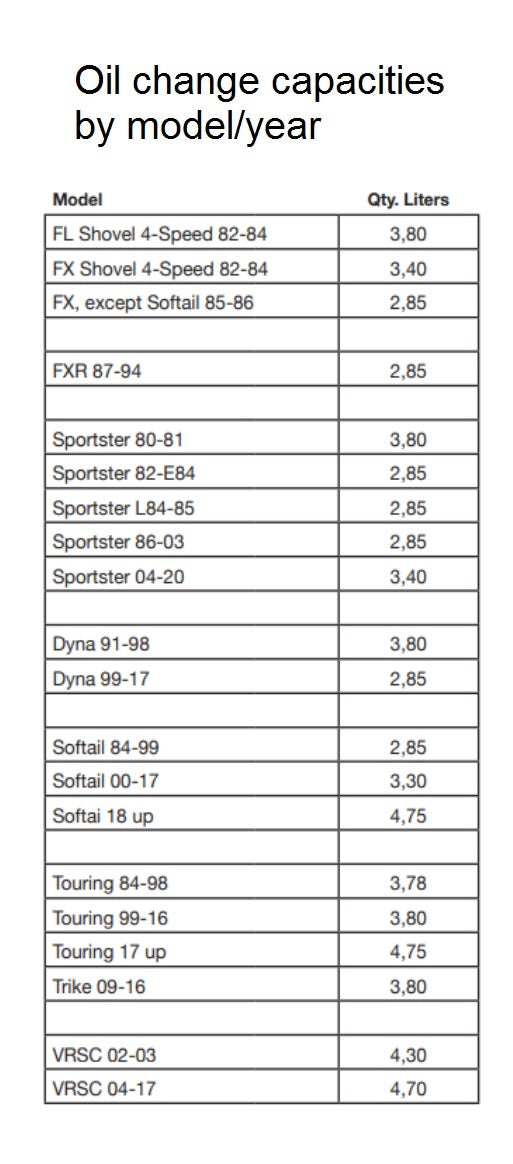
For more accuracy, let’s break down oil capacities for specific Harley families and popular years. These values include both dry (after a rebuild) and wet (oil change) capacities.
Sportster Oil Capacity
| Year/Engine | Engine Oil (qt/L) | Primary/Transmission (qt/L) |
|---|---|---|
| 1986–2003 (Ironhead/Evo) | 3.6 qt / 3.4 L | 1.2 qt / 1.1 L |
| 2004–2024 (Evo) | 2.8 qt / 2.65 L | 1 qt / 0.95 L |
Tip: For Sportsters, always check the oil with the bike on a level surface and the dipstick screwed in (unless your manual says otherwise).
Touring Models Oil Capacity
These include Road King, Street Glide, Electra Glide, and Road Glide.
| Year/Engine | Engine Oil (qt/L) | Primary Fluid (qt/L) | Transmission Oil (qt/L) |
|---|---|---|---|
| 1999–2016 (Twin Cam) | 4 qt / 3.8 L | 1 qt / 0.95 L | 1 qt / 0.95 L |
| 2017–2024 (Milwaukee-Eight) | 4.5 qt / 4.25 L | 1 qt / 0.95 L | 1 qt / 0.95 L |
Insight: Milwaukee-Eight engines need more oil than the older Twin Cam. If you switch bikes, always check the specific requirement.
Softail Models Oil Capacity
| Year/Engine | Engine Oil (qt/L) | Primary Fluid (qt/L) | Transmission Oil (qt/L) |
|---|---|---|---|
| 2000–2017 (Twin Cam) | 3.5 qt / 3.3 L | 1 qt / 0.95 L | 1 qt / 0.95 L |
| 2018–2024 (Milwaukee-Eight) | 4.5 qt / 4.25 L | 1 qt / 0.95 L | 1 qt / 0.95 L |
Non-obvious tip: Some Softail models have a dipstick that is difficult to read when the oil is fresh and clear. Wipe and re-dip several times for accuracy.
Dyna Models Oil Capacity
- 2006–2017 Dyna (Twin Cam 88/96/103):
- Engine oil: 3 qt / 2.8 L
- Primary: 1 qt / 0.95 L
- Transmission: 1 qt / 0.95 L
Older Dyna models may have slightly different capacities—always confirm with your model year.
Street Models Oil Capacity
- Street 500/750 (2015–2021):
- Engine oil: 3 qt / 2.8 L
- Transmission: Integrated (no separate fluid)
- Primary: 1 qt / 0.95 L
Street models have a compact engine design. Do not overfill—this can cause leaks and hard shifting.
Trike Models Oil Capacity
- Freewheeler, Tri Glide (2014–2024):
- Engine oil: 4.5 qt / 4.25 L
- Primary: 1 qt / 0.95 L
- Transmission: 1 qt / 0.95 L
If you ride a trike, pay attention to oil type as well as quantity. Many riders use the wrong viscosity, leading to noisy operation.
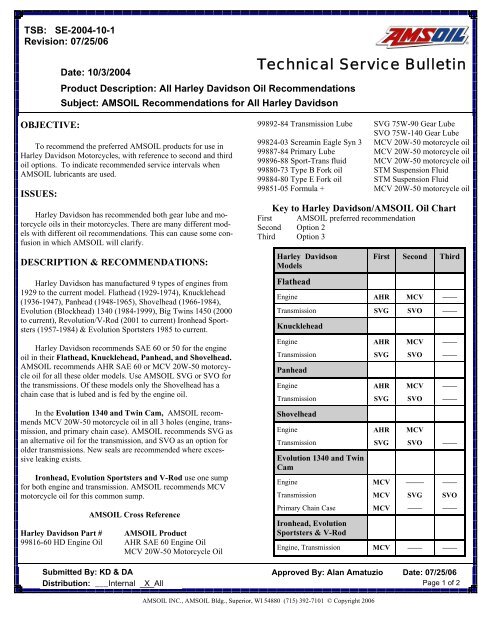
Oil Change Intervals: When To Change Harley-davidson Oil
Oil doesn’t last forever. Harley-Davidson recommends:
- Every 5,000 miles (8,000 km) for most models and all three fluids.
- Every year, even if you don’t reach the mileage.
- Change more often if riding in hot climates, dusty roads, or heavy traffic.
Skipping changes can lead to sludge, poor shifting, and even engine failure. Fresh oil is cheap insurance for your bike.
Credit: www.yumpu.com
Choosing The Right Oil For Your Harley-davidson
Oil capacity is only part of the story. Using the correct oil type and viscosity is just as important.
Factory-recommended Oils
Harley-Davidson recommends 20W-50 for most big-twin engines (Softail, Dyna, Touring) in all but the coldest climates. For Sportsters, 20W-50 is also common. In very cold areas, 10W-40 or 15W-50 may be suggested.
You can use Harley-Davidson SYN3 synthetic oil or a high-quality equivalent. Synthetic oils resist breakdown better, especially in hot weather or long-distance riding.
Primary And Transmission Fluids
- Use dedicated primary fluid for the primary drive.
- Use gear oil or the specified transmission oil for the gearbox.
- Some riders use engine oil in all three, but this is not recommended by Harley.
Insight: Using engine oil in your transmission can reduce gear life. Each compartment faces different loads and temperatures.
How To Read The Dipstick On A Harley-davidson
Many new owners struggle with the dipstick. Here’s how to do it right:
- Park on a level surface.
- If your manual says to check “hot,” run the engine, then wait 2-3 minutes after shutdown.
- Unscrew the dipstick, wipe clean, re-insert (screw in or not, check your manual), then remove and check the level.
- Oil should be between the “full” and “add” marks—never above.
Common mistake: Checking cold can show low oil even when full. Always follow your manual’s instructions.

Credit: www.scribd.com
Key Signs Your Harley Needs An Oil Change (or Top-up)
Even with careful measurements, things can go wrong. Watch for:
- Unusual engine noise (ticking or knocking)
- Hard shifting or gear clunking
- Oil warning light
- Burned oil smell
- Oil leaks under the bike
- Dirty or dark oil on the dipstick
If you see these signs, check your oil immediately. Catching a problem early can save thousands in repairs.
Factors That Affect Oil Capacity And Consumption
Some Harley-Davidson bikes use a little oil between changes. This is normal—air-cooled V-twins run hot and sometimes burn a bit of oil. However, excessive consumption can signal trouble.
What Affects Oil Capacity?
- Model and year: Newer engines may need more or less oil.
- Aftermarket oil pans: Some large-capacity pans hold extra oil.
- Oil coolers or external lines: These can add volume.
- Rebuilt engines: If an engine has been rebuilt or modified, check for updated specs.
What Causes Higher Oil Consumption?
- High RPMs or hard riding
- Hot weather
- Worn piston rings or valve seals
- Overfilling (causes leaks from breather lines)
If your Harley is using more oil than expected, have it checked by a mechanic.
Common Mistakes When Changing Harley-davidson Oil
- Using the wrong oil type. Always choose the correct viscosity and specification.
- Overfilling or underfilling. Measure carefully; use the charts above.
- Not changing the oil filter. Old filters can clog and reduce oil flow.
- Reusing old washers. These can leak—replace with every oil change.
- Not cleaning the drain plug. Metal shavings can stick to the magnet.
- Mixing up compartments. Pouring oil in the wrong hole is a common error—double-check before filling.
Non-obvious tip: Some Harleys have a “trap door” for the transmission or primary. Make sure all fasteners are torqued to spec when closing up.
Harley-davidson Oil Capacity: Quick Reference Chart
For those who want a simple summary, here’s an easy-to-scan reference for the most common Harley models.
| Model | Engine Oil (qt/L) | Primary Fluid (qt/L) | Transmission Oil (qt/L) |
|---|---|---|---|
| Sportster | 2.8 qt / 2.65 L | 1 qt / 0.95 L | Shared with primary |
| Softail | 4.5 qt / 4.25 L | 1 qt / 0.95 L | 1 qt / 0.95 L |
| Touring | 4.5 qt / 4.25 L | 1 qt / 0.95 L | 1 qt / 0.95 L |
| Dyna | 3 qt / 2.8 L | 1 qt / 0.95 L | 1 qt / 0.95 L |
| Street | 3 qt / 2.8 L | 1 qt / 0.95 L | Integrated |
| Trike | 4.5 qt / 4.25 L | 1 qt / 0.95 L | 1 qt / 0.95 L |
Keep this chart handy for your next oil change.
Expert Tips For Hassle-free Harley Oil Changes
- Label your oil bottles and funnels for each compartment—engine, primary, transmission.
- Pre-fill your oil filter (if possible) to avoid dry starts.
- Always check for leaks after the first ride post-change.
- Keep a logbook of oil changes with date, mileage, and type of oil used.
- Use OEM gaskets and washers for best fit and leak prevention.
- If you ride in extreme heat or cold, consider synthetic oil for extra protection.
- Don’t ignore small leaks—they often get worse quickly on Harley engines.
Where To Find Official Oil Capacity Data
Your Harley-Davidson owner’s manual always has the final word. If you’ve lost it, you can often find official specs on the Harley-Davidson website or from a local dealer. For more details, check resources like the Harley-Davidson Service Information Portal.
Credit: customizedchoppers.com
Frequently Asked Questions
What Happens If I Overfill My Harley-davidson With Oil?
Overfilling can cause oil to foam, leading to poor lubrication, leaks from seals or breather tubes, and even internal damage. Always drain excess oil if you go above the recommended level.
Can I Use The Same Oil For Engine, Primary, And Transmission?
For most modern Harleys, you should use separate oils for each compartment. The engine, primary, and transmission face different stresses and temperatures. Using the same oil everywhere can cause poor shifting or clutch issues.
How Do I Know If My Oil Is Too Old Or Contaminated?
Old oil turns dark, smells burnt, or feels gritty between your fingers. If you notice engine noise, hard shifting, or the oil warning light, change the oil right away—even if you haven’t reached the mileage limit.
What Oil Should I Use For A Milwaukee-eight Engine?
Most Milwaukee-Eight engines use 20W-50 synthetic oil. Always check your owner’s manual for the correct specification, especially in cold climates.
How Can I Safely Dispose Of Used Harley Oil And Filters?
Never pour used oil down the drain. Put the oil in a sealed container and take it, along with the old filter, to a recycling center or an auto parts store. Many locations offer free oil recycling.
Maintaining the right oil capacity is one of the simplest, smartest ways to protect your Harley-Davidson. With a little knowledge and care, you’ll keep your bike running strong, mile after mile.