
Electric cars have changed how we think about driving. They are quieter, cleaner, and use electricity instead of gasoline. But for many people, the biggest question is about charging: How do electric car charging stations work? If you are curious about the process, the technology, or what happens when you plug in your car, this guide will make everything clear. You’ll learn not just how to use charging stations, but also how the whole system works behind the scenes. By the end, you’ll understand what makes charging an electric car simple, reliable, and ready for the future.
What Is An Electric Car Charging Station?
An electric car charging station is a place where you can plug in your electric vehicle (EV) to refill its battery. Think of it like a gas station, but instead of fuel, you get electricity. These stations come in many forms, from small home chargers to large fast-charging stations on highways.
Charging stations use electricity from the local grid or, in some cases, from solar panels or other renewable sources. They have special connectors that fit into your car’s charging port. The station controls how much electricity flows into your car, making sure charging is safe and efficient.
Main Types Of Charging Stations
You will find different types of charging stations. Each one has its own speed and use case.
Level 1 Charging (standard Wall Outlet)
Level 1 charging uses a standard 120-volt outlet—the same as you use for home appliances. This is the slowest way to charge an EV.
- Charging Speed: About 3 to 8 km (2 to 5 miles) of range per hour.
- Where Used: Mostly at home or in places where you can park for a long time.
- Best For: Overnight charging or people who drive short distances daily.
Level 2 Charging (240-volt Charging)
Level 2 charging uses a 240-volt outlet, like those for dryers or ovens.
- Charging Speed: About 16 to 96 km (10 to 60 miles) of range per hour.
- Where Used: Homes, workplaces, public parking lots, and shopping centers.
- Best For: Daily charging, especially if you need more range.
Dc Fast Charging (level 3 And Above)
DC fast charging stations use direct current (DC) and much higher voltage.
- Charging Speed: Can add 100 to 300 km (60 to 200 miles) of range in 20 to 40 minutes.
- Where Used: Highways, travel stops, and busy city centers.
- Best For: Long trips, quick top-ups.
Ultra-fast And High-power Charging
Some new stations offer even faster charging with power above 350 kW. Cars must support these speeds, but they can charge a battery up to 80% in less than 20 minutes.
How Does Charging Actually Work?
Charging an EV is more than just plugging in. Here’s what happens step by step:
- Plug In: You connect the charging cable to your car’s charging port. The port is often at the front, rear, or side of the car.
- Communication: The charger and car “talk” to each other. They check if the connection is safe and decide how much power to send.
- Charging Begins: Once all checks are OK, electricity starts flowing into your car’s battery.
- Monitoring: Both the charger and the car monitor the process. If something goes wrong—like overheating—they can stop charging.
- Charging Ends: When your battery is full or you unplug, charging stops. The system may send a message to your phone or dashboard.
An important detail: Level 1 and Level 2 chargers use alternating current (AC). Your car has a built-in device called an onboard charger that converts AC to the direct current (DC) the battery needs. DC fast chargers skip this step and send DC straight to the battery, which is why they are much faster.
Different Charging Connector Types
Not all electric cars use the same plug. There are several main connector types around the world.
- Type 1 (SAE J1772): Common in North America for Level 1 and Level 2 charging.
- Type 2 (Mennekes): Used in Europe and some other regions for Level 2.
- CHAdeMO: A Japanese fast-charging standard, used by brands like Nissan.
- CCS (Combined Charging System): Popular for fast charging in Europe and North America.
- Tesla Connector: Tesla uses its own plug but provides adapters for other stations.
To help you compare, here’s a quick look at the main connector types and their use:
| Connector Type | Where Used | Charging Level | Max Power Output |
|---|---|---|---|
| Type 1 (J1772) | North America | Level 1 & 2 | Up to 19.2 kW |
| Type 2 (Mennekes) | Europe | Level 2 | Up to 43 kW |
| CHAdeMO | Japan, global | DC Fast | Up to 62.5 kW |
| CCS | Europe, North America | DC Fast | Up to 350 kW |
| Tesla | Tesla Superchargers | All levels | Up to 250 kW |
Most public stations provide multiple connector types, so you can charge most cars at the same place.
How Does A Charging Station Get Its Power?
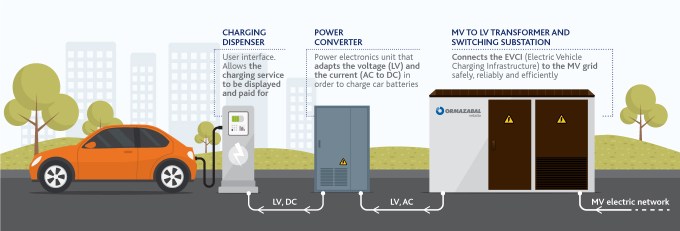
Charging stations are connected to the local electricity grid. The station draws power from the same network that supplies homes, factories, and businesses. For high-speed stations, extra electrical equipment is often added to handle the high power demand safely.
Some stations also use solar panels or store energy in large batteries to reduce stress on the grid during busy times. This is called energy management, and it helps keep costs and pollution lower.
A growing trend is the use of renewable energy. Some stations advertise “100% green energy,” which means the electricity comes from wind or solar farms instead of fossil fuels.
How Do You Pay At Charging Stations?
You usually don’t pay with cash at an electric car charging station. Most stations have these payment methods:
- Mobile Apps: You scan a QR code or use an app to start and stop charging.
- RFID Cards: Tap a card provided by the charging network.
- Credit/Debit Card: Some stations have contactless payment.
- Subscription: Some networks offer monthly plans for unlimited charging.
Prices can be by the kilowatt-hour (kWh), by the minute, or a flat session fee. Fast charging is usually more expensive per kWh than Level 2.
Here’s a simple comparison of typical charging costs:
| Charging Type | Average Cost (USD/kWh) | Typical Use |
|---|---|---|
| Home Level 1/2 | $0.12 – $0.25 | Overnight, daily use |
| Public Level 2 | $0.20 – $0.40 | Work, shopping |
| DC Fast Charge | $0.30 – $0.60 | Travel, long trips |
Some charging networks offer free charging at workplaces, hotels, or malls to attract customers.
What Happens Inside The Charging Station?
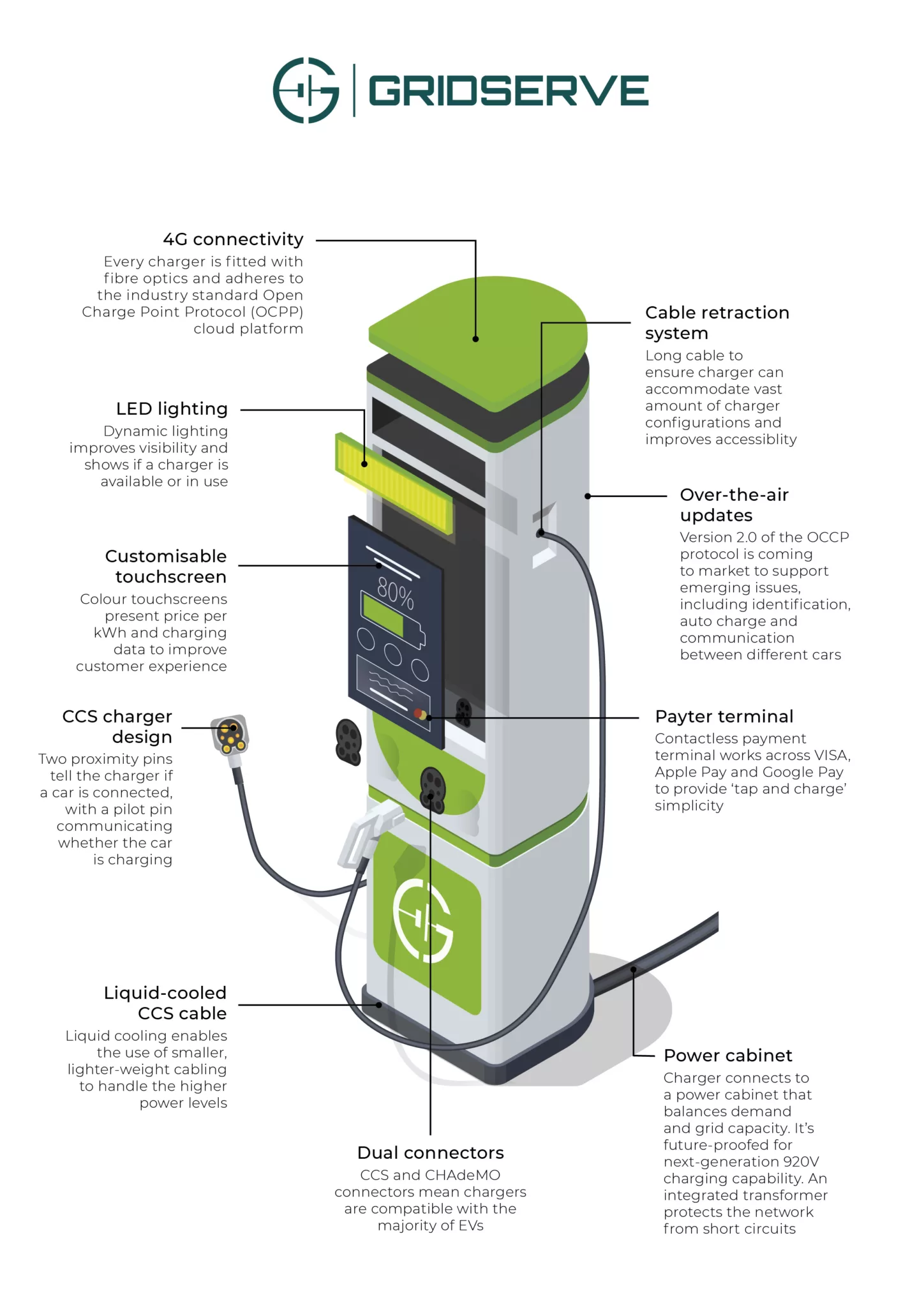
There’s a lot of technology inside every charging station. Here’s what happens behind the scenes:
- Power Conversion: The station changes the grid’s AC power to the right voltage and current for your car.
- Safety Checks: Before charging, the station checks for faults or problems.
- User Interface: Most stations have screens, lights, or apps to show charging status and instructions.
- Communication: The station talks to your car and to the network to keep everything running smoothly.
- Billing: The system tracks how much energy you use and processes payments.
Some stations also connect to the internet. This lets them update prices, report problems, and show real-time status (like “available” or “in use”) on apps.
How Charging Networks Work
A charging network is a group of stations operated by one company. Examples are ChargePoint, EVgo, and Tesla Supercharger. Networks make it easy to find, start, and pay for charging.
Key features of charging networks:
- Location Maps: Find stations with apps or GPS.
- Membership: Get lower rates or special access.
- Customer Support: Help if something goes wrong.
- Roaming: Some networks let you use partner stations.
Networks also help with maintenance and updates. If a station has a problem, the network can often fix it remotely or send a technician.
Smart Charging And Load Management
As more people drive electric cars, smart charging becomes important. Smart charging means the station can adjust when and how fast it charges cars. This helps balance electricity use and avoids blackouts.
Some smart features:
- Time-of-Use Charging: Stations charge more during busy hours and less at night.
- Vehicle-to-Grid (V2G): Some cars can send power back to the grid when needed.
- Remote Control: Utilities can slow down charging to protect the grid.
Smart charging helps keep costs down and reduces stress on the power system.
How To Use A Public Charging Station: Step-by-step
If you are new to electric cars, the process can feel different from refueling a gas car. Here’s a simple guide:
- Find a Station: Use your car’s navigation, a mobile app, or a charging network map.
- Park and Plug In: Park your car so the charging port is close to the station. Plug the connector into your car.
- Start Charging: Use the app, card, or station screen to begin.
- Monitor Progress: Most apps and stations show charging speed, battery level, and estimated time.
- Stop Charging: End the session with your app, card, or by unplugging (some stations lock the cable until payment is done).
- Unplug and Go: Remove the connector, close your charging port, and you’re ready to drive.
Non-obvious tip: Many stations charge higher prices if you leave your car plugged in after charging is done. This is called an idle fee.
Home Vs. Public Charging: Which Is Better?
Most EV owners charge at home. It’s cheaper and more convenient. Public stations are great for travel or when you need extra range fast.
Home charging benefits:
- Lower cost: Electricity rates are usually lower at home.
- Convenience: Plug in overnight and wake up to a full battery.
- Control: No waiting for an available spot.
Public charging benefits:
- Speed: Fast chargers are much quicker.
- Location: Useful for trips and emergencies.
- Backup: Good if you can’t install a charger at home.
A common mistake: Not planning for home charging before buying an EV. If you rent or don’t have a garage, check public charging options nearby.
Safety Features Of Charging Stations
Electricity and water don’t mix well, but charging stations are built to be safe in all weather.
- Ground Fault Protection: Stops power if a problem is detected.
- Weatherproof Design: Stations are sealed against rain and dust.
- Locking Mechanisms: The cable often locks in place so nobody can unplug it while charging.
- Emergency Shutoff: Stations have buttons to cut power instantly.
Non-obvious detail: Most public stations test the connection before sending power, so you can’t get shocked even if you touch the connector.

Credit: www.evgo.com
Charging Speed: What Affects It?
Charging speed depends on several factors:
- Charger Power: Higher kW means faster charging.
- Car’s Limit: Your car’s battery and onboard charger may limit speed. For example, some cars can only use Level 2, even at a DC fast charger.
- Battery State: Charging is fastest when the battery is low and slows as it nears full.
- Temperature: Very hot or cold weather can reduce charging speed to protect the battery.
- Shared Stations: Some stations split power between cars, so charging slows if many cars are plugged in.
A typical example: A Nissan Leaf charges at 6.6 kW at a Level 2 station, adding about 35 km (22 miles) of range per hour. At a DC fast charger, it can charge up to 50 kW, adding 140 km (87 miles) in 30 minutes.
Charging Station Availability And Growth
There are now over 2 million public charging points worldwide, and the number is growing fast. China, Europe, and the US lead the way.
However, charging stations are not always evenly spread out. Cities have many, but rural areas may have few. Planning is important for long trips.
A useful resource to find charging stations is PlugShare, which maps stations globally.
Environmental Impact Of Charging Stations
Charging stations themselves have a small environmental footprint compared to gas stations. The main impact comes from the source of electricity.
- Green Power: If stations use solar or wind, charging is nearly emission-free.
- Grid Power: If the local grid uses coal or gas, emissions are higher.
- Station Construction: Modern stations are built with durable, often recycled materials.
Some companies use solar canopies or batteries to power stations during the day and reduce demand at night.
Real-world Example: Tesla Supercharger Network
The Tesla Supercharger network is the largest fast-charging system worldwide. Here’s what makes it unique:
- Exclusive Use: Most chargers are for Tesla cars, but some are opening to other brands.
- High Speed: Up to 250 kW, adding up to 320 km (200 miles) in 15-20 minutes.
- Seamless Payment: Billing is automatic—just plug in and charge.
- Navigation Integration: Tesla’s system routes you to the nearest charger and tells you how long to charge.
Tesla’s model shows the power of a well-designed charging network: fast, reliable, and easy to use.
Future Trends In Charging Stations
The next few years will bring big changes:
- Ultra-Fast Charging: More stations with power above 350 kW.
- Wireless Charging: Some tests allow cars to charge by parking over a special pad—no cables needed.
- Solar-Powered Stations: More stations will use on-site renewable energy.
- More Connectors: Universal adapters will make it easier to use any station.
- Smart Grids: Stations will help balance grid demand, store energy, and even power homes during outages.
Insight: In the future, your EV could help power your house or even sell power back to the grid during emergencies.
Common Mistakes When Using Charging Stations
Many beginners make these errors:
- Not checking connector type: Make sure the station matches your car.
- Ignoring idle fees: Move your car when charging is done.
- Assuming all stations are fast: Many public chargers are slower Level 2.
- Not planning for long trips: Use apps to check station locations and availability.
- Forgetting payment method: Bring your RFID card or set up the app in advance.
A little planning can make your charging experience smooth and stress-free.
Advantages And Limitations Of Electric Car Charging Stations
Advantages:
- Cleaner and quieter than gas stations.
- More places to charge as networks grow.
- Home charging is convenient and affordable.
- Renewable energy options reduce pollution.
Limitations:
- Charging takes longer than refueling with gasoline.
- Some areas still lack enough stations.
- Not all stations support all car types or charging speeds.
- High-power charging can be more expensive.
Despite these limits, electric car charging is improving rapidly.
Charging Station Etiquette And Best Practices
To make charging fair and friendly for everyone:
- Don’t unplug others’ cars: Wait your turn unless charging is finished.
- Move when done: Free up the charger for others.
- Keep cables tidy: Don’t leave cables on the ground.
- Report issues: Use the app to report broken or blocked chargers.
- Be patient: Fast chargers are busy during holidays and weekends.
Good manners help everyone enjoy the benefits of electric driving.
Why Charging Infrastructure Matters
A strong charging network is key to the success of electric cars. It removes “range anxiety”—the fear of running out of power. As more stations are built, EVs become a practical choice for more people.
Government support is speeding up this growth. Many countries offer grants to build new stations, especially in rural or underserved areas.
For example, in the United States, the government plans to install 500,000 new public chargers by 2030.
The Human Side: Stories From Ev Drivers
Real EV owners often find charging easier than they expected. Many say they charge at home most of the time and use public stations for travel.
One non-obvious insight: Some people discover new favorite shops or restaurants while waiting at a charging station. Charging time can become a break to relax or explore.
EV drivers also share tips and updates in online groups, helping new owners avoid common mistakes and find the best charging spots.
Frequently Asked Questions
How Long Does It Take To Charge An Electric Car?
Charging time depends on the charger type and your car’s battery. Level 1 takes 8-24 hours for a full charge, Level 2 takes 4-8 hours, and DC fast charging can add 80% charge in 20-40 minutes.
Can I Use Any Charging Station With My Electric Car?
Most modern EVs can use many public charging stations, but you may need an adapter for some connectors. Always check your car’s compatibility before traveling.
Are Charging Stations Safe To Use In The Rain?
Yes, charging stations are designed for all weather. Connectors and stations are waterproof and have safety systems to prevent shocks or faults.
How Much Does It Cost To Use A Public Charging Station?
Costs range from $0. 20 to $0. 60 per kWh, depending on the charging speed and location. Some places offer free charging, while fast chargers and busy locations cost more.
Where Can I Find Electric Car Charging Stations?
You can find stations using apps like PlugShare, your car’s navigation system, or charging network websites. These tools show real-time status and connector types.
Electric car charging stations are a key part of the shift to cleaner transportation. They may seem complex at first, but with a little knowledge, using them becomes as simple as plugging in your phone. As networks grow and technology improves, charging will become faster, easier, and available everywhere you travel.