
Testing a fuse may sound like a technical task, but with the right tools and clear steps, anyone can do it safely. Fuses protect our electrical devices by stopping too much current. If a device stops working, a blown fuse could be the reason. Knowing how to check a fuse with a multimeter can save time, money, and prevent electrical problems. This guide explains everything: what a fuse is, why testing matters, and, most importantly, how to use a multimeter to check a fuse step by step. Whether you are a car owner, a DIY enthusiast, or just want to learn, you will find all the details you need here.
Understanding Fuses And Multimeters
Before you start testing, it’s important to know what you are working with. Fuses and multimeters are simple, but understanding their basics will make the process easier and safer.
What Is A Fuse?
A fuse is a small safety device found in electronics, cars, and home wiring. It contains a thin wire that melts if the current is too high. When the wire melts, it breaks the circuit, stopping electricity to protect other parts. Fuses come in different shapes and sizes: glass tubes, ceramic cylinders, blade types, and more. Each one is designed for a certain voltage and current.
Why Do Fuses Blow?
Fuses blow when there is too much current. Common reasons include:
- Short circuits
- Overloaded circuits
- Faulty devices
When a fuse blows, it must be replaced, but first you need to check if it is the real problem.
What Is A Multimeter?
A multimeter is a tool for measuring electrical values like voltage, current, and resistance. There are two main types:
- Analog multimeters: Use a needle to show values.
- Digital multimeters (DMMs): Show numbers on a screen.
You will use a multimeter to check if a fuse is “open” (broken) or “closed” (working). The most common test is the continuity test or resistance test.
Why Test A Fuse With A Multimeter?
Sometimes a fuse looks fine, but is actually bad. Visual checks are not enough. A multimeter gives a clear answer. Testing a fuse with a multimeter is:
- Accurate
- Quick
- Safe (if you follow the steps)
Many beginners forget to check fuses before replacing expensive parts. This is a common mistake that can cost time and money.
Tools And Safety Precautions
Before testing, you need the right tools and must follow important safety steps.
Essential Tools
- Multimeter: Digital is best for beginners.
- Test leads: These are wires with metal tips for connecting the multimeter.
- Gloves (optional): For extra safety.
- Screwdriver or pliers: To remove the fuse, if needed.
- Spare fuses: In case you need to replace a blown one.
Safety Rules
- Power off the device before removing or testing fuses.
- Never test a fuse in a live circuit unless you know exactly what you are doing.
- Use insulated tools to avoid shocks.
- If the fuse is in a high-voltage device (like mains electricity), consult a professional.
A missed safety step can cause injury or damage equipment. Always put safety first.
Types Of Fuses And Where You Find Them
Fuses are everywhere, but they don’t all look the same. Knowing the type helps you find and test them correctly.
Common Fuse Types
| Type | Shape | Where Used |
|---|---|---|
| Glass Cartridge | Tube-shaped, metal ends | Electronics, appliances |
| Ceramic Cartridge | Tube-shaped, ceramic body | Home wiring, high-current devices |
| Blade Fuse | Plastic body, two metal prongs | Cars, trucks, motorcycles |
| Resettable (PTC) | Disc or block | Power supplies, computer boards |
Finding The Fuse
- In cars: Under the dashboard or in the engine bay.
- In electronics: Inside the case, often near the power supply.
- In home wiring: Fuse boxes or breaker panels.
Finding the right fuse is the first step. Always check the fuse rating before testing or replacing.
How A Multimeter Tests A Fuse
A multimeter can check a fuse using two main settings:
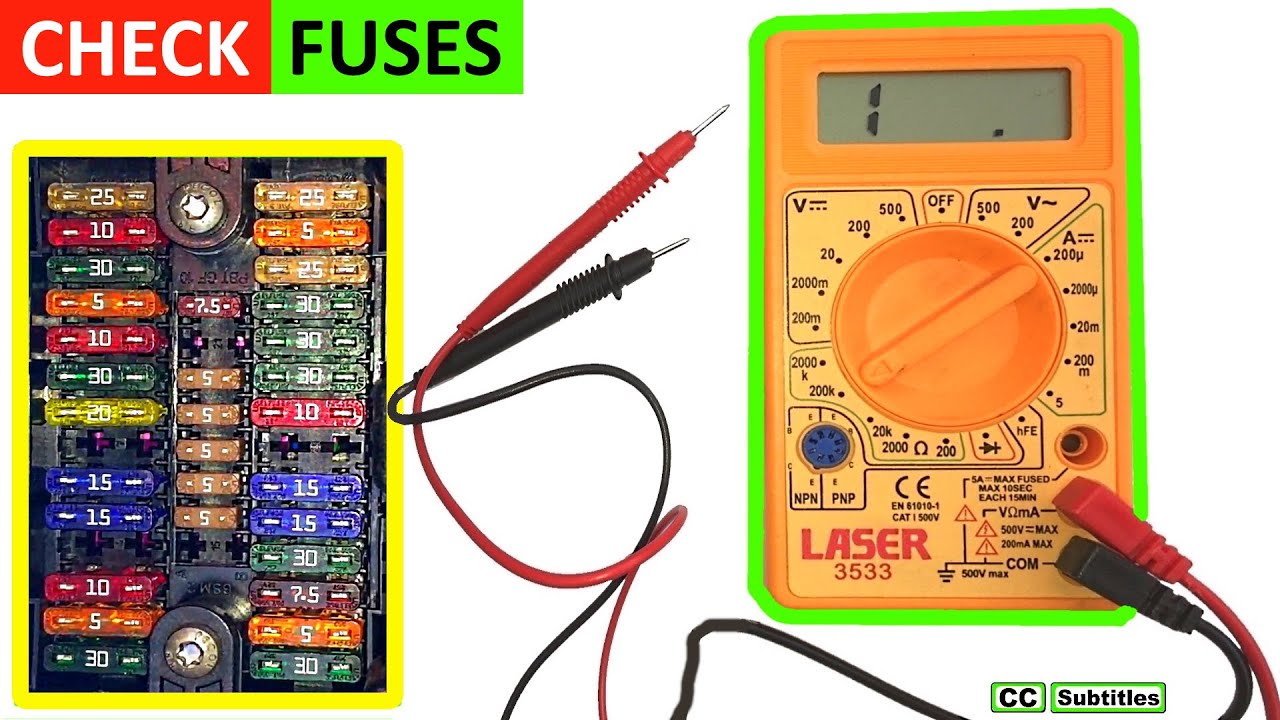
- Continuity mode: Makes a sound or shows a reading if the fuse is good.
- Resistance (ohms/Ω) mode: Measures the fuse’s resistance. A good fuse has very low resistance.
Many people skip reading their multimeter’s manual. But every multimeter works a little differently. Take a minute to check the basic functions before you begin.

Step-by-step: How To Test A Fuse With A Multimeter
Now, let’s go through the whole process. Each step is important. This method works for most fuses in cars, home appliances, and electronic devices.
1. Turn Off And Unplug The Device
Always start by cutting the power. This is the most important step. If you test a fuse while the device is on, you risk shock or damage. Unplug the device or disconnect the battery.
2. Find And Remove The Fuse
Locate the fuse. Use a diagram if needed (car manuals, appliance guides). Use a screwdriver or pliers if the fuse is hard to reach. Take the fuse out gently to avoid breaking it.
3. Set Up Your Multimeter
Insert the test leads into the multimeter:
- Black lead goes in the “COM” port.
- Red lead goes in the “VΩmA” or similar port.
Turn the dial to “continuity” (often a sound wave symbol) or “resistance” (Ω).
| Multimeter Setting | Symbol | Use |
|---|---|---|
| Continuity | Sound wave or diode | Quick check with sound |
| Resistance (Ohms) | Ω (Omega) | Shows precise resistance |
4. Test The Multimeter (optional But Smart)
Touch the two test leads together. You should hear a beep (continuity) or see a “0” or very low number (resistance). This confirms your multimeter is working.
5. Touch The Test Leads To The Fuse
Hold the fuse with one hand. Touch one lead to each end of the fuse.
- If using continuity: A beep or “0” shows the fuse is good. No beep means the fuse is blown.
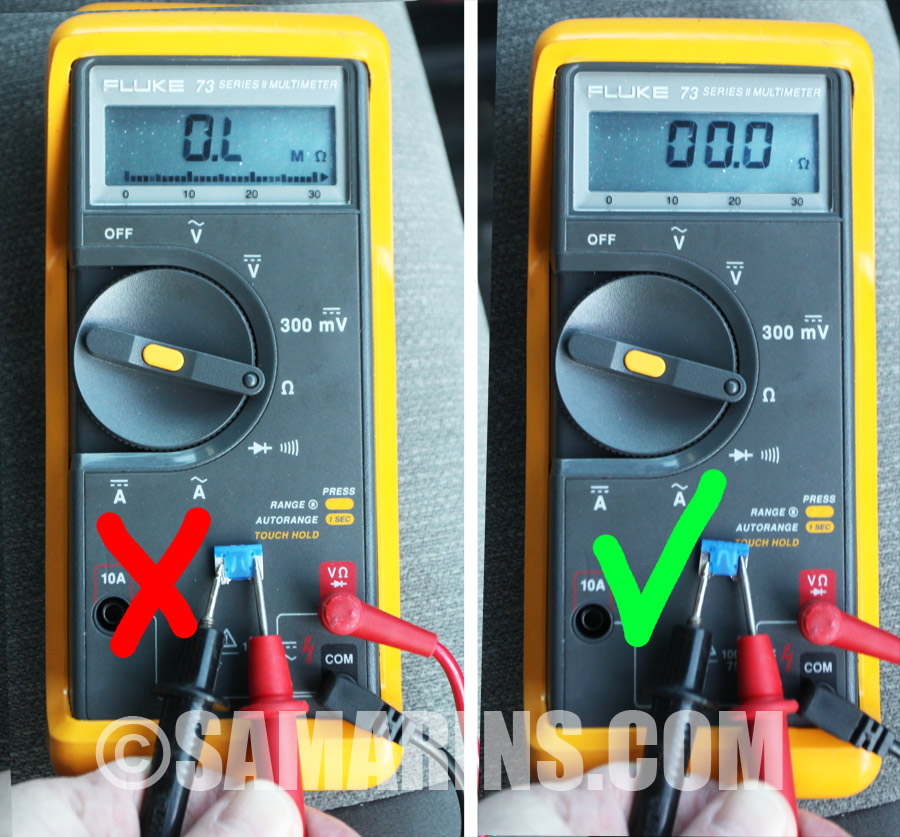
- If using resistance: A good fuse gives a reading near “0” ohms (usually less than 1Ω). “OL” or a very high number means the fuse is blown.
Pro tip: Sometimes, dirty fuse ends can cause a bad reading. Clean them gently with a dry cloth if needed.
6. Interpret The Results
- Good fuse: Beep (continuity) or low resistance (0-1Ω).
- Blown fuse: No beep or high/“OL” resistance.
If your multimeter gives a strange result, repeat the test. Make sure the leads are touching the metal ends, not the plastic.
7. Replace Or Reinstall The Fuse
If the fuse is blown, replace it with one of the same rating (voltage and current). Never use a higher-rated fuse. If the fuse is good, put it back and keep searching for the problem.
8. Power On And Retest
After replacing or reinstalling the fuse, turn the device back on and check if it works. If the new fuse blows again, there is a deeper problem. Do not keep replacing fuses without finding the cause.
Real-world Example: Testing A Car Fuse
Let’s say your car’s radio suddenly stops working. Here’s how you would test the fuse:
- Turn off the car and remove the key.
- Find the fuse box (often under the dashboard).
- Use the diagram on the box to find the radio fuse.
- Remove the fuse with plastic tweezers.
- Set your multimeter to continuity.
- Touch the leads to each prong of the fuse.
- If you hear a beep, the fuse is good. If not, replace with the same type.
A common mistake is putting in a bigger fuse “just to get it working. ” This is dangerous and can cause more damage.
Advanced Tips And Insights
Not All Fuses Blow The Same Way
Some fuses “look” good but are not. Inside a glass fuse, the wire may break in a spot you can’t see. In ceramic fuses, you can’t see the wire at all. That’s why testing with a multimeter is more reliable than just looking.
Watch Out For Slow-blow Fuses
Some devices use slow-blow fuses. They tolerate short bursts of high current but will blow if the current stays high. These are common in amplifiers and some appliances. The test method is the same, but always replace with the same type.
Testing Fuses In-circuit
You can sometimes test fuses without removing them, but results can be confusing. Other parts of the circuit may affect the reading. For beginners, always remove the fuse first.
Document Your Results
Write down which fuses you test, the results, and the date. If a fuse keeps blowing, this record helps you or a professional find the real problem.
Common Mistakes To Avoid
- Testing with the device powered on.
- Using the wrong multimeter setting.
- Not replacing with the same fuse type.
- Ignoring repeated blown fuses (could mean a bigger issue).
Learning to spot and avoid these mistakes saves time and prevents accidents.
Multimeter Settings Explained
Understanding your multimeter’s settings makes testing easier and safer.
Continuity Vs. Resistance
- Continuity: Fast, audible, and clear. Best for checking if a fuse is good or bad.
- Resistance: Shows the exact resistance. Useful if you want to check if a fuse is getting “weak” or partially damaged (rare, but possible).
Digital Vs. Analog Multimeters
Digital is easier to read and more accurate for most people. Analog meters can be harder to read and less precise, especially for small values like fuse resistance.
Practical Example: Reading Resistance
If your digital multimeter shows “0. 2Ω” when you touch the leads together, and “0. 4Ω” when you test the fuse, the fuse’s resistance is 0. 2Ω. This is normal and means the fuse is good.
When A Fuse Passes The Test But The Device Still Fails
Testing a fuse is just one step in troubleshooting. Sometimes, the fuse is fine but the device still does not work. Here’s what to check next:
- Look for loose wires or connectors.
- Check the device’s power switch or plug.
- Test other fuses in the same circuit.
- If you find nothing wrong, the problem may be inside the device.
Never keep replacing fuses if they keep blowing. This points to a deeper electrical fault.
Buying The Right Replacement Fuse
When you need a new fuse, check three things:
- Current rating (amps): Printed on the fuse or in the manual.
- Voltage rating: Must be the same or higher than the old fuse.
- Physical size/type: Shape and size must match.
Never use a fuse with a lower current rating. It will blow too soon. Never use a higher-rated fuse—it will not protect your device.
Example: Reading A Fuse Label
A fuse labeled “250V 5A” means it can handle up to 5 amps and 250 volts. Always match these numbers when buying a new one.
Comparing Fuse Testing Methods
You may hear about other ways to test a fuse, like using a light bulb or just looking. Here’s how they compare:
| Method | Accuracy | Ease of Use | Risk |
|---|---|---|---|
| Visual Check | Low | Easy | Misses hidden faults |
| Light Bulb Tester | Medium | Simple | Not for all fuses |
| Multimeter | High | Moderate | Very safe |
The multimeter is the best tool for testing because it finds problems you can’t see with your eyes.
Troubleshooting: If A New Fuse Blows Again
If you replace a fuse and it blows right away, don’t just keep replacing it. Possible causes include:
- Short circuit in the device
- Faulty wiring
- Incorrect fuse rating
- Other damaged components
In this case, stop and check the device carefully. If you are not sure, ask a professional.
Special Cases: Testing Fuses In Large Appliances And High-voltage Devices
Some fuses are in devices that use high voltage (like ovens or air conditioners). These need extra care:
- Always unplug before opening.
- Some appliances have “thermal fuses” that reset themselves. These are harder to test.
- If you are not experienced, do not open high-voltage devices. Hire a licensed electrician.
The Role Of Fuses In Electrical Safety
Fuses are not just for fixing devices—they are critical for safety. They prevent fires, equipment damage, and electric shocks. Never “bypass” a fuse with wire or foil. This is extremely dangerous and can cause serious accidents.
How Often Should You Test Fuses?
Fuses only need testing when a device stops working, or after a power surge. Regular testing is not needed unless you suspect a problem. For cars and important appliances, check fuses when you do regular maintenance.
Multimeter Maintenance Tips
A good multimeter lasts for years if you take care of it:
- Store in a dry place.
- Replace batteries when the screen dims.
- Clean the test leads with a dry cloth.
- Calibrate once a year if you use it often.
A faulty multimeter can give wrong results, leading to wrong decisions about fuses.
Common Fuse Ratings And Where You’ll Find Them
Knowing the typical ratings helps you identify fuses quickly.
- 0.5A – 2A: Small electronics (radios, chargers)
- 5A – 15A: Car circuits, small appliances
- 15A – 30A: Large appliances, home wiring (older systems)
Check the rating before replacing any fuse.
Learning From Mistakes: Two Insights Beginners Miss
- Testing Only One Fuse: Sometimes, more than one fuse protects a circuit. Always check all fuses in a device, not just the obvious one.
- Trusting Visual Checks: Many beginners only look at the fuse. But a fuse can look perfect and still be open inside. Always test with a multimeter for certainty.
Where To Learn More
If you want to dive deeper into the science of fuses and electrical safety, the Wikipedia page on fuses offers detailed technical information.
Frequently Asked Questions
How Do I Know If My Fuse Is Blown Without A Multimeter?
You can look for a broken wire or a dark spot inside the fuse. But this is not always reliable. Some fuses look fine but are still blown. A multimeter gives a sure answer.
Can I Test A Fuse While It Is Still In The Circuit?
Yes, but results may be confusing. Other parts of the circuit can affect the reading. For the most accurate result, remove the fuse first.
What Happens If I Use A Higher-rated Fuse?
The device may work, but you lose protection. A higher-rated fuse will not blow in time to stop damage or fire in case of a problem. Always use the correct rating.
Is It Safe To Test Fuses In High-voltage Devices?
Only if the device is completely unplugged and you are experienced. High-voltage devices are dangerous. For most people, it’s best to call a professional.
Why Does My Fuse Keep Blowing?
This usually means there is a deeper problem, such as a short circuit, faulty wiring, or a damaged component. Replacing the fuse again and again will not fix the root cause.
Testing a fuse with a multimeter is a valuable skill for anyone who uses electrical devices or vehicles. It saves money, prevents bigger problems, and keeps you safe. With patience and the right steps, you can quickly find and fix blown fuses and keep your equipment running smoothly.