
A non contact voltage tester is a small, pocket-sized tool that can save lives. It helps you find out if electricity is present in a wire, outlet, or device—without touching any bare wires. That’s why both professionals and beginners trust it when working with electrical systems.
But to use a non contact voltage tester safely and correctly, you need to understand how it works, what it can (and can’t) detect, and how to avoid mistakes. In this guide, you’ll discover everything you need to know about using a non contact voltage tester—from basic concepts to advanced tips you won’t find in the tool’s manual.
What Is A Non Contact Voltage Tester?
A non contact voltage tester (sometimes called a “voltage detector” or “NCVT”) is a handheld tool that senses the presence of AC (alternating current) voltage. It does this through electromagnetic fields, so you don’t have to touch any metal parts.
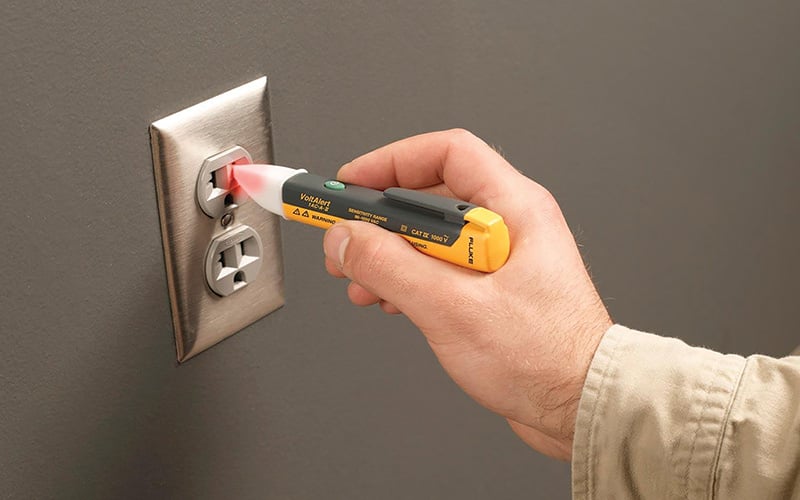
Most testers look like a thick pen with a plastic tip. When you bring the tip near a live wire or outlet, the tester lights up or beeps if voltage is present. No direct contact with the conductor is needed.
This makes it much safer than older test methods.
How Does It Work?
Non contact voltage testers use sensors to pick up the electric field around a live wire. When AC voltage flows, it creates a field that extends outside the wire’s insulation. The tester’s tip detects this field and triggers a light or sound alert.
Most models are tuned for standard household voltages (110–240V AC), but some can detect higher or lower voltages. The tool does not detect DC voltage (from batteries or solar panels), only AC.
Main Features
- Contactless detection: No need to touch wires.
- Visual and audio alerts: Lights up and/or beeps.
- Battery powered: Uses small batteries (often AAA or coin cell).
- Compact and portable: Fits in a shirt pocket.
Why Use A Non Contact Voltage Tester?
Working with electricity can be dangerous. Each year, thousands of people are injured or killed by electric shocks—many during DIY work at home. A non contact voltage tester gives you a fast, reliable way to check for live wires before you start work.
Key Benefits
- Safety: You don’t have to touch wires or terminals, reducing shock risk.
- Speed: Instantly checks outlets, switches, cords, and more.
- Convenience: Fits in your pocket and works with one hand.
- Versatility: Useful for home repairs, construction, industrial work, and troubleshooting.
- No need to disconnect wires: Detects voltage through insulation, so you can test wires in walls or bundles.
Example Use Cases
- Before changing a light switch or outlet, you check the wires to make sure power is off.
- An electrician traces which wires in a bundle are live without opening each connection.
- You test extension cords, power strips, or appliances for hidden faults.

Types Of Non Contact Voltage Testers
Not all testers are the same. They come in different shapes, voltage ranges, and with special features. Choosing the right one can make your work easier and safer.
| Type | Main Use | Voltage Range | Special Features |
|---|---|---|---|
| Basic Pen-Style | Home wiring, outlets | 90–1000V AC | Light and sound alert |
| Dual Range | Low and high voltages | 12–1000V AC | Detects lower voltages |
| Industrial | Factories, heavy equipment | 100–4000V AC | High sensitivity, rugged body |
| Multimeter with NCV | General electrical work | Varies | Other measurement functions |
Basic Pen-style Testers
These are the most common. They’re great for home use and most electrical outlets. If you’re just starting out, this is the type to get.
Dual Range Testers
Some models have a dual voltage range switch. This lets you detect both low-voltage (like thermostat or doorbell wires) and standard household voltage. These are helpful for troubleshooting electronics or automotive circuits.
Industrial Testers
Built for professionals, these can sense very high voltages (above 1000V). They’re often more durable and may include extra safety features. Unless you work in factories or with industrial equipment, you probably don’t need one.
Multimeters With Ncv
Some digital multimeters have a non contact voltage feature. This means you can test for voltage without buying a separate tool. However, dedicated testers are usually simpler and more sensitive.
How To Choose The Right Non Contact Voltage Tester
With so many models, it’s easy to feel overwhelmed. Here’s what matters most when picking a non contact voltage tester:
1. Voltage Range
Make sure the tester covers the voltage you’ll be working with. For home use, a range of 90–1000V AC is enough. If you need to check low-voltage systems (like HVAC controls or data cables), choose a model that works down to 12V or 24V.
2. Sensitivity
A tester’s sensitivity means how well it detects weak electric fields. Some testers struggle with thick insulation or wires buried in walls. Higher sensitivity is better—but too much can cause false alerts. Look for adjustable sensitivity if you work in varied environments.
3. Alert Type
Most testers use a combination of light (usually a bright LED) and sound (a beep or buzz). Some add vibration alerts for noisy environments. Pick the alert style that suits where you work.
4. Build Quality And Safety
Choose a tester with a strong, insulated body. Check for safety certifications like CAT II or CAT III—these show the tester meets standards for electrical protection. A rubberized grip can help prevent drops.
5. Battery Life
A good tester should last months between battery changes. Some models have auto-off or low-battery indicators.
6. Extra Features
Some testers include:
- Flashlight (for dark panels)
- Clip for pockets
- Waterproofing
- Replaceable tips
While these are nice, don’t pay extra unless you need them.
Common Buyer Mistakes
- Picking a tester with a voltage range too high or too low for your needs
- Ignoring build quality—cheap models may give unreliable results
- Not checking for certifications or safety ratings
How To Use A Non Contact Voltage Tester: Step-by-step Guide
Using a non contact voltage tester is simple, but small mistakes can be dangerous. Follow these steps every time:
Step 1: Read The Manual
Before using any new tester, read the instruction manual. Each brand may have unique steps or safety warnings.
Step 2: Check The Batteries
A weak battery can cause the tester to give false negatives (not detecting voltage when it’s present). Press the “test” button (if your model has one), or test on a known live source (like a powered outlet) before starting work.
Step 3: Set The Range (if Needed)
If your tester has a sensitivity or range switch, set it to the correct range for the job. Use a lower range for low-voltage circuits, higher for main power lines.
Step 4: Test On A Known Live Source
Always verify that your tester is working before trusting it. Touch the tip to a live outlet or cord you know is “hot. ” The tester should light up or beep. This proves the tool is working.
Step 5: Approach The Wire Or Outlet
Hold the tester by its body, not the tip. Bring the tip near the insulated part of the wire, socket, or device. Do not touch any bare metal.
Step 6: Observe The Indicator
If the tester lights up or beeps, voltage is present. If it stays dark or silent, the wire is likely dead—but always double-check.
Step 7: Check All Wires
Test every wire in a bundle, not just one. Sometimes, only one wire is live.
Step 8: Double-check
After turning off a breaker or unplugging a device, test again to make sure power is truly off.
Step 9: Retest On A Live Source
When done, check your tester on a live source again. This confirms the tester didn’t fail during your work.
Practical Examples: Real-world Uses
Non contact voltage testers are used in many situations. Here are some common scenarios:
Checking Wall Outlets
Before replacing a wall outlet, use the tester to check all slots and the faceplate. If it lights up, power is still present—don’t start work until it’s off.
Tracing Faulty Wires
If a light or outlet isn’t working, you can use the tester to check each wire in the circuit. If the tester lights up at one point but not the next, the break is between those points.
Testing Extension Cords
Plug in the cord and run the tester along its length. If it beeps at one end but not the other, the cord may have a break.
Verifying Power Off
After shutting off a circuit breaker, always test the wires before touching them. Never trust just the breaker label—wiring mistakes happen.
Locating Live Wires In Walls
Some sensitive testers can detect wires behind drywall. Slowly move the tester along the wall; if it lights up, there may be a live wire inside.
Common Mistakes And How To Avoid Them
Even experienced users make errors with non contact voltage testers. Here are the most frequent mistakes and how to prevent them:
Mistake 1: Not Testing The Tester
Never assume your tester is working. Batteries die, sensors fail, or the tool can be damaged in your toolbox. Always check on a known live source first.
Mistake 2: Using The Wrong Range
If your tester isn’t detecting voltage, check the range setting. Too high or too low can give false results.
Mistake 3: Ignoring Low-voltage Wires
Some testers can’t detect low-voltage circuits. If you work on alarm systems, thermostats, or network cables, make sure your tester is rated for those voltages.
Mistake 4: Testing Only One Wire
In a cable with multiple wires (like a three-way switch), check each wire. Sometimes only one is live.
Mistake 5: Trusting The Tester Alone
A non contact tester tells you if voltage is present, but not how much. For more complex work, back up your test with a multimeter.
Mistake 6: Using On Dc Circuits
Most non contact testers cannot detect DC voltage. Don’t use them on car batteries, solar panels, or electronics.
Mistake 7: Testing In Wet Conditions
Water can affect the tester’s reading or damage the tool. Always keep the tester dry.
Safety Tips For Non Contact Voltage Testers
Even though these tools are designed for safety, you must still follow basic rules when working around electricity.
1. Always Wear Insulated Gloves
Even with a non contact tester, gloves reduce risk if you accidentally touch a live wire.
2. Stand On An Insulated Surface
A rubber mat or dry wooden floor prevents electricity from passing through your body.
3. Don’t Use A Broken Tester
If the body is cracked, the tip is damaged, or the tester gives inconsistent results, replace it. Do not try to fix it yourself.
4. Avoid Crowded Panels
In tight electrical panels, it’s easy to bump into live parts. Work slowly and keep your hands clear.
5. Keep Away From Children
These tools look like toys. Store your tester out of reach of kids.
6. Turn Off Power When Possible
Even if you test first, always turn off the main breaker before working on wiring.
7. Know When To Call A Professional
If you’re unsure, call a licensed electrician. Electricity is unforgiving.
Understanding Tester Limitations
It’s important to know what your non contact voltage tester cannot do.
1. Doesn’t Measure Voltage Level
The tester only tells you if voltage is present—not how much. For exact numbers, you need a multimeter.
2. False Positives And Negatives
Nearby strong fields, static electricity, or faulty wires can sometimes trigger a false alarm—or mask a live wire.
3. Limited Use On Shielded Or Armored Cables
Thick insulation or metal shields can block the electric field. In these cases, the tester may not detect voltage even if it’s present.
4. Not For Dc Voltage
Most non contact testers ignore DC voltage. Always check your tool’s specs.
5. Cannot Detect Broken Neutral Wires
If a neutral wire is broken, the tester might not indicate voltage, but the circuit can still be dangerous.
Table: Non Contact Voltage Tester Vs Other Testers
Here’s a quick comparison between non contact voltage testers and other common electrical testers:
| Feature | Non Contact Voltage Tester | Test Light | Multimeter |
|---|---|---|---|
| Contact Needed? | No | Yes | Yes |
| Detects AC Voltage | Yes | Yes | Yes |
| Detects DC Voltage | No | Yes | Yes |
| Shows Voltage Level | No | Sometimes | Yes |
| Safe for Beginners | Yes | No | Depends |
Advanced Tips: Getting The Most From Your Tester
Once you’re comfortable with basic use, try these advanced techniques for even more accuracy and safety.
1. Use The Tester To Find Breaks In Cords
Run the tester slowly along a cord. If the light goes off at a certain point, the wire may be broken there.
2. Check For “ghost” Voltage
Sometimes, a tester will light up near a wire that’s supposed to be off. This is usually harmless “phantom” voltage from nearby live wires. To confirm, use a multimeter.
3. Test Gfci Outlets
After pressing the “test” button on a GFCI outlet, check with your tester to make sure power is really off.
4. Use In Crowded Boxes
Touch only one wire at a time, and be careful not to let the tip touch metal parts.
5. Combine With A Multimeter
For full safety, first use the non contact tester for a quick check, then verify with a multimeter before touching any wires.
6. Identify Live Wires In Junction Boxes
If you open a junction box and see multiple wires, use the tester to find which ones are live—before you disconnect anything.
Care And Maintenance Of Your Tester
A non contact voltage tester is only as good as its condition. Here’s how to keep it working safely for years.
1. Store In A Dry Place
Moisture can damage the electronics. Keep the tester in a toolbox or drawer away from water.
2. Change Batteries Regularly
Don’t wait for the tool to fail. Replace batteries every few months, or when the tester gets dim or weak.
3. Clean The Tip
Wipe the tip with a dry cloth after use. Dust or grease can affect sensitivity.
4. Check For Damage
Inspect the tester for cracks, loose parts, or missing labels. Never use a damaged tester.
5. Test Before Every Use
Make it a habit to verify the tester on a live source before starting any electrical work.
Environmental And Legal Considerations
Responsible tool use means thinking beyond your own safety.
Disposal
When your tester reaches the end of its life, don’t throw it in the trash. Most contain batteries and electronics that should be recycled according to local laws.
Compliance
Some regions require electrical work to be done by licensed professionals. Always follow local codes and laws. Using a non contact voltage tester does not replace professional training.
Table: Top Features To Look For
When shopping for a new tester, compare these features side by side:
| Feature | Why It Matters |
|---|---|
| Adjustable Sensitivity | Lets you work with different voltage levels |
| Bright LED | Easy to see in dark spaces |
| Sound/Vibration Alert | Helps in loud environments |
| CAT II/III Rating | Ensures safety for home/professional use |
| Pocket Clip | Convenient to carry |
Frequently Asked Questions
How Do I Know If My Non Contact Voltage Tester Is Working?
Test it on a known live source—like a working outlet—before you trust it. The tester should light up or beep. If it doesn’t, check the batteries or replace the tester.
Can A Non Contact Voltage Tester Detect Voltage Through Walls?
Some testers can sense voltage through thin drywall, but results depend on wall thickness and wire depth. For wires deep in walls, accuracy drops. Always use caution and don’t cut blindly.
Will A Non Contact Voltage Tester Work On Dc Circuits?
No. Most testers only detect AC voltage. They cannot sense DC voltage from batteries, cars, or solar panels. Always check your tool’s specs.
Why Does My Tester Beep Near Wires That Should Be Off?
This may be due to phantom voltage—weak fields from nearby live wires. Double-check with a multimeter if you’re unsure.
Is A Non Contact Voltage Tester Safe For Beginners?
Yes. They are among the safest electrical tools for home users. Just remember to test the tester first, follow instructions, and turn off power when possible.
Final Thoughts
A non contact voltage tester is one of the simplest tools you can own, but it can prevent serious injury or even save your life. By using it correctly—testing before each use, understanding its limits, and following safety steps—you can work with confidence on any electrical project. Remember, no tool replaces good judgment. If you’re ever in doubt, step back and call a professional. For more in-depth information on electrical safety, you can visit the Wikipedia article on voltage detectors. Stay safe, and make this small tool a habit every time you work around electricity.