
If you are planning a home renovation, working on DIY projects, or tackling demolition, you might find yourself choosing between a reciprocating saw and a jigsaw. Both tools cut wood, metal, and plastic, but their design, uses, and results are very different. Knowing the strengths and weaknesses of each tool will help you pick the right one for your job, save money, and avoid frustration.
Many beginners buy the wrong saw, believing all electric saws are similar. But a poor choice can ruin your project, damage materials, or even lead to injury. This guide will walk you through every important detail, from how each saw works to the kinds of jobs they handle best.
You will also learn practical tips, real-life examples, and key mistakes to avoid. By the end, you will have a clear answer to the reciprocating saw vs jigsaw debate—and the confidence to choose wisely.
What Is A Reciprocating Saw?
A reciprocating saw is a powerful cutting tool with a blade that moves back and forth (reciprocates) rapidly. Sometimes called a “Sawzall” (a popular brand name), it is designed for demolition, remodeling, and rough cuts through a variety of materials.
Most reciprocating saws have:
- A straight handle (like a drill)
- A long, thin blade that sticks out from the end
- A variable speed trigger
- A shoe (the flat part that rests against your work surface for stability)
The saw’s aggressive motion and blade shape let it cut through nails, pipes, studs, and even tree branches. It is not made for smooth, clean lines, but for quick, powerful cuts—even in awkward spaces.
Example: If you want to cut old window frames, remove a door, or slice through drywall and nails during demolition, a reciprocating saw is the tool of choice.
What Is A Jigsaw?
A jigsaw is a more precise electric saw with a short, straight blade that moves up and down rapidly. It is used for making curved cuts, straight lines, and intricate shapes in wood, plastic, metal, and even tile.
Most jigsaws have:
- A flat base plate (also called a “shoe”) that rests on your material
- A vertical handle above the blade
- Speed controls and sometimes an orbital setting (for faster or cleaner cuts)
- A blade that goes up and down beneath the tool
Jigsaws are ideal for detail work. You can cut out circles, curves, or patterns, and even start a cut in the middle of a board (plunge cutting).
Example: If you need to make a round hole in a countertop for a sink, or cut shapes into plywood for crafts, a jigsaw will give you the accuracy you need.
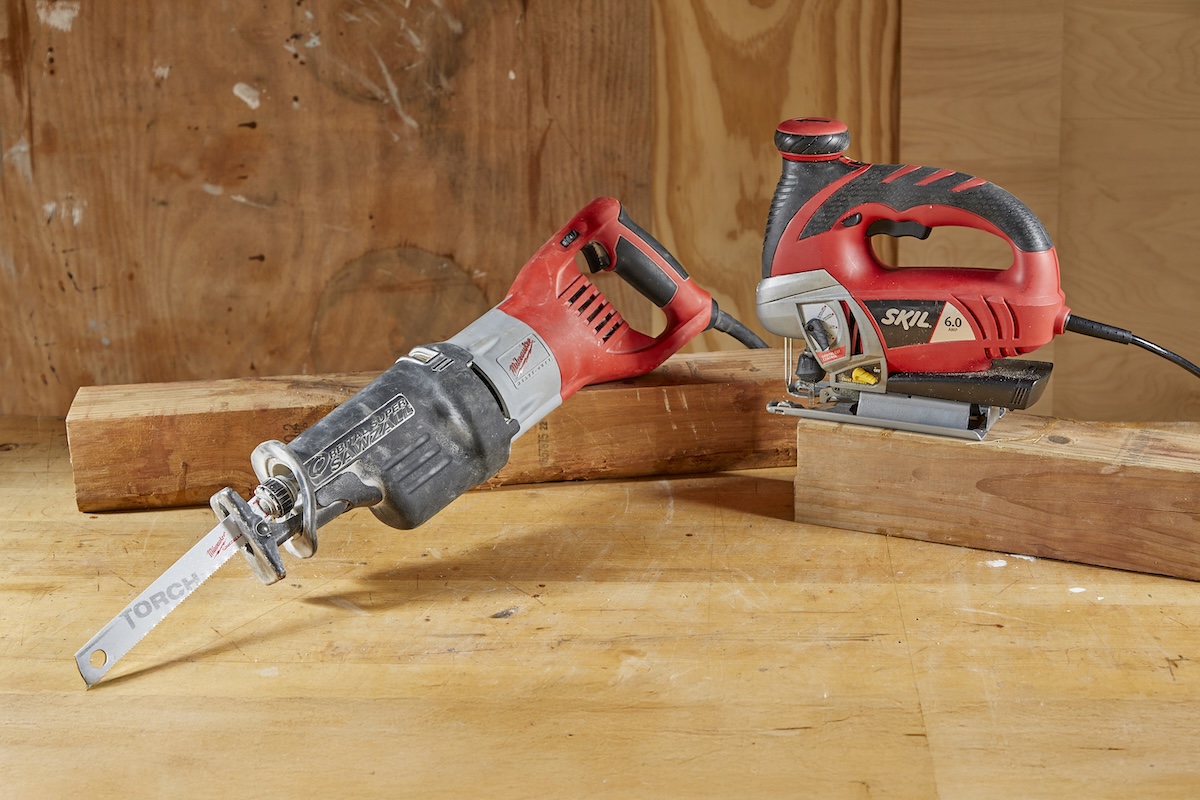
Credit: www.bobvila.com
Main Differences At A Glance
To quickly understand how these tools compare, see the side-by-side overview below:
| Feature | Reciprocating Saw | Jigsaw |
|---|---|---|
| Cutting Motion | Back-and-forth (reciprocating) | Up-and-down (vertical stroke) |
| Best For | Demolition, rough cuts | Curves, detail work, patterns |
| Blade Type | Long, straight, aggressive teeth | Short, thin, fine teeth |
| Material Compatibility | Wood, metal, PVC, drywall, nails | Wood, metal, plastic, tile (with correct blade) |
| Portability | High (often cordless) | High (lightweight, one hand use) |
| Precision | Low | High |
| Price Range | $40–$250+ | $30–$200+ |
Reciprocating Saw: In-depth Guide
How It Works
A reciprocating saw’s motor drives a shaft that moves the blade in a straight back-and-forth motion. This aggressive action cuts quickly through many materials. The long blade means you can reach into tight spaces, cut overhead, or slice flush against walls.
Common Uses
- Demolition: Cutting through old framing, nails, drywall, pipes, and more. No need for precision—just speed and power.
- Pruning Trees: With a pruning blade, a reciprocating saw can trim small branches faster than a hand saw.
- Plumbing and Electrical Work: Quickly cut pipes, conduit, or access holes in walls.
- Window and Door Removal: Easily cut around old frames, nails, and screws.
- Metal Cutting: With the right blade, you can slice through steel, aluminum, or rebar.
- Rescue Work: Firefighters and rescue workers use heavy-duty versions for vehicle extrication.
Blade Types
Reciprocating saw blades come in different sizes and shapes. The key is to match the blade to your material.
- Wood blades: Large teeth, fast cut
- Metal blades: Fine teeth, slower but smoother cut
- Demolition blades: Extra thick, handle nails and mixed materials
- Specialty blades: For masonry, pruning, or even bone
Strengths
- Raw Power: Cuts almost anything, even with embedded nails or screws.
- Speed: Finishes demolition jobs fast.
- Versatility: One tool, many materials.
- Access: Can reach into awkward spaces where other saws cannot fit.
Weaknesses
- Rough Cuts: Edges are jagged. Not for finish work.
- Vibration: Can be tiring for long use. Harder to control for straight lines.
- Accuracy: Almost impossible to make precise cuts.
- Noise and Mess: Loud and messy, not ideal for indoor clean work.
Safety Tips
- Always wear safety glasses—blades can break, and debris flies.
- Hold the saw firmly with both hands.
- Let the saw do the work—do not force it.
- Check for wires or pipes before cutting into walls.
- Use the right blade for your material.
Beginner insight: Many first-time users forget to brace the saw’s shoe against the work surface. This makes cutting much harder and causes the blade to bounce. Always keep the shoe pressed firmly for control and safety.
Jigsaw: In-depth Guide
How It Works
A jigsaw uses a small, straight blade that rapidly moves up and down. You guide the saw along your cutting line, and the flat shoe keeps the tool stable. Many jigsaws have orbital action—this means the blade not only moves up and down, but also slightly forward and back, helping clear dust and speed up the cut.
Common Uses
- Cutting Curves: The best tool for circles, arches, and custom shapes in wood or plastic.
- Straight Cuts: Good for short, straight lines, especially with a guide or fence.
- Plunge Cuts: Start a cut in the middle of a board—great for sinks, outlets, or vents.
- Crafts and Patterns: Cut out letters, signs, or puzzles.
- Metal and Tile Cutting: With the right blade, handles thin aluminum, steel, or even ceramic tile.
Blade Types
Jigsaw blades are much smaller and thinner than reciprocating saw blades. They also come in a range of tooth patterns:
- Wood blades: Coarse teeth for fast cutting, fine teeth for smooth finishes
- Metal blades: Tiny, fine teeth for thin metals
- Specialty blades: For tile, plastic, or laminate
- Reverse-tooth blades: Cut on the down stroke, reducing splinters on the top surface
Beginner insight: Always match your blade’s TPI (teeth per inch) to your material. More TPI = smoother, slower cut (good for metal and finish work). Fewer TPI = rougher, faster cut (good for soft wood).
Strengths
- Precision: Make detailed, accurate cuts.
- Versatility: Cuts curves, angles, straight lines.
- Low Vibration: Easier to control, less tiring.
- Cleaner Edges: Suitable for finish work.
- Portability: Lightweight, can be used with one hand.
Weaknesses
- Limited Power: Not ideal for thick or tough materials.
- Slower Cutting: Cuts slower than a reciprocating saw, especially in thick wood.
- Blade Bending: Long cuts in thick material can cause the blade to wander.
- Not for Demolition: Can break if forced through nails or screws.
Safety Tips
- Always unplug before changing blades.
- Wear eye protection—chips can fly upward.
- Use the right speed for your material (slower for metal).
- Keep the shoe flat for smooth, straight cuts.
- Let the blade stop before lifting the saw off your work.
Beginner insight: To avoid splintering, place the “good side” of your workpiece facing down. Most jigsaws cut on the upstroke, which can chip the top surface.
When To Use A Reciprocating Saw
You should choose a reciprocating saw when your project needs speed and brute force, not accuracy. It is perfect for:
- Tearing down old walls or decks
- Cutting through pipes, nails, or metal bars
- Removing window or door frames
- Pruning large branches quickly
- Any job where finish quality does not matter
Think of the reciprocating saw as your demolition partner. If you are breaking down and removing materials—rather than building or finishing—the reciprocating saw will save you time and effort.
Tip: For remodeling, have a reciprocating saw handy for surprises like hidden nails or tough fasteners. It will let you cut what you cannot unscrew or pry loose.
When To Use A Jigsaw
A jigsaw is your go-to tool for accuracy, curves, and detail. Use a jigsaw when:
- Cutting out shapes, circles, or patterns in wood, plastic, or thin metal
- Installing countertops, sinks, or vents that need a neat edge
- Working on crafts, signs, or decorative trim
- Needing plunge cuts in the middle of material
- Making straight cuts in sheet goods (with a guide)
A jigsaw is best for precision work, not demolition. If your project requires clean lines, smooth edges, or complex shapes, this is the tool you want.
Tip: For long, straight cuts, clamp a straightedge to your work and run the saw base against it for perfect results.
Side-by-side Performance Comparison
Let’s compare the two tools in real job scenarios:
| Task | Reciprocating Saw | Jigsaw |
|---|---|---|
| Demolition (wall studs, nails, drywall) | Excellent | Poor |
| Cutting Curves | Difficult | Excellent |
| Straight Cuts (finish quality) | Poor | Good |
| Cutting Metal Pipe | Excellent | Fair (thin metal only) |
| Pruning Branches | Good | Poor |
| Plunge Cuts (in the middle of material) | Fair | Excellent |
| Speed | High | Medium |
| Precision | Low | High |
Factors To Consider Before Buying
Not sure which saw to add to your toolbox? Consider these points before making your decision:
1. Type Of Projects
- If you mostly do demolition, remodeling, or plumbing, a reciprocating saw is best.
- If you focus on crafts, furniture, or finish carpentry, choose a jigsaw.
2. Material Thickness
- Reciprocating saws handle thick materials—4x4s, pipes, or tree branches.
- Jigsaws are for thin to medium material—plywood, paneling, laminate.
3. Cutting Style
- For rough, fast cuts, go reciprocating.
- For curves and accuracy, go jigsaw.
4. Portability & Space
Both tools are portable, but reciprocating saws are heavier. If you work in tight spaces or overhead, a smaller, lighter jigsaw may be easier to control.
5. Budget
Expect to pay $40–$150 for a good DIY-level tool. Pro models can go higher. Blades are usually inexpensive, but you may need several types for different jobs.
6. Power Source
Both come in corded and cordless models. Cordless is convenient for outdoor or remote work, but corded models offer unlimited run time.
7. Versatility
If you can only buy one and do a wide range of jobs, a reciprocating saw has more “all-purpose” uses. But if you want clean, beautiful results, a jigsaw is worth the investment.
Extra insight: Many people do not realize that the blade’s quality is as important as the saw itself. A cheap saw with a good blade often outperforms an expensive saw with a dull or wrong blade.
Common Mistakes To Avoid
Many beginners waste money or ruin their projects by making these mistakes:
- Using the wrong tool for the job. Trying to cut curves with a reciprocating saw or demolish nails with a jigsaw will lead to poor results and broken blades.
- Ignoring blade choice. Always use the right blade for your material—wood, metal, or specialty.
- Forcing the tool. Let the blade do the cutting; pushing too hard can cause the blade to bend, break, or wander.
- Skipping safety gear. Eye protection is a must. Hearing protection is wise, especially with reciprocating saws.
- Not securing your work. Unclamped boards can shift, leading to crooked cuts or even injury.
- Overlooking the material’s hidden dangers. Always check for hidden wires, pipes, or fasteners before cutting.
Pro tip: If you are new to power saws, practice on scrap material first. Learn how the tool handles before starting your real project.
Real-world Examples
Home Renovation
- Reciprocating saw: Removing old window frames with hidden nails and screws. Makes demolition fast and easy.
- Jigsaw: Cutting a curved opening in a new countertop for a sink. Ensures a smooth, accurate fit.
Outdoor Work
- Reciprocating saw: Pruning branches too thick for loppers. Quick and powerful.
- Jigsaw: Cutting custom shapes in plywood for garden decorations.
Plumbing & Electrical
- Reciprocating saw: Cutting through old copper pipes in a wall.
- Jigsaw: Making precise holes in drywall or cabinets for electrical outlets.
Crafting & Diy
- Reciprocating saw: Rarely used.
- Jigsaw: Essential for signs, puzzles, and decorative woodwork.
Maintenance And Longevity
Both tools can last many years if cared for properly. Here is what you should do:
Reciprocating Saw
- Clean the tool after each use, removing dust and debris.
- Check the blade clamp for wear.
- Lubricate moving parts as recommended in your manual.
- Replace dull blades promptly.
Jigsaw
- Keep the base plate clean and smooth.
- Make sure the blade is straight and sharp.
- Blow out dust from vents regularly.
- Store in a dry place to avoid rust.
Extra tip: Never use a bent or damaged blade. It can break and cause injury.
Cost Comparison
Let’s look at what you can expect to pay for each tool and their accessories:
| Item | Reciprocating Saw (USD) | Jigsaw (USD) |
|---|---|---|
| Basic Tool | $40–$100 | $30–$80 |
| Mid-Range | $100–$180 | $80–$130 |
| Professional | $180–$250+ | $130–$200+ |
| Blade Set | $10–$40 | $5–$30 |
Note: Prices may vary by brand, power source, and included accessories. Cordless models cost more, especially with batteries.
Future Trends And Innovations
Power tools are becoming smarter and safer. Here are some recent advances:
- Brushless motors: Deliver more power, longer life, and less heat.
- Tool-free blade change: Quick swaps without wrenches.
- Variable speed controls: More control for delicate materials.
- LED lights: Help you see your cut line clearly.
- Bluetooth connectivity: Some high-end tools now track performance or battery life via smartphone apps.
Manufacturers are also making lighter, more ergonomic designs to reduce fatigue. For the latest innovations, check trusted sources like Popular Mechanics.

Credit: www.youtube.com
Which One Should You Buy?
The answer depends on your needs:
- Choose a reciprocating saw if you do demolition, remodeling, or need to cut through tough, unknown materials.
- Choose a jigsaw for finish work, crafts, or whenever you need accuracy, curves, or clean edges.
Many serious DIYers and pros own both. If your budget allows, having both tools will cover nearly every cutting job around the house.
Final advice: Do not buy the most expensive tool unless you need it. A quality mid-range saw with the right blades will handle most DIY tasks.
Frequently Asked Questions
What Is The Main Difference Between A Reciprocating Saw And A Jigsaw?
The main difference is cutting style. A reciprocating saw is made for rough, straight cuts and demolition, while a jigsaw is designed for curves and detail work. Reciprocating saws cut with a back-and-forth motion; jigsaws cut up and down.
Can I Use A Jigsaw Blade In A Reciprocating Saw?
No, the blades are not interchangeable. Reciprocating saw blades are longer, thicker, and designed for different mounting systems. Always use blades made for your specific tool.
Which Tool Is Safer For Beginners?
A jigsaw is generally safer for beginners. It has less vibration, is easier to control, and is less likely to kick back. Still, always wear safety gear and follow the manual.
Can I Cut Metal With A Jigsaw Or Reciprocating Saw?
Yes, both can cut metal with the right blade. Use fine-tooth blades for metal, go slowly, and use lubricant for thick or hard metals. Reciprocating saws are better for pipes and thick metal, while jigsaws are best for thin sheet metal.
Do I Need Both Tools For Home Improvement?
You do not need both, but many projects benefit from having both. If you do a lot of demolition and detail work, having each tool will save time and improve results. For basic tasks, choose the one that matches your typical projects.
Choosing between a reciprocating saw and a jigsaw does not have to be confusing. Focus on your needs, use the right blades, and work safely. With the right tool, your projects will be faster, easier, and more enjoyable.

Credit: www.reddit.com