
Choosing the right saw can make or break your woodworking project. When you need to cut curves, shapes, or straight lines, two popular tools often come up: the band saw and the jigsaw. They may seem similar at first glance, but their design, abilities, and best-use situations are very different. Understanding these differences helps you work faster, safer, and with better results. Whether you’re a beginner, a weekend hobbyist, or a seasoned woodworker, knowing when to use a band saw versus a jigsaw can save you time and money—and give you the results you want.
Let’s explore the world of band saws and jigsaws in detail. We’ll break down how each tool works, what they’re best at, their pros and cons, and real-life situations where one clearly beats the other. Along the way, you’ll discover practical tips, common mistakes, and even insights that many new users miss.
By the end, you’ll know exactly which saw to use for your specific project.
What Is A Band Saw?
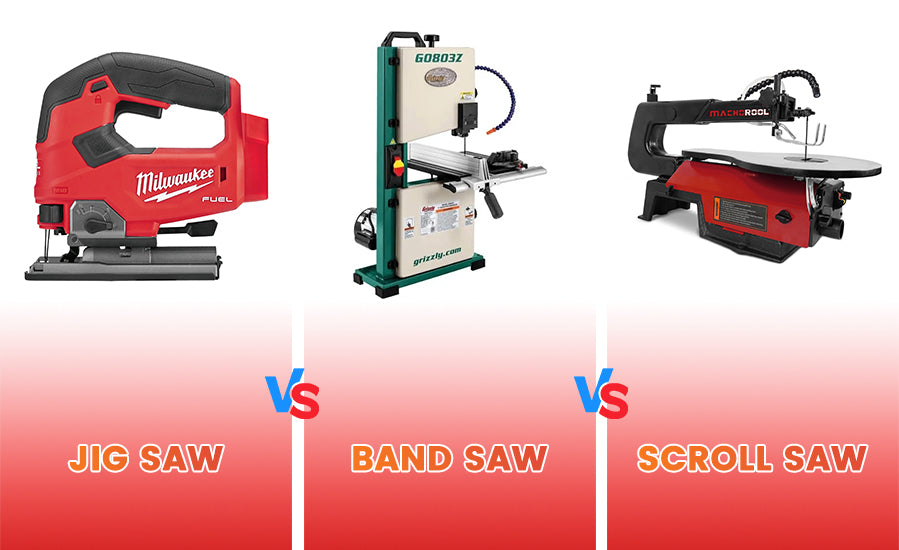
A band saw is a stationary power tool used mainly in woodworking, metalworking, and sometimes even in meat processing. It uses a continuous looped blade stretched around two or more wheels. As the wheels spin, the blade moves in one direction, cutting through the workpiece placed on its flat table.
Most band saws are large, heavy, and built for use in a workshop. The blade’s width and the saw’s throat (the distance from the blade to the frame) determine the size and type of cuts you can make. Band saws can handle both thick and thin materials, and they are famous for making smooth, accurate curved cuts.
Key Features Of Band Saws
- Continuous blade: The blade is a metal band with teeth along one edge, moving in one direction.
- Stationary setup: The saw stays in place, and you move the material through the blade.
- Large work table: Provides support for bigger pieces and allows for controlled, steady cuts.
- Adjustable blade guides: Keep the blade steady, reducing vibration and improving accuracy.
- Variable speeds: Some models let you adjust the speed for cutting wood, metal, or plastic.
Typical Uses
- Cutting thick wood or lumber into thinner pieces (resawing)
- Making smooth, consistent curved cuts
- Cutting irregular shapes for furniture or art projects
- Creating tenons, dovetails, and other joinery
- Cutting metal or plastic with the right blade
What Is A Jigsaw?
A jigsaw is a handheld power tool with a straight, narrow blade that moves up and down (reciprocating motion). This design makes it easy to cut curves, patterns, and shapes in wood, metal, plastic, or even tile.
Jigsaws are light, portable, and simple to use. They’re often the first power saw many people buy because you can take them to your workpiece, not the other way around. The blade is easy to swap out for different materials or types of cuts.
Key Features Of Jigsaws
- Reciprocating blade: Moves up and down rapidly, cutting on the upstroke.
- Handheld and lightweight: You guide the tool along your marked line.
- Bevel adjustment: Many jigsaws can tilt to cut at angles (bevel cuts).
- Variable speed: Lets you match the speed to the material.
- Quick blade change: Most modern models use tool-free blade changing systems.
Typical Uses
- Cutting intricate curves and shapes in thin materials
- Making inside cuts (starting from a drilled hole)
- Cutting out sink openings in countertops
- Trimming laminate, plywood, or plastic
- Making quick, rough cuts where high precision isn’t needed
Band Saw Vs Jigsaw: Core Differences
Understanding the main differences between a band saw and a jigsaw is key to picking the right tool. Here’s a direct comparison:
| Feature | Band Saw | Jigsaw |
|---|---|---|
| Blade Movement | Continuous loop, downward motion | Up-and-down (reciprocating) |
| Portability | Stationary, heavy | Handheld, portable |
| Cutting Capacity | Thick materials, large pieces | Thin materials, smaller pieces |
| Precision | Very high for straight and curved cuts | Moderate, best for rough or curved cuts |
| Types of Cuts | Straight, curved, resawing, joinery | Curved, intricate, plunge cuts |
| Cost | Higher (from $250 to $2000+) | Lower (from $40 to $200+) |
| Learning Curve | Moderate, requires setup | Easy, beginner-friendly |
| Noise & Vibration | Generally quieter, less vibration | Louder, more vibration |
A band saw is best for heavy-duty, accurate work on larger pieces. A jigsaw is more flexible, perfect for smaller projects and working in tight spaces.
Pros And Cons Of Band Saws
Every tool has strengths and weaknesses. Let’s look at what makes the band saw shine—and where it might let you down.
Advantages
- Smooth, accurate cuts: The steady motion of the blade and sturdy table make it easy to cut precise shapes and curves.
- Handles thick materials: Band saws can cut through thick wood, metal, or plastic without bogging down.
- Safer for long cuts: The stationary setup means your hands stay clear of the blade’s path.
- Resawing ability: You can slice boards into thinner pieces, something almost impossible with a jigsaw.
- Consistent results: Less blade wandering compared to handheld saws.
Disadvantages
- Bulky and heavy: You can’t move a band saw to your project; the project must come to the saw.
- Expensive: Good-quality band saws cost more than most jigsaws.
- Setup needed: Adjusting blade tension, guides, and table takes time.
- Limited inside cuts: You can’t start a cut in the middle of a workpiece unless you pre-drill a hole and thread the blade (which is time-consuming).
- Maintenance: Band saws need regular care—blade changes, wheel alignment, cleaning.

Pros And Cons Of Jigsaws
Jigsaws are incredibly popular for DIY and light professional work. But they’re not perfect for every job.
Advantages
- Portable and lightweight: Carry it anywhere—no need for a dedicated workshop.
- Cuts inside shapes easily: Start from a drilled hole to cut out windows, circles, or letters.
- Versatile: Use different blades for wood, metal, plastic, tile, or even carpet.
- Great for curves: The narrow blade lets you follow tight curves and complex patterns.
- Low cost: Entry-level models are affordable for beginners.
Disadvantages
- Less precise: Handheld use means more chance of blade wandering or uneven cuts.
- Can’t handle thick stock: Struggles with thick or very hard materials.
- Rougher finish: Cuts may need extra sanding or cleanup.
- Blade deflection: Blades can bend during tight curves, making cuts less accurate.
- Shorter blades: Limits the depth of material you can cut.
When To Use A Band Saw
Knowing when to reach for the band saw helps you get the best results with less effort. Here are situations where a band saw is the clear winner:
- Resawing thick lumber: If you need to turn a 2×8 into two 1×8 boards, only a band saw can do it cleanly.
- Cutting large, smooth curves: Making a round tabletop or curved chair parts is easier and more accurate.
- Bulk work: When you have many repeated cuts, the stability and power of a band saw save time.
- Joinery: Cutting tenons, dovetails, or lap joints is much simpler and more precise.
- Cutting metal: With the right blade and speed, a band saw can slice through pipes, rods, or metal sheets with minimal sparks.
Real-world Example
A furniture maker needs to cut dozens of identical chair legs with a gentle curve. Using a band saw and a template, each leg comes out nearly identical. Doing this with a jigsaw would be slower, harder, and less accurate.
When To Use A Jigsaw
The jigsaw shines in situations where flexibility and portability matter most. Reach for a jigsaw when:
- Cutting inside shapes: Need to cut a hole in the middle of a countertop for a sink? Drill a starter hole and insert the jigsaw blade.
- Working on-site: If you’re installing flooring or paneling in a room, bring the jigsaw to the job.
- Curved or irregular cuts in thin materials: Making puzzles, signs, or decorative panels is quick and easy.
- Quick jobs: For fast, rough cuts where perfection isn’t critical, a jigsaw is much faster to set up.
- Cutting a variety of materials: With the right blade, cut metal, plastic, laminate, even tile.
Real-world Example
A kitchen installer needs to cut a curved opening for a new sink. Carrying a heavy band saw into the kitchen isn’t realistic, but a jigsaw does the job quickly and neatly.
Blade Types And Selection
The blade you use is just as important as the saw itself. Let’s break down the main blade differences for both tools.
Band Saw Blades
Band saw blades come in different widths, tooth counts (TPI), and materials:
- Wide blades (1/2” or more): Great for straight cuts and resawing.
- Narrow blades (1/8”–1/4”): Better for tight curves.
- High TPI (teeth per inch): Smoother cuts, best for thin or hard materials.
- Low TPI: Faster, rougher cuts, best for thick wood.
- Bimetal or carbide-tipped: Last longer and cut harder materials.
Jigsaw Blades
Jigsaw blades are shorter, thinner, and made for quick changes:
- U-shank or T-shank: Make sure your blade fits your jigsaw.
- Metal-cutting blades: Finer teeth, slower speed.
- Wood-cutting blades: Larger teeth, faster cutting.
- Reverse-tooth blades: For clean cuts on laminates (teeth point down).
- Specialty blades: For tile, plastic, or scrolling.
Insight: Many beginners use the wrong blade for the material, leading to poor results. Always match the blade to both the material and the type of cut you want.
Safety Considerations
Both band saws and jigsaws are safer than circular saws or table saws, but accidents still happen. Here’s how to stay safe:
Band Saw Safety Tips
- Keep hands away: Use push sticks or blocks for small pieces.
- Wear safety glasses: Protect your eyes from flying debris.
- Adjust blade guides: Keep them close to the workpiece to prevent twisting.
- Check blade tension: Loose blades can wander or break.
- Avoid loose clothing: It can get caught in the blade or wheels.
Jigsaw Safety Tips
- Secure the workpiece: Clamp it to prevent movement.
- Start slow: Let the blade reach speed before touching the material.
- Keep fingers clear: The blade moves fast and can jump unexpectedly.
- Unplug before changing blades: Always disconnect power to avoid accidents.
- Wear hearing protection: Jigsaws can be surprisingly loud.
Non-obvious insight: Dust from either saw can be hazardous, especially when cutting treated wood or metal. Use a dust mask or connect a vacuum if possible.
Price And Value Comparison
Cost is a big factor, especially for beginners or hobbyists. Let’s look at what you can expect to pay—and what you get for your money.
| Tool | Entry-Level Price | Mid-Range Price | Pro-Level Price | Typical Lifespan |
|---|---|---|---|---|
| Band Saw | $250–$400 | $600–$1000 | $1500–$3000+ | 10–20 years |
| Jigsaw | $40–$70 | $80–$150 | $180–$300 | 5–10 years |
Band saws are a bigger investment but last longer and handle tougher jobs. Jigsaws are affordable, easy to replace, and perfect for casual use.
Accuracy And Quality Of Cut
One of the biggest differences between a band saw and a jigsaw is the quality of the cut.
- Band saws: Known for straight, smooth, splinter-free cuts. The blade stays stable, so you get repeatable results even on long or thick pieces.
- Jigsaws: Cuts can be rougher, especially on curves or thicker materials. Blade flex is a common problem, leading to angled or uneven edges.
Pro tip: If you need perfectly matching pieces, a band saw is the better choice. For simple shapes or where you’ll sand the edge anyway, a jigsaw is fine.
Ease Of Use And Learning Curve
Beginners often wonder which tool is easier to master. Here’s what you need to know:
- Jigsaws: Very beginner-friendly. Just plug in, insert a blade, and follow your line. Mistakes are usually minor.
- Band saws: Require more setup (tensioning, tracking, guide adjustment). There’s a learning curve, but the payoff is better results on complex projects.
Non-obvious insight: Many new users ignore blade alignment and tracking on band saws, leading to poor cuts and rapid blade wear. Always check these before starting.

Maintenance And Care
Taking care of your saw keeps it running longer and safer. Here’s what’s involved:
Band Saw Maintenance
- Blade changes: Swap out when dull or damaged.
- Wheel cleaning: Sawdust and resin build up over time.
- Guide adjustment: Keeps cuts straight and prevents blade drift.
- Lubrication: Moving parts need oil or grease as recommended.
Jigsaw Maintenance
- Blade replacement: Blades wear out quickly, especially on hard materials.
- Dust removal: Blow or vacuum out dust from vents and motor.
- Cord inspection: Check for fraying or damage.
Both tools benefit from regular cleaning and inspection. Don’t ignore odd noises or vibrations—these often signal a problem.
Common Mistakes Beginners Make
Both tools are easy to use, but certain mistakes can ruin your project or even cause accidents.
Band Saw Mistakes
- Wrong blade for the job: Using a wide blade for tight curves or a fine blade for thick wood leads to poor results.
- Ignoring blade tension: Too loose, and the blade wanders; too tight, and it may break.
- Not using guides: Skipping blade guide adjustment causes rough, inaccurate cuts.
Jigsaw Mistakes
- Forcing the saw: Let the blade do the work. Pushing too hard bends the blade.
- Skipping pilot holes: For inside cuts, always drill a starter hole.
- Not securing the workpiece: Movement leads to jagged cuts or even injuries.
Pro tip: Always make test cuts on scrap material. This helps you check blade choice, speed, and technique before committing to your real project.
Project Examples: Band Saw Vs Jigsaw
To make things clearer, here are real project examples and which tool is best:
- Cutting a guitar body shape: Band saw for clean, repeatable outlines; jigsaw for roughing out or detailed inner cuts.
- Making a wooden puzzle: Jigsaw for intricate inside cuts and curves.
- Resawing a thick walnut board: Only a band saw can do this accurately.
- Installing a sink in a countertop: Jigsaw, for portability and ability to start inside the panel.
- Cutting metal pipe: Band saw (with metal blade) for straight, burr-free cuts; jigsaw for small, thin pipes if portability is needed.
Environmental And Space Considerations
Your workspace often decides which tool makes sense.
- Small or shared spaces: A jigsaw is easy to store in a drawer or toolbox. Band saws need dedicated space.
- Noise: Band saws are generally quieter and produce less vibration, making them better for indoor use.
- Dust collection: Band saws can be connected to shop vacuums. Jigsaws scatter dust unless you attach a vacuum hose.
Which One Should You Buy First?
If you’re building your first workshop or starting woodworking, this is a common question. Here’s how to decide:
- Go with a jigsaw if you:
- Need portability
- Work on small, varied projects
- Have a tight budget
- Don’t have much space
- Are a beginner
- Invest in a band saw if you:
- Work with thick wood or need to resaw
- Make furniture or repeatable parts
- Have a workshop space
- Want the most accurate, smooth cuts
- Plan to do lots of woodworking
Many experienced woodworkers eventually own both. Each tool fills a different role.
Pro tip: Renting a band saw or borrowing a jigsaw before buying helps you decide which fits your style best.
Latest Innovations And Trends
Both band saws and jigsaws have seen advances in recent years:
- Cordless jigsaws: New battery technology means you can cut anywhere, no cord needed.
- Precision blade tracking (band saws): Digital systems help keep blades perfectly aligned.
- Tool-free adjustments: Both tools now feature easier blade changes and angle adjustments.
- Integrated dust control: Better systems to keep your workspace clean and safe.
- Smart saws: Some high-end models feature sensors that detect blade binding or overload.
According to Wood Magazine, user demand for safer, smarter, and more portable saws continues to drive innovation in both categories.
Frequently Asked Questions
What Can A Band Saw Do That A Jigsaw Cannot?
A band saw can resaw thick boards, make extremely smooth curved cuts, and handle bulk work with consistent results. It’s also better for cutting metal and making joinery like tenons or dovetails. A jigsaw cannot reliably cut thick wood or make repeated identical cuts with high precision.
Can I Use A Jigsaw Instead Of A Band Saw?
You can use a jigsaw for many curved cuts or inside shapes, but it won’t match a band saw’s accuracy, smoothness, or ability to handle thick materials. For rough work or small projects, a jigsaw is fine. For professional results or big jobs, a band saw is better.
Which Is Safer For Beginners: Band Saw Or Jigsaw?
Both are generally safe if used correctly. A jigsaw is more beginner-friendly because it’s handheld, lighter, and less intimidating. However, because your hands are closer to the blade, always use caution. Band saws, while stationary, require more setup and awareness of moving parts.
How Do I Choose The Right Blade For Each Saw?
For both tools, match the blade to your material and desired cut. Use wider blades for straight cuts and narrow blades for curves. More teeth per inch (TPI) give smoother cuts, while fewer teeth cut faster but rougher. Always check manufacturer recommendations.
Can I Cut Metal With A Band Saw Or Jigsaw?
Yes, but you need the right blade (fine-tooth, bimetal, or carbide) and the correct speed settings. Band saws are better for thick or hard metals, while jigsaws are suitable for thin sheets or pipes. Always wear eye protection, and check that your saw supports metal cutting.
Making the right choice between a band saw and a jigsaw depends on your projects, workspace, and budget. Both tools are valuable, and each excels in different areas. By understanding their strengths, limitations, and proper use, you’ll work smarter—and enjoy better, safer results in every project.