
When you pick up a multimeter, you probably expect it to give you the right answer every time. But have you ever wondered how close those numbers are to the real value? This is where multimeter accuracy comes in. If you use a multimeter for electronics, car repairs, or home projects, understanding accuracy is not just for engineers—it’s for anyone who needs results they can trust. The truth is, accuracy is often misunderstood or overlooked, and even a small mistake can lead to big problems: wrong repairs, wasted money, or even dangerous situations.
This article will explain multimeter accuracy in simple terms. You’ll learn what accuracy means, how to read accuracy specs, what affects accuracy, and how to choose the right tool for your work. We’ll break down complex concepts, share real examples, and reveal tips that even experienced users sometimes miss. By the end, you’ll be able to look at any multimeter’s accuracy and know exactly what you’re getting—and what you’re not.
What Does Multimeter Accuracy Mean?
Accuracy on a multimeter is how close the reading is to the actual value. For example, if you measure a battery that is exactly 1. 500 volts, but your multimeter shows 1. 520 volts, your reading is off by 0.
020 volts. The smaller the difference, the more accurate your multimeter.
Manufacturers express accuracy as a percentage of the reading plus a number of digits. For instance, you might see “±(0.5%+2)” in the specs. This means the reading could be off by 0.5% plus two counts of the last digit.
Key points to remember:
- Accuracy is not the same as resolution (how small a change you can see on the display).
- It is also different from precision (how repeatable the result is).
- Accuracy tells you the total possible error in your measurement.
How Is Multimeter Accuracy Specified?
Most people check the packaging and see numbers like “0. 8%” or “±(1. 0%+3)”, but what do these actually mean in practice? Let’s break it down.
The Typical Accuracy Format
Manufacturers usually write accuracy in this format:
±(percentage of reading + number of least significant digits)
For example, if your multimeter’s DC voltage accuracy is “±(1.0%+2)”:
- 1.0% is a percentage of the measured value.
- 2 means the last digit on the display can be off by two steps (also called counts).
Example Calculation
Suppose you measure 12.00V on a 20V range. The multimeter shows “12.00”. With “±(1.0%+2)” accuracy:
- 1.0% of 12.00V = 0.12V
- The last digit is the “0.01” place, so “2 counts” = 0.02V
- Total possible error = 0.12V + 0.02V = 0.14V
So, your real voltage could be anywhere from 11. 86V to 12. 14V.
What Is “count”?
A count means the smallest change the display can show. On a “3 1/2 digit” multimeter (1999 counts), the last digit steps from 0 to 9. If accuracy is “±2 counts”, that means the last digit could be off by two steps.
Range Matters
Accuracy specs usually apply only to a specific range. If you use the wrong range, your reading could be less accurate.
Why Multimeter Accuracy Matters
You might ask: does a small error really matter? Sometimes, a little inaccuracy is not a big deal. Other times, it can be critical.
- For electronics: Choosing the wrong resistor because your meter is off by 5% might not matter for a simple LED, but it could ruin a sensitive circuit.
- For batteries: A 0.1V error could mean the difference between “good” and “replace now.”
- For safety checks: In high-voltage work, inaccurate readings can be dangerous.
Non-obvious insight: Cheap multimeters may have poor accuracy not just in the “spec” but also because of poor build quality, drift over time, or poor calibration. In critical work, always use a trusted brand and check the calibration date.
Types Of Multimeter Accuracy
Not all measurements are equal. Multimeters have different accuracy for different functions.
Dc Voltage Accuracy
Usually, the best accuracy. For example, a high-quality meter might have ±(0. 05%+1) for DC voltage.
Ac Voltage Accuracy
Often less accurate than DC voltage, because AC requires extra circuitry. You may see ±(1. 0%+3) or worse.
Resistance Accuracy
Varies by range. At low resistances (ohms), accuracy is often worse due to test lead resistance.
Current Accuracy
Usually lower than voltage accuracy. For small currents, errors can be large compared to the actual value.
Frequency, Capacitance, Temperature
Most general multimeters have basic accuracy for these. If you need very accurate capacitance or temperature, use a specialized meter.
Accuracy Classes: What They Mean
Some multimeters (especially analog) are labeled with an accuracy class, such as Class 1, Class 2, or “Cat II”. This is not the same as the “±(0.5%+2)” spec, but tells you the general quality and safety of the instrument.
- Class 1: Highest accuracy (rare in handheld meters)
- Class 2: General use
- Class 3 or 4: Basic or hobby use
Non-obvious insight: Some cheap meters claim “Class 2” but do not meet any recognized standard. Always check for real certifications (like IEC).
How Display Digits Affect Accuracy
You might see “3 1/2 digit” or “4000 counts” on a multimeter spec sheet. This is not the same as accuracy, but it does affect how small a change you can see and how the “+X digits” part affects your reading.
What Is A “digit”?
- A “3 1/2 digit” display can show from 0 to 1999 (the “half” digit can only be 0 or 1).
- “4000 count” meters can show up to 3999.
- “6000 count” meters can show 0–5999, and so on.
Why Does It Matter?
Suppose your meter is “±(1.0%+2)”:
- On a 2000-count meter, each count is bigger, so “+2 counts” is a bigger error.
- On a 6000-count meter, each count is smaller, so “+2 counts” is a smaller error.
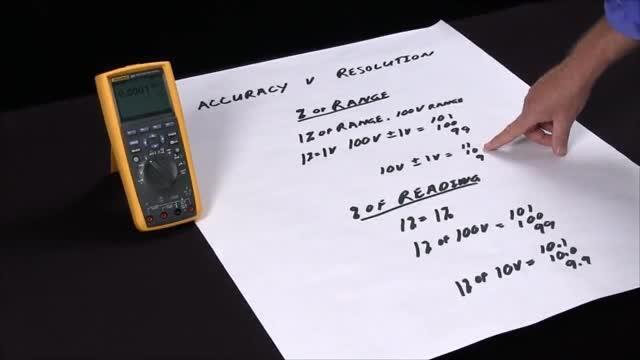
Table: Accuracy Spec Vs. Display Count
Below is a comparison of two meters with the same percentage accuracy but different counts.
| Meter Model | Display Count | Accuracy Spec | Possible Error for 12.00V |
|---|---|---|---|
| Basic Meter | 2000 | ±(1.0%+2) | 0.14V |
| Advanced Meter | 6000 | ±(1.0%+2) | 0.12V |
As you can see, a higher count means a smaller possible error from the “digit” part.
Factors That Affect Multimeter Accuracy
Accuracy is not just about specs. Several real-world factors can change your results.
Temperature
Most accuracy specs are valid only at a certain temperature (usually 18–28°C). If you use your meter in a cold garage or a hot attic, your readings can drift.
Battery Level
A low battery can cause some meters to give wrong readings. Some models show a “low battery” sign, but not all do.
Lead Resistance
When measuring low resistances, the resistance of your test leads can add to the reading. Good meters let you “zero” this out, but cheap ones do not.
Ac Frequency Response
Not all meters are accurate at all AC frequencies. Some meters are only accurate for 50–60 Hz (household power). Measuring higher or lower frequencies can result in large errors.
Input Impedance
A meter with low input impedance (like some cheap analog meters) can change the circuit you are measuring, making the reading less accurate. Good digital multimeters have input impedance of 10 MΩ or more.
Calibration
Even the best meter drifts over time. Calibration means checking and adjusting the meter against a known reference. For important work, your meter should be calibrated every year.

Practical Examples: How Accuracy Affects Real Measurements
Let’s look at some real-life situations to see how multimeter accuracy matters.
Measuring A 9v Battery
Suppose you test a 9V battery and your multimeter reads 8. 90V. The accuracy is “±(1. 0%+2)” and the display shows to two decimal places.
- 1.0% of 8.90V = 0.089V
- 2 counts = 0.02V
- Possible error: 0.089V + 0.02V = 0.109V
So, the real voltage could be between 8. 791V and 9. 009V. If your battery is supposed to be “good” above 8. 5V, you’re safe, but if you’re close to the cut-off, this uncertainty could matter.
Checking A 100ω Resistor
Meter accuracy: “±(1.0%+2)”, reading to the nearest 0.1Ω.
- 1.0% of 100Ω = 1Ω
- 2 counts = 0.2Ω
- Total possible error = 1.2Ω
So, the real value could be from 98. 8Ω to 101. 2Ω.
Troubleshooting A Car Alternator (14.0v Expected)
If your meter reads 13.8V, with “±(0.8%+2)” accuracy:
- 0.8% of 13.8V = 0.110V
- 2 counts = 0.02V
- Total possible error = 0.13V
Your real voltage could be between 13. 67V and 13. 93V. If the alternator is supposed to keep voltage above 13. 6V, you’re just barely in the safe zone.
Table: Typical Accuracy For Different Meter Types
Let’s compare typical accuracy levels for different categories of meters.
| Type | DC Voltage Accuracy | AC Voltage Accuracy | Resistance Accuracy | Price Range (USD) |
|---|---|---|---|---|
| Cheap Analog | ±(2.0%+5) | ±(3.0%+10) | ±(2.0%+5) | $10–$25 |
| Basic Digital | ±(1.0%+2) | ±(2.0%+5) | ±(1.5%+2) | $15–$40 |
| Advanced Handheld | ±(0.5%+1) | ±(1.0%+2) | ±(1.0%+2) | $40–$150 |
| Laboratory Bench | ±(0.02%+1) | ±(0.2%+1) | ±(0.1%+1) | $200+ |
Choosing A Multimeter: How Much Accuracy Do You Need?
Not everyone needs a lab-grade meter. Here’s how to decide what accuracy is “good enough” for your work.
For Hobby Electronics
A basic digital meter with ±(1.0%+2) accuracy is fine for most tasks: testing batteries, checking components, finding broken wires.
For Automotive Work
Look for better DC voltage accuracy, ±(0. 8%+2) or better. This helps you diagnose charging systems, sensors, and wiring.
For Electricians
Accuracy is less important than safety (look for CAT ratings), but ±(1. 0%+2) or better is a good target.
For Precision Electronics
If you design or repair high-accuracy circuits, look for meters with ±(0. 1%+1) or better, and consider calibration certificates.
For Industrial Or Lab Use
Bench meters with ±(0. 02%+1) accuracy are worth the cost if you need extremely reliable data.
Non-obvious insight: Accuracy costs money. There’s no point in paying extra for high accuracy if your application does not need it.
Common Mistakes When Reading Multimeter Accuracy
Many users, even experienced ones, get tripped up by accuracy specs. Here are mistakes to avoid:
- Ignoring the “digits” part: The “+2” or “+5” is just as important as the percentage.
- Using the wrong range: Read the manual—accuracy often drops on the highest range.
- Not considering temperature: Specs are only valid in a certain temperature range.
- Assuming all functions have the same accuracy: AC voltage, resistance, and current usually have different specs.
- Relying on old calibration: Even the best meter drifts over time.
How To Test And Improve Your Multimeter’s Accuracy
You can’t always trust a meter out of the box. Here’s how to check and improve accuracy.
Use A Reference Source
A “calibration source” is a device that outputs a known voltage or resistance. You can buy commercial references or use high-quality batteries (like a new 1. 500V alkaline cell) for a quick check.
Compare With A Trusted Meter
If you have access to a calibrated bench meter (in a lab or repair shop), compare your readings. If yours is off by more than the spec, it may need calibration or repair.
Zero The Leads
For low-resistance measurements, touch your leads together and note the reading. Subtract this value from your measurement, or use the “REL” (relative) mode if your meter has it.
Keep It Calibrated
If you use your meter for important work, have it calibrated by a professional every 12–24 months.
Table: How Different Factors Affect Accuracy
Here’s a summary of how common factors impact your results.
| Factor | Effect on Accuracy | How to Minimize Error |
|---|---|---|
| Temperature | Drift outside 18–28°C | Measure at room temperature |
| Battery Level | May cause wrong readings | Replace battery regularly |
| Lead Resistance | Adds error to low-ohm readings | Zero leads before use |
| Wrong Range | Lower accuracy at extremes | Use correct range |
| Calibration | Drifts over time | Calibrate every 1–2 years |
Advanced Accuracy Topics
For those who want to go deeper, here are some advanced points.
True Rms Vs. Average-responding
For AC measurements, true RMS meters are more accurate for non-sinusoidal signals (like those from variable speed drives or inverters). Average-responding meters are only accurate for pure sine waves.
Crest Factor
Some meters specify accuracy only up to a certain crest factor (the ratio of peak to RMS value). If you measure distorted waveforms, accuracy can drop.
Burden Voltage (current Measurements)
When you measure current, the meter adds a small resistance (burden voltage). On small currents, this can affect the circuit and give less accurate results.
Long-term Stability
High-end meters specify stability over time. Cheap meters can drift a lot, so accuracy gets worse as the meter ages.
How To Read And Understand A Multimeter’s Datasheet
Datasheets are full of numbers and terms. Here’s how to find what matters.
- Look for DC voltage accuracy: This is usually the best.
- Check other functions: AC voltage, resistance, current, etc.
- Find the temperature range: Is the accuracy valid for your work environment?
- Check the calibration interval: How often does the maker recommend calibration?
- Review special notes: Some specs only apply to certain ranges or settings.
Tip: If the datasheet is unclear, look for a better brand. Trustworthy makers like Fluke, Keysight, or Brymen provide full, clear specs.
For more detailed explanations, you can check the Wikipedia multimeter article.

Frequently Asked Questions
What Is The Difference Between Accuracy And Precision On A Multimeter?
Accuracy is how close the reading is to the real value. Precision is how repeatable your results are—if you measure the same thing many times, do you get the same answer each time? A multimeter can be very precise (repeatable) but not accurate (always off by a bit), or vice versa.
How Often Should I Calibrate My Multimeter?
Most manufacturers recommend calibration every 12–24 months if you use your meter for important or professional work. For home use, every 2–3 years is usually enough, unless you notice big changes or use it in harsh conditions.
Does A Higher Number Of Display Counts Mean Better Accuracy?
Not always. Display counts show how many steps the meter can show (like 2000, 4000, or 6000), which affects resolution. But real accuracy also depends on the percentage and digit specs. A high-count meter with poor accuracy is not better than a lower-count meter with better specs.
Why Do Different Measurement Types (voltage, Current, Resistance) Have Different Accuracy On The Same Meter?
Each function uses different internal circuits. Measuring current is usually less accurate because it involves more sources of error (like burden voltage). Resistance measurements are affected by lead resistance and contact quality. Voltage is usually the most accurate.
Can I Improve The Accuracy Of A Cheap Multimeter?
You can reduce errors by using the correct range, measuring at room temperature, zeroing the leads, and replacing the battery often. But the basic accuracy is set by the meter’s design. For very accurate work, you need a better meter.
Final Thoughts
Understanding multimeter accuracy helps you trust your measurements and make better decisions. Whether you’re a hobbyist, an electrician, or a lab tech, you now know how to read accuracy specs, what affects your results, and how to choose the right tool. Remember, no meter is perfect, but with the right knowledge, you can avoid mistakes and work with confidence. Always check your specs, use the right techniques, and when accuracy really matters, don’t cut corners—invest in a tool you can trust.