
The Toyota Sienna is a popular minivan, appreciated for its comfort, reliability, and family-friendly features. But to keep any Sienna running smoothly for years, one maintenance task stands out: regular oil changes, using the correct oil and the right amount. Many Sienna owners, especially first-timers, ask: “What is the oil capacity for my Sienna?” This question seems simple, but the answer depends on the model year, engine type, and a few practical factors. Understanding oil capacity is not just about filling up; it’s about protecting your engine, avoiding costly mistakes, and making your vehicle last longer.
This article explores every aspect of Toyota Sienna oil capacity. Whether you own an older model or the latest hybrid, you’ll find clear, practical information. We’ll cover oil capacity by model year and engine, explain why correct oil volume matters, show you how to check and change oil, and point out common mistakes. You’ll also find tables for quick reference and answers to the most frequent questions Sienna owners have. If you want your Sienna to stay reliable, start here.
Why Oil Capacity Matters For Your Toyota Sienna
Engine oil does more than lubricate. It cools, cleans, and protects the engine’s moving parts. Using too little oil can cause overheating and severe engine damage. Overfilling can create pressure problems, leaks, and even harm engine seals. The correct oil capacity helps your Sienna perform at its best, keeps emissions in check, and extends the engine’s life.
Many Sienna owners overlook small differences in oil capacity between model years or engines. For example, the 3. 5L V6 may require a different amount than the 2. 5L Hybrid. Even a half-quart mistake can make a difference in the long run.
If you use the wrong amount, you risk voiding your warranty or facing unnecessary repairs.
Another detail often missed is the effect of improper oil levels during extreme weather. Low oil level in very hot or cold conditions puts extra stress on the engine, because oil not only lubricates but also helps regulate temperature. When the oil level drops below the minimum mark, the engine’s upper parts may not get enough lubrication, leading to increased wear, friction, and eventually, engine failure.
On the other hand, too much oil can cause the crankshaft to whip the oil into foam. Foamy oil does not lubricate well, and air bubbles reduce its ability to create a protective film. In modern engines like those found in recent Sienna models, oil overfill can also trigger engine warning lights or throw error codes, which may require a costly diagnostic visit to clear.
Toyota Sienna Oil Capacity By Model Year And Engine
Every Sienna model has a specific oil capacity. These differences depend on the engine type, whether you’re changing just the oil or also the filter, and sometimes the drive configuration (FWD or AWD). Here’s a detailed breakdown for all generations.
1st Generation (1998–2003)
- Engine: 3.0L V6 (1MZ-FE)
- Oil Capacity (with filter): 5.0 quarts (4.7 liters)
- Oil Capacity (without filter): 4.5 quarts (4.3 liters)
On these older models, a slight overfill is less likely to cause electronic problems, but it can still lead to leaks and smoke. When draining oil from the 1MZ-FE engine, allow extra time for all oil to drain out, as sludge buildup can be common if maintenance was neglected.
2nd Generation (2004–2010)
- Engines: 3.3L V6 (3MZ-FE), 3.5L V6 (2GR-FE)
- 3.3L V6: 5.0 quarts (4.7 liters) with filter
- 3.5L V6: 6.4 quarts (6.1 liters) with filter
The 2GR-FE engine introduced in 2007 has a larger oil sump. This is important if you’re switching between years or replacing an engine—be sure to check which engine is in your Sienna.
3rd Generation (2011–2020)
- Engine: 3.5L V6 (2GR-FE, 2GR-FKS)
- Oil Capacity (with filter): 6.4 quarts (6.1 liters)
- Oil Capacity (without filter): 6.1 quarts (5.8 liters)
This generation’s V6 uses more oil than earlier models, partly due to improved cooling and tighter emission standards. If you’re used to older Siennas, don’t underfill by accident—always measure carefully.
4th Generation (2021–present)
- Engine: 2.5L 4-Cylinder Hybrid (A25A-FXS)
- Oil Capacity (with filter): 4.8 quarts (4.5 liters)
- Oil Capacity (without filter): 4.5 quarts (4.2 liters)
Hybrid engines use less oil, but because they cycle on and off more frequently, oil quality and level are just as important. Some owners notice the dipstick is harder to read when the oil is brand new and clear—shine a flashlight on the stick to see the oil line more easily.
Quick Reference Table: Toyota Sienna Oil Capacity By Generation
| Generation | Model Years | Engine | Oil Capacity (With Filter) | Oil Capacity (Without Filter) |
|---|---|---|---|---|
| 1st | 1998–2003 | 3.0L V6 | 5.0 qts (4.7L) | 4.5 qts (4.3L) |
| 2nd | 2004–2010 | 3.3L V6 | 5.0 qts (4.7L) | 4.5 qts (4.3L) |
| 2nd | 2007–2010 | 3.5L V6 | 6.4 qts (6.1L) | 6.1 qts (5.8L) |
| 3rd | 2011–2020 | 3.5L V6 | 6.4 qts (6.1L) | 6.1 qts (5.8L) |
| 4th | 2021–Present | 2.5L Hybrid | 4.8 qts (4.5L) | 4.5 qts (4.2L) |
Special Cases: Awd Vs. Fwd
Most Sienna oil capacities are the same for all-wheel drive (AWD) and front-wheel drive (FWD) models within the same engine type and generation. However, always check your owner’s manual, as rare exceptions exist in some markets.
In certain regions, especially where climate conditions are extreme, Toyota may recommend a slightly different oil fill for AWD models to help with cold starts or additional drivetrain stress. If you drive in very cold areas or on steep terrain, consult your Toyota dealer for any special instructions.
Oil Filter Change Matters
The oil filter holds a small amount of oil. If you change the oil but not the filter, you’ll need slightly less oil. Always check if your oil change includes a new filter. Skipping this step leads to dirty oil circulating, which can harm your engine over time.
It’s also worth noting that some aftermarket oil filters have a different internal volume than Toyota’s OEM part. If you use a much larger or smaller filter, you may need to adjust your fill slightly—although for most quality brands, the difference is less than 0.
1 quart.
Choosing The Right Oil For Your Toyota Sienna
Oil capacity is only half the story. The type of oil matters just as much. Using the wrong viscosity or quality can reduce performance and damage the engine.
Recommended Oil Types By Generation
- 1st and 2nd Generation (1998–2010): Toyota recommends 5W-30 for most of these models.
- 3rd Generation (2011–2020): Most use 0W-20 synthetic oil, especially after 2017. Earlier years sometimes specify 5W-30.
- 4th Generation (2021–Present, Hybrid): Only 0W-16 or 0W-20 full synthetic oil is recommended.
Comparison Table: Oil Viscosity By Model
| Generation | Year Range | Recommended Oil | Notes |
|---|---|---|---|
| 1st/2nd | 1998–2010 | 5W-30 | Conventional or synthetic |
| 3rd | 2011–2016 | 0W-20 | Full synthetic preferred |
| 3rd | 2017–2020 | 0W-20 | Full synthetic required |
| 4th | 2021–Present | 0W-16 or 0W-20 | Hybrid engines only; use Toyota-approved oil |
Synthetic Vs. Conventional Oil
- Synthetic oil offers better engine protection, especially during extreme temperatures or long drives.
- Most Siennas after 2011 require full synthetic oil.
- If you use conventional oil in a model that requires synthetic, you risk poor lubrication and engine wear.
One detail to remember: synthetic oil also flows better at cold temperatures, which means your Sienna’s engine gets protection faster during winter starts. For families who live in snowy climates or make frequent short trips, this benefit is significant because cold starts are when most engine wear happens.
Oil Quality Standards
Always use oil that meets API (American Petroleum Institute) or ILSAC (International Lubricant Standardization and Approval Committee) standards. Toyota’s own brand is safe, but other high-quality brands are fine if they meet the specs.
Look for the “starburst” or “donut” symbol on the oil bottle, showing it meets current standards. This isn’t just marketing—using oil without these certifications can void your warranty if you have engine trouble.
How To Check And Top Up Oil In A Toyota Sienna
Knowing your oil capacity is important, but checking your oil level regularly is even more critical. Here’s a simple guide:
- Park on Level Ground: Wait 5–10 minutes after turning off the engine to let oil settle.
- Find the Dipstick: Usually a yellow or orange handle near the front of the engine.
- Pull and Wipe: Remove the dipstick, wipe it clean, reinsert fully, then pull it out again.
- Read the Level: Oil should be between the min and max marks. If it’s low, add oil slowly—never overfill.
- Check Oil Color: Fresh oil is amber. If it’s black, gritty, or smells burnt, it’s time to change it.
Example: Topping Up Correctly
If your 2022 Sienna (4. 8 qt capacity) shows halfway between min and max, add about 1 quart, then recheck. Never guess—always add small amounts and check again.
Another tip: on new Siennas, the dipstick can be hard to read if oil is very clean. Hold the dipstick sideways under bright light or place it against a white paper towel to see the oil level line more clearly.
If you need to top up often (more than once between changes), this may signal leaks, gasket wear, or even internal engine issues. Don’t ignore regular top-ups—have your mechanic check for slow leaks around the valve covers, oil pan, or timing cover.
How To Change Oil In A Toyota Sienna
Many Sienna owners prefer to do oil changes at home. Here’s a step-by-step approach. The process is similar for all generations, but always consult your specific owner’s manual.
What You Need
- Correct amount of oil (see tables above)
- New oil filter
- Oil drain pan
- Socket wrench and oil filter wrench
- Funnel
- Gloves, rags, and jack stands (if needed)
Don’t forget to have a new drain plug washer (crush washer) on hand. Reusing the old washer can cause leaks. Toyota recommends replacing this small part each time.
Step-by-step Oil Change
- Warm Up Engine: Let the engine run for 2–3 minutes, then turn it off.
- Raise Vehicle: Use jack stands if needed for access.
- Remove Drain Plug: Place the oil pan underneath, remove the plug, and let oil drain completely.
- Replace Oil Filter: Unscrew old filter, lubricate new filter’s gasket with fresh oil, and install.
- Reinstall Plug: Tighten to the recommended torque (check your manual).
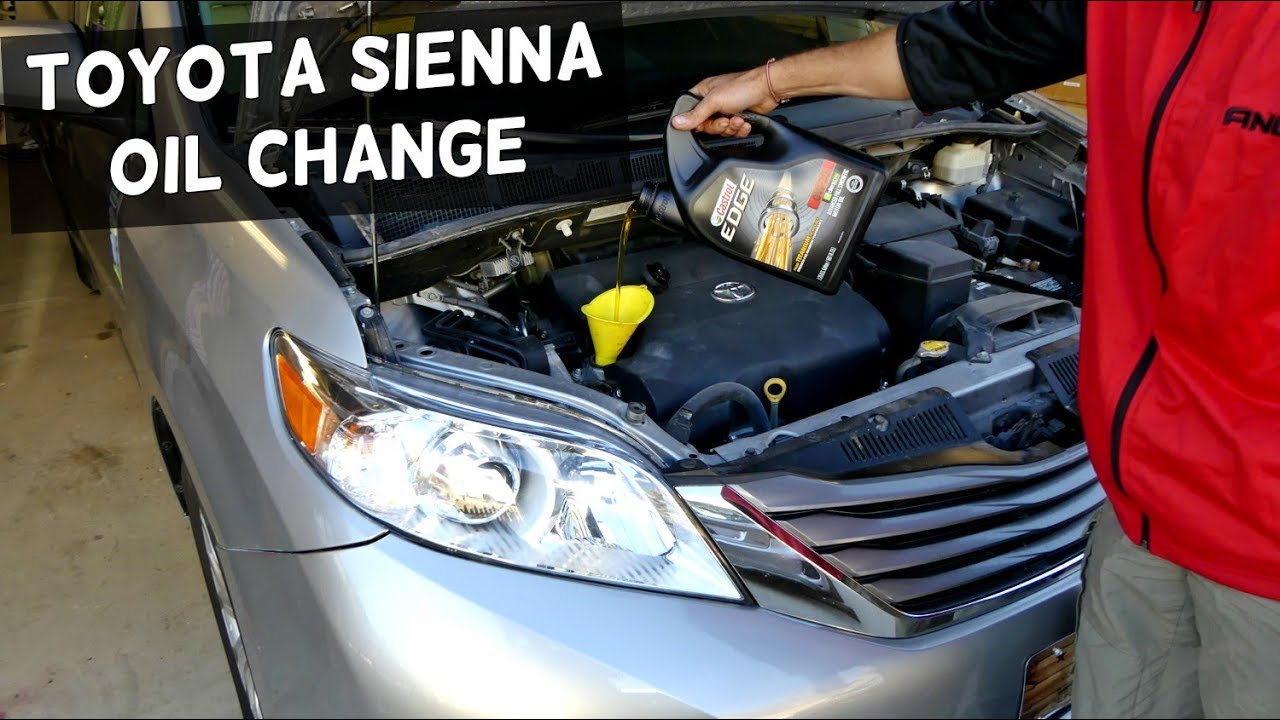
- Add New Oil: Use a funnel, pour in the correct amount. Replace the cap.
- Check for Leaks: Start the engine, run for a minute, check for leaks.
- Recheck Level: Wait a few minutes, check the dipstick, and top up if needed.
Practical Tips
- Always recycle old oil properly—most auto shops accept used oil.
- Write down the mileage and date for future reference.
- Don’t rely on the dashboard oil light alone; check manually.
Another tip: Before removing the oil filter, wrap it with a plastic bag to catch drips. This helps keep your driveway clean. And when tightening the new oil filter, hand-tighten only—over-tightening can damage the filter seal or make removal difficult next time.
Estimated Time And Cost
- Time required: 30–60 minutes
- DIY cost: $40–$70 (oil and filter)
- Shop cost: $60–$120 (varies by location and oil type)
If you live in a cold area, allow the car to cool only slightly before starting—the oil drains more thoroughly when still warm. But avoid working on a hot engine to prevent burns.
How Often Should You Change Sienna’s Oil?
The oil change interval depends on your model year, oil type, and driving habits.
- Older Siennas (conventional oil): Every 5,000 miles or 6 months.
- Newer Siennas (synthetic oil): Every 10,000 miles or 12 months.
- Severe conditions (frequent short trips, towing, hot climates): Change oil every 5,000 miles, even if using synthetic.
Always check the maintenance schedule in your owner’s manual. Hybrid Siennas may display reminders on the dashboard.
Two Insights Most Owners Miss
- Oil burns slowly over time, even without leaks. Always check your oil at least once a month, not just at change intervals.
- The oil filter’s quality matters. Cheap filters may clog early, reducing oil flow and harming your engine, no matter how good your oil is.
A third insight: If you drive mostly short trips, your Sienna’s engine may not get hot enough to evaporate moisture in the oil, leading to sludge. In this case, change oil more often, even if you haven’t reached the mileage limit.
Common Mistakes Sienna Owners Make With Oil
Even experienced car owners sometimes make errors. Here are the most frequent mistakes to avoid:
- Overfilling the engine. More is not better—overfilled oil can foam, losing lubrication and causing damage.
- Using the wrong viscosity. “Close enough” is not safe. 5W-30 and 0W-20 are not interchangeable for newer engines.
- Ignoring the filter. Skipping filter changes leaves dirty oil in the system.
- Not resetting the maintenance light. After an oil change, follow the manual to reset the dashboard indicator.
- Delaying oil changes. Waiting too long, especially in tough conditions, risks engine sludge and major repairs.
Another common mistake is forgetting to tighten the oil drain plug or filter, resulting in leaks. After your oil change, always double-check that both are secure and that you’ve replaced the oil cap—leaving it off can spray oil inside the engine bay and cause a huge mess.
Signs Of Oil Issues In Your Sienna
Catch problems early by watching for these symptoms:
- Oil pressure warning light comes on—stop and check immediately.
- Knocking or ticking noises from the engine—often a sign of low oil or poor lubrication.
- Excessive exhaust smoke—could mean oil is leaking into the combustion chamber.
- Burning oil smell inside or outside the car.
Address any of these signs quickly to avoid bigger (and more expensive) engine problems.
Also, if you see oil spots where you park, inspect the oil pan gasket and drain plug. Small leaks can quickly become big problems if ignored.
Sienna Oil Capacity And Warranty
Following Toyota’s recommended oil capacity and change intervals is essential to keep your warranty valid. If you use the wrong oil or skip changes, you may lose coverage for engine repairs. Always keep receipts for oil and filter purchases, or service invoices if you go to a shop.
For hybrid Siennas, Toyota may require proof that you used the correct grade of oil at the right interval before honoring warranty claims. If you change your own oil, keep a logbook with dates, mileage, oil brand, type, and receipts.
Sienna Oil Capacity Vs. Other Minivans
How Does The Sienna Compare To Its Main Rivals?
| Minivan Model | Engine | Oil Capacity (With Filter) |
|---|---|---|
| Toyota Sienna (2021–Present) | 2.5L Hybrid | 4.8 qts (4.5L) |
| Honda Odyssey (2021–Present) | 3.5L V6 | 5.7 qts (5.4L) |
| Chrysler Pacifica (2021–Present) | 3.6L V6 | 5.9 qts (5.6L) |
| Kia Carnival (2022–Present) | 3.5L V6 | 6.0 qts (5.7L) |
As you can see, the Sienna’s hybrid engine uses less oil than most V6 minivans. This means lower oil costs and less waste per oil change.
The Sienna’s lower oil capacity is partly due to its hybrid system, which relies on the electric motor at low speeds. This reduces engine run time, so less oil is needed for cooling and lubrication between changes. However, don’t let the smaller oil volume fool you—hybrids still need regular maintenance, as their engines can run at higher RPMs during hard acceleration.
Practical Tips For Sienna Owners
- Record each oil change in your logbook or app. This builds a good service history.
- Check for service bulletins. Sometimes Toyota issues updates on recommended oil or capacity—especially for newer hybrids.
- Bring extra oil on road trips. Especially for older Siennas, keeping a quart in the trunk can prevent trouble far from home.
- Use a funnel when adding oil—this avoids spills and mess.
- Let the engine cool before draining oil to avoid burns.
Here’s another useful tip: when parking your Sienna for long periods (like at an airport or during winter storage), check the oil before and after. Sometimes, long sits can lead to minor leaks or slow gasket shrinkage, so a quick check gives peace of mind.
If you’re not sure about the last oil change—like if you just bought a used Sienna—change the oil right away and start fresh with a new filter and your own maintenance log.
The Bottom Line
Caring for your Toyota Sienna means more than just filling up with gas and driving. Paying attention to oil capacity and using the right oil protects your engine, saves money, and keeps your family safe on the road. Whether you drive an older V6 or the newest hybrid, following Toyota’s recommendations is always the smart choice. Don’t guess—know your Sienna’s oil needs, check regularly, and change on time. This simple routine is the foundation of long, trouble-free ownership.
If you want even more detail on engine maintenance, the official Toyota Sienna owner’s manual is available at Toyota Owners Resources.
Frequently Asked Questions
What Happens If I Use Too Much Oil In My Sienna?
Adding too much oil can cause high pressure inside the engine. This may lead to oil leaks, damaged seals, foaming of the oil (which reduces lubrication), and in severe cases, engine failure. If you suspect overfilling, drain the excess immediately and check the dipstick again.
Can I Use Synthetic Oil In An Older Sienna?
Yes, you can use synthetic oil in older Siennas. In fact, synthetic oil provides better protection and lasts longer, especially in extreme temperatures. Just make sure to use the correct viscosity (like 5W-30 for most first and second-generation models).
Is It Okay To Mix Different Oil Brands Or Types?
It’s best to use the same brand and type of oil, but mixing different brands with the same viscosity and standards (like 0W-20, API certified) is usually safe. Never mix synthetic with conventional oil unless it’s an emergency and change the oil as soon as possible.
How Do I Reset The Oil Maintenance Light On My Sienna?
Turn the ignition to “On” (without starting the engine), press the trip meter reset button, then turn the ignition off and back on while holding the button. The maintenance light will blink and reset. Procedures may differ by year, so check your manual for exact steps.
What Should I Do If My Oil Level Keeps Dropping?
If your Sienna uses or loses oil quickly, check for leaks under the vehicle and around the engine. If no leaks are seen, you may have internal engine wear or burning oil. Schedule a service visit to diagnose the problem before it leads to engine damage.