
Harley-Davidson motorcycles are legendary for their unique style, power, and engineering. One key part of their design is the suspension system, especially the 49mm front forks. These forks are not only about smooth riding—they also play a big role in safety, handling, and comfort. For any Harley owner or mechanic, knowing the correct fork oil capacity is essential. If you use too little or too much oil, your ride can feel rough, unstable, or even dangerous.
But there’s more to it than just the number of milliliters or ounces. Understanding the 49mm fork oil capacity means knowing why it matters, how it changes between models, and how to maintain your forks for the best performance. Whether you ride a Street Glide, a Road King, or another Harley model with 49mm forks, this guide will help you master everything you need to know—from exact capacities to real-world tips and common mistakes.
What Are 49mm Harley Forks?
The 49mm fork refers to the diameter of the fork tubes on certain Harley-Davidson models. These are the two main tubes at the front of your bike, connecting the handlebars to the front wheel. The “49mm” measurement means the tubes are 49 millimeters wide. This size is common on touring, Dyna, and some Softail models made after 2006.
Why does this matter? Thicker forks like the 49mm type offer more stability, better handling, and can handle heavier bikes and rougher roads. They are a big upgrade from the older, narrower forks seen on earlier Harley models.
Why Fork Oil Capacity Matters
Many riders think fork oil is just “something you change.” But the oil capacity is crucial for several reasons:
- Ride Quality: The right amount of oil helps absorb bumps and keeps the front end stable.
- Safety: Too little oil can cause the forks to bottom out. Too much can make the ride harsh and unpredictable.
- Suspension Life: Correct oil levels protect fork internals from wear, reducing repair costs.
A fork with the wrong oil level can feel “dead” or “spongy,” or even leak oil out the top. This is not just annoying—it can lead to dangerous riding conditions.
Harley 49mm Fork Oil Capacity By Model
Not every Harley with 49mm forks uses the same amount of oil. Even small differences in the fork design or internals can change the needed capacity. Below is a detailed overview for the most common models that use 49mm forks.
| Model | Year Range | Fork Oil Capacity (per fork) | Notes |
|---|---|---|---|
| Street Glide (FLHX) | 2014–2023 | 11.6 oz (343 ml) | Standard forks, non-cartridge |
| Road King (FLHR) | 2014–2023 | 11.6 oz (343 ml) | Cartridge on some models |
| Road Glide (FLTRX) | 2015–2023 | 11.6 oz (343 ml) | Standard forks |
| Softail (FXFB, FXBR) | 2018–2023 | 10.7 oz (317 ml) | Some models use Showa forks |
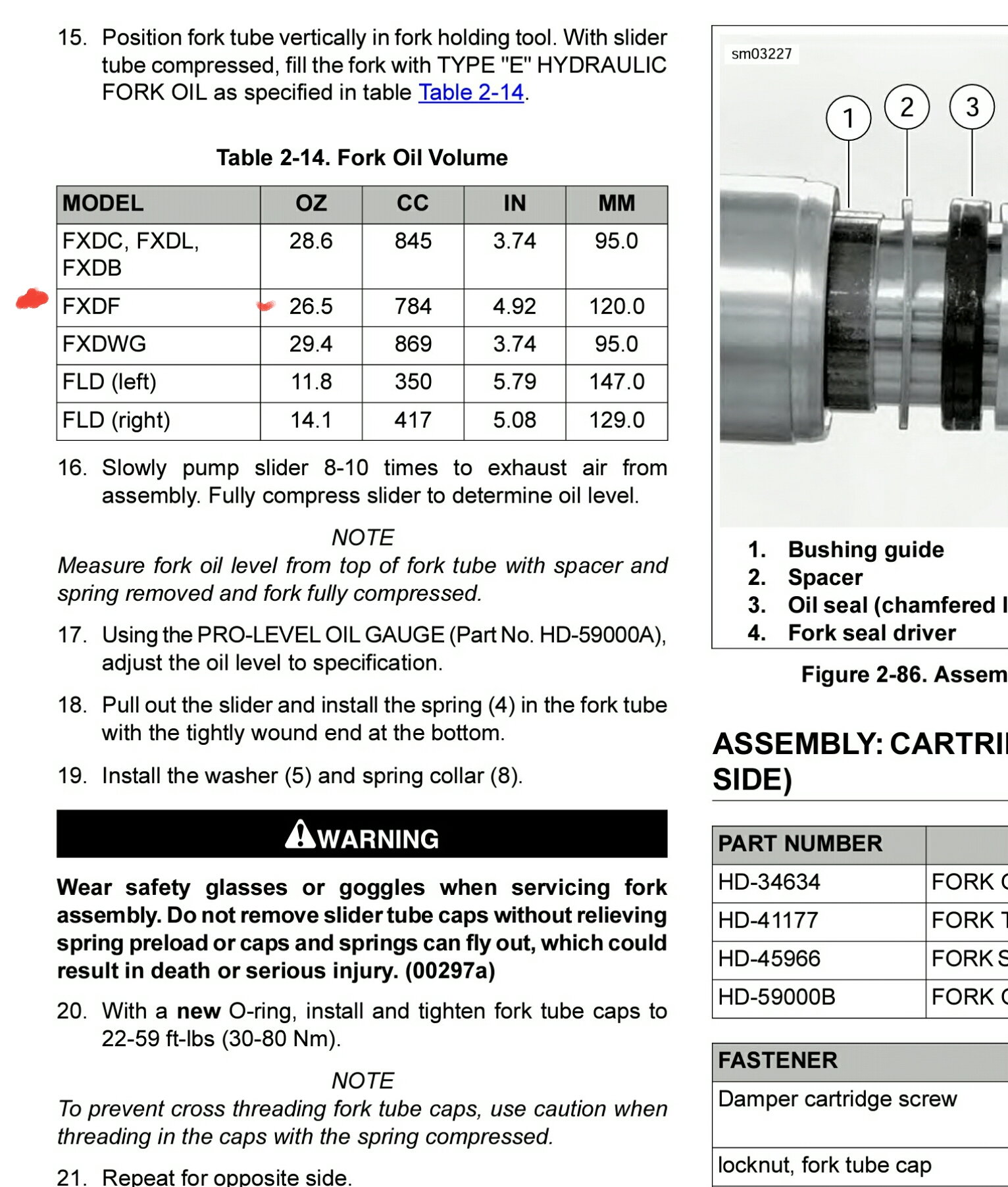
| Dyna (FXDF, FXDL, FXDLS) | 2006–2017 | 11.3 oz (334 ml) | Varies by fork style |
Note: Always check your service manual for the exact capacity. Small changes in the fork design can affect the required amount. Never guess.
How To Check And Change Harley 49mm Fork Oil
Changing fork oil is not just about pouring in new fluid. There’s a process to get the oil level right and protect your bike. Here’s a step-by-step guide:
Tools And Supplies Needed
- Fork oil (Harley recommends 20W, but check your manual)
- Measuring cup or syringe
- Allen wrenches and sockets
- Torque wrench
- Clean rags
- Catch pan
- Service manual for your model
Step-by-step Instructions
- Secure the Motorcycle: Use a proper stand or lift to keep your Harley stable.
- Remove the Forks: For a full oil change, you usually need to remove the forks. Loosen the axle, brake calipers, and fender.
- Drain Old Oil: Remove the fork caps slowly (they are under spring pressure). Invert the fork over the catch pan to drain old oil. Pump the fork to get all oil out.
- Measure New Oil: Use a measuring cup or syringe for accuracy. Pour in the exact amount recommended for your model.
- Reassemble Forks: Refit the fork caps, then reinstall forks on the bike. Use a torque wrench to tighten everything to spec.
- Test Ride: After reassembly, check for leaks and take a careful test ride. Listen and feel for any odd noises or handling issues.
Common Mistakes To Avoid
- Using the wrong oil weight: This can make your forks too stiff or soft.
- Guessing the oil amount: Always measure precisely.
- Not cleaning parts: Dirt inside forks can ruin the new oil quickly.
- Forgetting to torque bolts: Loose or overtightened bolts can be dangerous.
Comparing 49mm Fork Oil Capacity To Other Sizes
Harley-Davidson uses other fork sizes, like 39mm and 41mm, especially on Sportsters and older bikes. How does the 49mm fork oil capacity compare?
| Fork Size | Typical Oil Capacity (per fork) | Common Models |
|---|---|---|
| 39mm | 10.2 oz (302 ml) | Sportster, Dyna (pre-2006) |
| 41mm | 10.5–11.2 oz (311–331 ml) | Older Touring, Softail |
| 49mm | 11.3–11.6 oz (334–343 ml) | Modern Touring, Dyna, Softail |
Insight: The 49mm forks generally require more oil. This matches their larger volume and stronger damping needs. If you switch to aftermarket forks, always check the new specs.
What Kind Of Fork Oil Should You Use?
Not all fork oil is the same. The weight (viscosity) affects how your bike handles. Most Harley 49mm forks use 20W fork oil, but some riders experiment with 15W or 10W for a softer ride. Thicker oil slows down fork movement, while thinner oil makes it quicker and softer.
Tip: Stick to Harley-Davidson’s recommended oil unless you want to change how your bike handles. Mixing brands or weights can lead to unpredictable suspension action.
Signs Your Fork Oil Needs Changing
Fork oil is out of sight, but it shouldn’t be out of mind. Here’s how to know it’s time for a change:
- Leaking Oil: If you see oil around the fork seals, the oil level is dropping, and the seals likely need replacing.
- Poor Handling: If your front end feels soft, bouncy, or makes “clunking” noises, old oil could be the cause.
- Fork Dive: If your forks compress too much under braking, the oil may be worn out.
- Mileage: Harley recommends changing fork oil every 20,000 miles, or sooner for hard riding.
Non-obvious insight: Riding in wet, salty, or dusty conditions can contaminate your oil faster, so change it more often if you ride in these environments.
How To Measure Fork Oil Level (the Air Gap Method)
Some mechanics prefer the air gap method instead of measuring by ounces or milliliters. This is the distance from the top of the fork tube to the oil level (with the fork fully compressed, spring removed). For 49mm forks, the air gap is usually 135 mm (5.3 inches), but always check your manual.
Why Use The Air Gap Method?
- More precise: Compensates for small differences inside the fork.
- Good for performance: Ensures consistent damping and ride feel.
Example: If you have upgraded springs or internal parts, using the air gap method gives better results than just measuring oil by volume.
How Fork Oil Capacity Affects Performance
Changing the oil capacity—on purpose or by accident—has real effects:
- Too Much Oil: Forks may bottom out less, but ride becomes harsh, and seal leaks can occur.
- Too Little Oil: Forks compress too easily, leading to poor control and possible metal-to-metal contact.
- Correct Oil: Smooth, controlled suspension, better traction, and longer fork life.
Advanced tip: Racers sometimes fine-tune the air gap for track conditions, but for street riding, stick to factory specs.
Upgrades And Modifications: What Changes Oil Capacity?
If you install aftermarket cartridges, progressive springs, or other fork internals, the required oil volume may change. Always follow the instructions from the part maker.
- Cartridge kits: May need more or less oil than stock.
- Lowering kits: Can reduce the air gap, changing how much oil fits.
- Performance springs: Usually need the same oil, but check the specs.
Don’t assume the stock capacity applies after modifications. Always check with the manufacturer or a trusted mechanic.
Real-world Examples And Mistakes
Many riders—even experienced ones—make errors with fork oil capacity. Here are a few stories that show what can go wrong:
- A rider swapped his Road King’s springs and used the stock oil amount. His forks felt harsh. The new springs were longer, reducing the space for oil. He needed less oil, not more.
- Another owner guessed at the amount, pouring in what “looked right.” The forks leaked, and handling suffered.
- One mechanic forgot to fully drain old oil. When he added the full amount, the fork was overfilled.
Lesson: Always fully drain, measure precisely, and adjust for any internal changes.
Environmental Impact And Fork Oil Disposal
Used fork oil is a hazardous waste. Never pour it down the drain or on the ground. Instead:
- Collect old oil in a sealed container.
- Take it to a recycling center or auto shop that accepts used oil.
- Wipe up any spills immediately to avoid damage to your garage floor or driveway.
Tip: Some shops will recycle oil for free if you bring it in a clean jug.
How Often Should You Check Fork Oil?
Most Harley owners only check fork oil during major services or when there’s a problem. But for the best performance:
- Check for leaks every oil change (about every 5,000 miles).
- Inspect the fork action—push down on the handlebars to feel for smoothness.
- Change the oil every 20,000 miles, or sooner if you ride hard or in tough conditions.
Non-obvious insight: Fork oil can break down from heat and pressure, even if you don’t ride much. Age, not just mileage, matters.
Special Notes For Diyers And Pros
Changing fork oil is a job many riders can tackle at home, but it does require care:
- DIYers: Take photos as you disassemble, so you remember how everything goes back together.
- Pros: Always use a torque wrench and follow the latest service manual updates. Harley sometimes revises oil capacities.
Pro tip: Wear safety glasses. Fork oil under pressure can spray unexpectedly.
Common Questions About Fork Oil Capacity
Many Harley riders have similar questions about fork oil. Here are some of the most frequent concerns:
- Can I use ATF (automatic transmission fluid) instead of fork oil?
- It’s not recommended. ATF is thinner and can change the way your forks work. Stick with proper fork oil for your 49mm forks.
- Should I fill the forks to the top?
- No. Forks need an air gap to function properly. Overfilling can damage seals and create a harsh ride.
- Is it OK to mix fork oil brands or weights?
- Mixing can lead to unpredictable results. Use the same brand and weight in both forks for consistency.
- Does changing fork oil improve my ride?
- Absolutely. Fresh oil restores damping and smoothness, especially if your current oil is old or contaminated.
- What happens if I use too much fork oil?
- You may experience seal leaks, harsh suspension, and possible internal damage.
How To Find Your Exact Fork Oil Capacity
While the above tables are accurate for most bikes, Harley sometimes makes running changes. The best sources for your specific model are:
- The official Harley-Davidson service manual
- The fork manufacturer’s guide (for aftermarket parts)
- Trusted forums and dealer resources
If you have a limited edition or custom model, always double-check before adding oil.

Is There A “best” Fork Oil For 49mm Harley Forks?
Harley-Davidson sells its own Type E fork oil, which is a 20W weight. Many riders stick with this. Some prefer synthetic oils from brands like Bel-Ray or Motul, which claim better performance and longer life.
Key factors when choosing oil:
- Use the correct viscosity (weight)
- Choose a reputable brand
- Avoid using automotive oils or random substitutes
How Fork Oil Quality Affects Suspension
Quality fork oil resists breakdown from heat and pressure. Cheaper or old oil can foam, leading to less effective damping and a rougher ride. Good oil also protects seals and prevents rust inside the fork tubes.
Example: After 10,000 miles, old fork oil often looks dark and smells burnt. Fresh oil is clear and smooth.
What Does “progressive” Fork Oil Mean?
Some brands market “progressive” fork oil, claiming it adapts to different riding conditions. In reality, fork oil is not truly progressive—spring design and internal fork parts create the progressive feel. Use standard fork oil for most riding, unless your fork or spring manufacturer recommends otherwise.
How To Tell If You Have 49mm Forks
Not sure what size forks your Harley has? Here’s how to check:
- Measure the diameter of the fork tubes with a caliper.
- Check your owner’s manual or service manual.
- Look for model-specific info online or at your dealer.
Many modern Touring and Dyna models (2006 and newer) come standard with 49mm forks.
Fork Oil Capacity And Suspension Tuning
Serious riders sometimes adjust fork oil capacity as part of suspension tuning. They may use a slightly larger or smaller air gap to make the forks stiffer or softer. This is advanced territory—small changes can make a big difference.
Warning: If you’re not sure, stick to the factory specs.
When Should A Mechanic Handle The Job?
While changing fork oil is possible at home, call a pro if:
- You don’t have the right tools or a lift
- Your forks are leaking badly
- You are uncomfortable handling springs under pressure
A pro will also check for worn bushings or damaged seals, which can save you money in the long run.
How To Extend The Life Of Your Forks
To get the most from your 49mm Harley forks:
- Keep the fork tubes clean—wipe them after rides.
- Inspect fork seals for leaks.
- Change oil at recommended intervals.
- Avoid high-pressure washing near the forks.
Extra tip: After long rides in the rain or through mud, clean and dry the fork area to prevent corrosion.
Resources For More Information
For the latest specs, service techniques, and advice, check the official Harley-Davidson service site, or trusted motorcycle tech sources like Harley-Davidson Service Information Portal. These provide the most up-to-date details for your model.
Frequently Asked Questions
How Much Fork Oil Do I Put In My Harley 49mm Forks?
Most 49mm forks on modern Harleys require 11.3–11.6 ounces (334–343 ml) per fork. Always check your service manual for your exact model.
Can I Use A Different Weight Fork Oil For A Softer Or Stiffer Ride?
Yes, using a lighter oil (like 15W) makes the suspension softer, while a heavier oil (like 20W or 30W) makes it stiffer. Only change the weight if you understand how it will affect your handling.
How Do I Know If I Put Too Much Fork Oil?
If your ride becomes harsh, you notice seal leaks, or the front end feels “locked up,” you may have too much oil. Drain and refill to the correct amount.
Is It Necessary To Remove The Forks From The Bike To Change The Oil?
For a full oil change and to clean out all old fluid, removing the forks is best. Some models allow partial draining through a drain screw, but this does not remove all old oil.
What’s The Difference Between The Air Gap And Measuring By Ounces/milliliters?
Measuring by air gap sets the oil level based on the space above the oil (with the fork fully compressed and spring removed). Measuring by volume (ounces or ml) is faster but less precise if you have aftermarket parts.
Harley’s 49mm fork oil capacity is more than just a number—it’s the foundation for smooth, safe riding and long-lasting suspension. Whether you’re a DIYer or trust your local shop, knowing the right oil amount and how to maintain your forks will keep your Harley handling at its best for years to come.