
When your car refuses to start, the frustration can ruin your day. Often, the problem is a faulty starter motor. But before you spend money on repairs or replacements, it’s smart to confirm if the starter is actually the cause. Testing a starter with a multimeter is a reliable way to diagnose the problem yourself. Even if you’re not a professional mechanic, you can do this with basic tools and a bit of patience. This guide will show you how to test a starter with a multimeter, explain why it matters, and help you avoid common mistakes that beginners make.
Understanding The Starter And Its Importance
The starter motor is a key part of your car’s starting system. Its job is simple but vital: it turns the engine over so it can start running. If the starter fails, your car won’t start, even if everything else is working perfectly. Sometimes, a bad starter gives warning signs like clicking noises, slow cranking, or no response when you turn the key.
However, these symptoms can also be caused by a dead battery, poor connections, or a failing ignition switch. Testing the starter directly is the best way to avoid guessing.
What Is A Multimeter And Why Use It?
A multimeter is a device that measures electrical values like voltage, current, and resistance. You can use it to check the health of many car parts, including the starter. Multimeters can be digital or analog, but digital models are easier for beginners.
Testing with a multimeter gives you numbers you can trust, not just guesses. It helps you:
- Confirm if the starter is really faulty
- Avoid changing good parts by mistake
- Save time and money on unnecessary repairs
Tools And Safety Gear You’ll Need
Before you start, gather these items:
- Digital multimeter (with voltage and resistance settings)
- Basic hand tools (like wrenches or sockets)
- Safety gloves
- Protective glasses
- Car’s service manual (for reference)
- Battery charger (optional, if your battery is weak)
- Alligator clip leads (optional but helpful)
Always put safety first. Disconnect the battery if you’re removing the starter or touching live wires.
Locating The Starter Motor
The starter motor is usually near where the engine meets the transmission. It’s a small, cylindrical device, often with wires attached. In most cars, you’ll find it under the engine, sometimes behind other parts.
If you’re not sure, check your car’s manual or look for online diagrams. Knowing the exact location saves you time and avoids damaging other parts.

Step-by-step: How To Test A Starter With A Multimeter
Testing the starter involves several steps. Each step tells you something different about the starter’s condition. Below, you’ll learn how to test the starter both in the car (in situ) and after removing it (bench testing).
Step 1: Check The Battery First
A weak or dead battery is the most common cause of starting problems. Before blaming the starter, confirm your battery is healthy.
- Set your multimeter to DC voltage.
- Touch the black probe to the battery’s negative terminal, and the red probe to the positive.
- A healthy battery should read 12.4 to 12.7 volts when the car is off.
If your reading is below 12. 2 volts, charge or replace the battery before testing the starter.
Step 2: Inspect Cables And Connections
Loose or corroded wires can stop the starter from working. Check these before any electrical tests:
- Battery terminals: Clean and tight
- Starter connections: No rust or looseness
- Ground wires: Secure and free of corrosion
Bad connections can mimic starter failure.
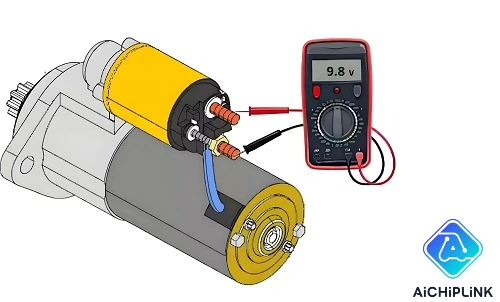
Step 3: Test For Voltage At The Starter
Now, check if power is reaching the starter when you turn the key.
- Set the multimeter to DC voltage.
- Locate the large wire going to the starter (usually red).
- Place the black probe on a clean metal part of the engine (ground).
- Place the red probe on the starter’s main power terminal.
- Ask a helper to turn the ignition key to “start.”
You should see battery voltage (12+ volts) on the multimeter. If not, there’s a wiring or relay problem, not a bad starter.
Step 4: Check The Starter Solenoid Signal
The starter solenoid is a small cylinder attached to the starter. It receives a signal wire when you turn the key.
- Find the small wire on the solenoid (often labeled “S”).
- Place the black probe on ground.
- Place the red probe on the solenoid signal terminal.
- Turn the key to “start” (have someone help).
If you see battery voltage, the ignition system is sending the signal. If not, the problem is upstream (key switch, relay, or wiring).
Step 5: Measure Starter Voltage Drop
A starter can fail to spin if it’s not getting full voltage, even if wires look fine.
- Keep the black probe on the starter’s metal body.
- Place the red probe on the starter’s main power post.
- Turn the key to “start.”
- Note the voltage while the starter is trying to work.
A healthy voltage drop should be less than 0.5 volts. Higher drops mean high resistance, possibly from corroded cables or connectors.
Step 6: Test Starter Resistance (ohms Test)
This test checks for internal shorts or open circuits inside the starter.
- Disconnect the battery before testing!
- Remove the starter from the car if possible.
- Set the multimeter to ohms (Ω).
- Touch one probe to the starter’s main terminal, the other to the case (ground).
A good starter should show very low resistance (close to zero). High resistance or infinity means an open circuit (bad starter).
Step 7: Bench Testing The Starter
If you remove the starter, you can do a full bench test.
- Connect the starter’s main terminal to a good battery’s positive terminal (use a heavy cable).
- Connect the starter case to the battery’s negative terminal.
- Use a jumper wire to touch the solenoid terminal to positive.
The starter should spin strongly and the pinion (gear) should move out. Weak spinning or no movement means the starter is bad.
Bench testing is useful when you’re not sure if the issue is inside the starter or elsewhere.
Step 8: Compare Readings With Specifications
Check your readings against the car’s service manual. Starters can vary by vehicle, so always use your model’s specs as the final judge.
Understanding The Test Results
Numbers alone don’t tell the whole story. Here’s how to interpret what your multimeter reveals.
- Low voltage at the starter: Problem is likely in the wiring, not the starter itself.
- No voltage at solenoid signal wire: Ignition switch, relay, or wiring problem.
- High resistance: Starter is faulty or has internal corrosion.
- Starter spins weakly on bench: Internal failure or worn brushes.
If all tests pass but the car still won’t start, the issue might be elsewhere.
Common Mistakes Beginners Make
Testing a starter with a multimeter is simple, but mistakes can lead you to wrong conclusions or even damage your car. Here are errors to watch for:
- Skipping the battery check: A dead battery can mimic a bad starter.
- Testing with dirty or loose probes: This can give false readings.
- Not disconnecting the battery before resistance testing: This can damage your multimeter.
- Confusing volts and ohms settings: Set your meter correctly for each test.
- Ignoring ground connections: A bad ground can stop the starter, even if everything else is fine.
- Not comparing with specs: Always check your car’s manual for correct values.
- Bench testing with weak cables: Thin wires can’t handle starter current and may overheat.
Avoiding these mistakes will save time and help you find the real problem.
Real-world Examples
Let’s look at two real-life cases that show how testing with a multimeter made the difference.
Example 1: The Mystery Click
A 2012 Honda Accord owner heard a single click when turning the key but the engine didn’t crank. Battery voltage was 12. 5 volts, and all connections looked clean. Using the multimeter, the voltage at the starter’s main terminal dropped to only 8 volts while trying to start.
The problem? A corroded battery cable hidden under the insulation. Replacing the cable fixed the car.
Example 2: The Silent Starter
A 2008 Ford F-150 wouldn’t start, and there was no sound at all. The battery tested at 12. 6 volts. Multimeter showed no voltage at the solenoid signal wire when the key was turned. The issue was a failed ignition relay.
Replacing the relay brought the truck back to life.
These examples show why using a multimeter is better than guessing.
Comparing In-car Vs Bench Testing
Both methods have pros and cons. See the comparison below:
| Feature | In-Car Testing | Bench Testing |
|---|---|---|
| Time Required | Faster | Slower (removal needed) |
| Accuracy | May be affected by car wiring | Direct test of starter |
| Tools Needed | Basic multimeter | Multimeter, battery, jumper cables |
| Risk of Sparks | Lower | Higher (if not careful) |
If you’re unsure, doing both tests gives the clearest answer.
Essential Multimeter Settings For Starter Testing
Choosing the right multimeter setting is crucial. Many beginners miss this step, leading to wrong results. Here’s a quick guide:
| Test Type | Multimeter Setting | Expected Reading |
|---|---|---|
| Battery Voltage | DC Volts (20V range) | 12.4 – 12.7 V |
| Starter Voltage | DC Volts (20V range) | 12+ V |
| Resistance (Ohms) | Ohms (Ω) | ~0 Ω (low resistance) |
| Voltage Drop | DC Volts (2V range) | <0.5 V drop |
Always double-check your setting before starting any test.
Safety Tips When Testing Starters
Working with your car’s electrical system can be dangerous. Follow these safety rules:
- Wear safety glasses and gloves.
- Keep the car in park or neutral with the parking brake on.
- Never touch both battery terminals with metal tools.
- Disconnect the battery before removing the starter.
- Work in a well-ventilated area (starters can spark).
- Keep loose clothing and hair away from moving parts.
If you’re ever unsure, ask a qualified mechanic for help.
Advanced Troubleshooting: When The Starter Isn’t The Problem
Sometimes, after all your tests, the starter checks out fine. That means the issue is somewhere else. Here are other areas to investigate:
- Battery: Even if it shows 12+ volts, it may have low cranking amps.
- Ignition switch: If the switch is bad, the starter won’t get a signal.
- Starter relay: A failed relay can break the circuit.
- Neutral safety switch: This prevents starting unless the car is in park or neutral.
- Security system: Some cars have anti-theft systems that block starting.
A common beginner mistake is to overlook the neutral safety switch. If your car won’t start in “park,” try “neutral”—if it starts, the switch is likely faulty.
When To Replace The Starter
After testing, you may find that the starter is indeed the problem. Signs that you should replace the starter include:
- High resistance or open circuit in the starter
- No movement during bench test
- Starter spins, but pinion gear doesn’t move
- Burned smell or visible damage on the starter
Replacing a starter is a job many DIYers can handle, but if you’re not comfortable, a professional can help.
Starter Maintenance Tips
To avoid starter problems in the future:
- Clean battery terminals at least twice a year
- Check and tighten all starter connections regularly
- Avoid holding the key in “start” position for more than 10 seconds
- Fix oil leaks near the starter (oil can damage it)
- Listen for slow cranking—this is often a warning sign
Preventive care can help your starter last 100,000 miles or more.

The Value Of Accurate Testing
Testing your starter with a multimeter is a skill that saves you money and trouble. Unlike guesswork, it gives you data you can trust. It also helps you spot problems in wiring, switches, and relays—things that often get overlooked.
Many car owners replace starters when the real issue is a bad cable or weak battery. A few simple tests prevent wasted effort and cost.
For more about car electrical systems, see this resource: Wikipedia: Starter Motor.
Frequently Asked Questions
What Are The Main Signs Of A Bad Starter?
Common signs include a single clicking sound when turning the key, the engine not cranking, slow or weak cranking, or no sound at all. Sometimes, lights on the dashboard will turn on, but the car won’t start. However, these symptoms can also be caused by a dead battery or poor wiring, so testing is important.
Can A Starter Fail Without Warning?
Yes. Sometimes, a starter works perfectly one day and fails the next, especially if an internal part breaks. But often, there are warning signs like slow cranking or occasional clicks before total failure.
What Is The Normal Voltage Drop When Starting A Car?
A healthy system should have a voltage drop of less than 0.5 volts from the battery to the starter when cranking. Higher drops mean resistance in the cables or connections, which can stop enough power from reaching the starter.
Is It Safe To Bench Test A Starter At Home?
It’s safe if you follow basic rules: use thick cables, wear gloves and glasses, and keep the battery away from flammable items. Always secure the starter so it doesn’t move when spinning. If you’re not confident, ask a professional for help.
Can A Multimeter Test All Parts Of The Starting System?
A multimeter can check voltage, resistance, and continuity in the starter, solenoid, cables, and ignition switch. However, it can’t measure cranking amps, which is another sign of starter health. For full testing, some shops use a dedicated starter tester.
Testing your starter with a multimeter is a smart, cost-effective way to solve starting problems. Armed with this knowledge, you can fix your car faster, avoid wasted money, and learn more about how your vehicle works. With the right tools and careful steps, even a beginner can become confident in diagnosing starter issues.