
The Kia Optima is a popular midsize sedan known for its comfort, value, and reliable engineering. But one detail often overlooked by drivers is its oil capacity—a small spec that has a big impact on your car’s health. Whether you’re a DIY mechanic or you just want to understand what happens under the hood, knowing the correct oil capacity for your Kia Optima is essential. The right amount of oil ensures smooth operation, protects your engine, and extends the lifespan of your vehicle. But the answer isn’t as simple as one number; it depends on your Optima’s model year and engine type.
Choosing the right oil capacity for your car is more than just filling to the top line. Too little oil and you risk engine damage from overheating and friction. Too much, and you could face leaks, sensor problems, or even catastrophic engine failure. In this guide, you’ll find all the specifics you need about Kia Optima oil capacity for every generation and engine type. You’ll also learn why oil capacity matters, how oil changes affect performance, and how to avoid the common mistakes that many Optima owners make. Let’s get started and make sure your Optima gets exactly what it needs.
Why Oil Capacity Matters For Your Kia Optima
Every engine is engineered with a precise oil capacity for a reason. Oil lubricates moving parts, reduces wear, and helps dissipate heat. If the level drops too low, metal components rub together, generating excessive heat and friction. This can lead to costly repairs, or worse, complete engine failure.
On the other hand, overfilling is a lesser-known but serious issue. Excess oil can froth up, reducing its effectiveness and putting extra pressure on seals and gaskets. In the worst cases, it causes the engine to work harder and may even damage the catalytic converter.
For the Kia Optima, using the correct oil capacity maintains optimal oil pressure and ensures all parts receive proper lubrication. It also supports better fuel efficiency, lower emissions, and a longer engine life.
Kia Optima Oil Capacity By Model Year And Engine
The Kia Optima has seen several generations, each with different engine options. Below, you’ll find a breakdown of oil capacities for each major generation and engine type. This helps you avoid guesswork and ensures accuracy, whether you’re doing an oil change yourself or checking a mechanic’s work.
1st Generation (2000–2006)
Early Optimas offered a choice between a four-cylinder and a V6 engine.
| Model Year | Engine | Oil Capacity (with filter) | Oil Type |
|---|---|---|---|
| 2001–2006 | 2.4L I4 | 4.5 quarts (4.3 liters) | 5W-20 or 5W-30 |
| 2001–2006 | 2.7L V6 | 4.8 quarts (4.5 liters) | 5W-30 |
2nd Generation (2007–2010)
This period brought some engine improvements and slight adjustments in oil capacity.
| Model Year | Engine | Oil Capacity (with filter) | Oil Type |
|---|---|---|---|
| 2007–2010 | 2.4L I4 | 4.5 quarts (4.3 liters) | 5W-20 or 5W-30 |
| 2007–2010 | 2.7L V6 | 4.8 quarts (4.5 liters) | 5W-30 |
3rd Generation (2011–2015)
In these years, the Optima lineup expanded with turbocharged options and hybrids.
- 2.4L GDI I4: 5.1 quarts (4.8 liters), 5W-20
- 2.0L Turbo I4: 4.8 quarts (4.5 liters), 5W-30
- 2.4L Hybrid: 4.76 quarts (4.5 liters), 5W-20
Notable insight: Turbocharged engines often require less oil than larger naturally aspirated ones, despite their higher performance, due to smaller sumps and tighter tolerances.
4th Generation (2016–2020)
This generation features advanced turbo engines and direct injection technology.
- 2.4L GDI I4: 4.8 quarts (4.5 liters), 5W-20
- 1.6L Turbo I4: 4.8 quarts (4.5 liters), 5W-30
- 2.0L Turbo I4: 5.1 quarts (4.8 liters), 5W-30
- Hybrid/Plug-In Hybrid: 4.7 quarts (4.4 liters), 5W-20
Practical tip: Always check your owner’s manual for the exact specification for your trim, as some trims may have minor differences in oil pan size or filter design.
5th Generation (2021 Onwards) – Now K5 In Most Markets
The Optima is now branded as the Kia K5 in many regions, but oil capacity standards remain similar.
- 1.6L Turbo I4: 4.8 quarts (4.5 liters), 5W-30
- 2.5L Turbo I4: 5.1 quarts (4.8 liters), 5W-30
Non-obvious detail: If you own a K5, it’s worth noting that the oil filter design changed, and aftermarket filters may have different oil retention capacities. Always use an OEM filter for the most accurate oil level.
How To Check And Top Up Your Oil Correctly
Even with the right numbers, mistakes can happen during an oil change. Follow these steps for accurate checking and topping up:
- Park on Level Ground: Always check oil when the car is on a flat surface and the engine is cool.
- Wait After Driving: If the engine has been running, wait at least 5 minutes for oil to settle.
- Pull the Dipstick: Remove, wipe clean, reinsert, and pull out again to check the level.
- Add Slowly: If you need to add oil, pour in small amounts and wait a minute before rechecking.
- Never Overfill: Stop at or just below the “full” mark. Overfilling is just as risky as running low.
Beginner mistake: Many drivers check oil right after shutting off the engine, which gives a false low reading because oil hasn’t drained back to the pan.
Choosing The Right Oil For Your Optima
Using the correct oil type is just as critical as the right capacity. Kia recommends synthetic or high-quality conventional oil matching the viscosity listed in your owner’s manual.
Understanding Oil Grades
- 5W-20 and 5W-30 are the most common for Optimas. The numbers refer to oil thickness at cold and hot temperatures.
- In colder climates, 5W-20 helps with cold starts. In hotter areas, 5W-30 may offer better protection.
Synthetic Vs. Conventional Oil
- Synthetic oil lasts longer, provides better protection at extreme temperatures, and keeps the engine cleaner.
- Conventional oil is cheaper but needs more frequent changes.
Pro insight: If your Optima has a turbocharged engine, always use full synthetic oil to prevent premature turbo wear.
Oil Change Intervals And Why They Matter
Changing oil at the right interval is essential for engine longevity. For most Kia Optimas:
- Conventional oil: Change every 3,000–5,000 miles (4,800–8,000 km)
- Synthetic oil: Change every 7,500–10,000 miles (12,000–16,000 km)
However, if you drive in extreme temperatures, heavy traffic, or make many short trips, change oil more frequently.
Non-obvious insight: Short trips under 5 miles can be harder on oil than long highway drives, as the engine doesn’t reach full operating temperature, causing moisture and contaminants to build up.
How Oil Capacity Affects Engine Performance
The right oil capacity ensures the engine stays lubricated, but there’s more to it:
- Fuel efficiency: Low oil can make your engine work harder, reducing miles per gallon.
- Engine wear: Both low and high oil levels accelerate wear and tear.
- Emissions: Incorrect oil levels can impact sensors and increase tailpipe emissions.
Example: An underfilled engine may trigger the oil pressure warning light, while an overfilled engine might cause the “Check Engine” light due to sensor errors.

Symptoms Of Incorrect Oil Level
If you suspect your oil level isn’t right, watch for these signs:
- Warning Lights: Oil pressure or check engine light may turn on.
- Strange Noises: Tapping or knocking sounds from the engine.
- Burning Smell: Overfilled oil can leak onto hot components.
- Smoke from Exhaust: Too much oil may cause blue/white smoke.
- Poor Performance: Hesitation or rough running.
Action tip: If you notice any of these, stop driving and check your oil immediately. Continuing to drive can cause serious engine damage.
Common Mistakes When Changing Oil In A Kia Optima
Even experienced DIYers can make errors that affect oil capacity and engine health:
- Not replacing the oil filter: The filter holds oil; skipping replacement changes the total oil needed.
- Pouring oil too quickly: This leads to overfilling, as oil takes time to settle.
- Using the wrong viscosity: Always match your climate and engine type.
- Forgetting to reset the oil change indicator: The dash reminder won’t reset automatically; follow your manual instructions.
- Mixing oil types: Avoid combining conventional and synthetic oils unless it’s an emergency top-up.
Pro tip: After changing oil, run the engine for a minute, turn it off, and recheck the level. This circulates oil through the filter for an accurate reading.
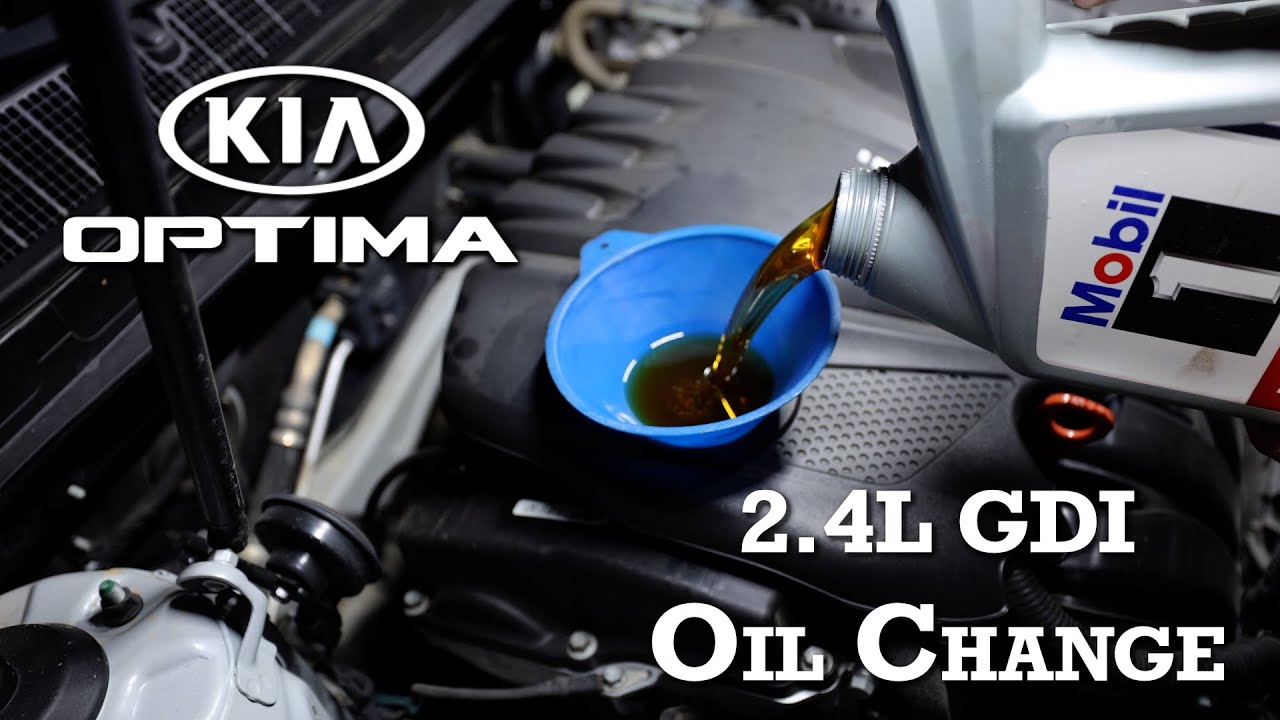
How To Perform A Proper Oil Change On A Kia Optima
If you want to change your own oil, here’s a step-by-step guide tailored to the Optima:
Tools And Materials Needed
- Correct amount and type of engine oil
- New oil filter (OEM recommended)
- Oil catch pan
- Funnel
- Wrenches and filter wrench
- Gloves and shop rags
Step-by-step Process
- Warm up the engine: Let it run for 2–3 minutes to thin the oil.
- Raise the vehicle: Use ramps or jack stands safely.
- Remove the drain plug: Place the catch pan and let oil drain fully (about 10–15 minutes).
- Replace the oil filter: Use a filter wrench and lubricate the new filter’s gasket.
- Reinstall the drain plug: Tighten securely but do not over-torque.
- Add new oil: Pour in about 90% of the required capacity.
- Check the level: Start the engine, let it run for a minute, shut off, and recheck.
- Top off as needed: Add oil slowly to reach the “full” mark.
Important: Always dispose of used oil and filters at a recycling center.
How To Read Your Kia Optima’s Owner’s Manual For Oil Specs
Your owner’s manual is the most accurate source for oil capacity and recommended oil types. But many owners overlook key details hidden in the fine print:
- Capacity listed is usually “with filter.” If you don’t change the filter, the capacity is less.
- Manuals often provide a range for oil viscosity based on climate. Choose the one best suited to your area.
- Some manuals specify different capacities for turbo vs. non-turbo engines.
Example: For a 2015 Kia Optima 2.4L, the manual may list “4.8 US quarts (with filter),” but only 4.5 quarts if the filter is not replaced.
Comparing Oil Capacities With Other Midsize Sedans
To give context, here’s how the Kia Optima’s oil capacity compares with other popular midsize sedans:
| Model | Engine | Oil Capacity (with filter) |
|---|---|---|
| Kia Optima (2.4L I4) | 2.4L I4 | 4.8 quarts (4.5 L) |
| Honda Accord (2018 1.5T) | 1.5L Turbo I4 | 3.7 quarts (3.5 L) |
| Toyota Camry (2018 2.5L) | 2.5L I4 | 4.8 quarts (4.5 L) |
| Hyundai Sonata (2018 2.4L) | 2.4L I4 | 4.8 quarts (4.5 L) |
Observation: The Optima’s oil capacity is in line with most competitors, making it easier to find oil in a pinch if needed.
How Weather And Driving Style Affect Oil Needs
Climate and driving style influence not just how often you change oil, but also which viscosity to use:
- Cold climates: Use 5W-20 for better cold start protection.
- Hot climates or spirited driving: 5W-30 or even 10W-30 may offer better high-heat protection.
- Frequent towing or heavy loads: Consider changing oil more often, even with synthetic oil.
Key insight: Oil breaks down faster with stop-and-go driving, short trips, and extreme temperatures. Adjust your maintenance schedule accordingly.

Credit: www.youtube.com
Advanced Tips: Maximizing Engine Life In Your Kia Optima
Want your Optima engine to last well beyond 100,000 miles? Here’s how oil capacity and maintenance play a role:
- Stick to OEM specs: Always use the oil capacity and type recommended by Kia.
- Change filters every time: Skipping filter changes can leave old contaminants in the system.
- Monitor for leaks: Even small leaks reduce oil capacity and can cause major damage if left unchecked.
- Pay attention to oil color: Dark, dirty oil means it’s time for a change, regardless of mileage.
- Listen to your engine: Unusual noises after an oil change may indicate a problem—double-check the oil level and filter fitment.
Real-world example: A well-maintained Optima engine has been known to exceed 200,000 miles with regular oil changes and correct oil levels.
The Importance Of Using The Right Oil Filter
Oil filters are just as crucial as oil itself. The right filter ensures your engine receives clean, debris-free oil.
- OEM vs. Aftermarket: Original filters are designed for your engine’s oil flow and pressure. Aftermarket filters can differ in capacity and flow rate.
- Changing with every oil change: This is non-negotiable. A clogged filter starves your engine of oil, regardless of capacity.
Caution: Some aftermarket filters are longer or shorter than OEM, which changes the oil volume needed. Always verify compatibility.
How To Reset The Oil Change Light In A Kia Optima
After an oil change, you should reset the oil service indicator on your dashboard. Here’s a general method (always confirm with your manual):
- Turn the ignition to the “On” position (don’t start the engine).
- Use the steering wheel “Mode” or “Menu” button to navigate to “Service Interval.”
- Select “Reset” using the “OK” button.
- Confirm the reset.
If you skip this step, you may get an unnecessary warning before your next scheduled oil change.
Kia Optima Oil Capacity: Quick Reference Chart
For convenience, here’s a summary chart of oil capacities for the most common Optima engines:
| Engine | Years | Oil Capacity (with filter) | Recommended Oil |
|---|---|---|---|
| 2.4L I4 | 2011–2020 | 4.8–5.1 quarts (4.5–4.8 L) | 5W-20 |
| 1.6L Turbo I4 | 2016–2023 | 4.8 quarts (4.5 L) | 5W-30 |
| 2.0L Turbo I4 | 2011–2020 | 4.8–5.1 quarts (4.5–4.8 L) | 5W-30 |
| Hybrid/Plug-In | 2011–2020 | 4.7 quarts (4.4 L) | 5W-20 |
Use this chart for a quick reminder, but always double-check your specific model.
What To Do If You Overfill Or Underfill Your Oil
Mistakes happen. If you’ve added too much or too little oil:
- Overfilled: Remove excess oil by draining from the pan (or using a suction tool through the dipstick tube). Driving with too much oil can cause foaming and leaks.
- Underfilled: Add oil immediately. Running with low oil even for a short period risks serious engine damage.
Never ignore oil level warnings. Modern engines are less tolerant of incorrect oil levels due to tight tolerances and advanced sensors.
Where To Find Official Kia Optima Oil Capacity Information
For the most up-to-date information, visit the official Kia Motors website or consult your vehicle’s owner’s manual. For further technical details, the Kia Optima Wikipedia page is also a reliable resource.
Frequently Asked Questions
What Happens If I Use Too Much Oil In My Kia Optima?
Too much oil can cause foaming, which reduces lubrication and may lead to leaks or even engine damage. Sensors may trigger warning lights, and in severe cases, it can harm the catalytic converter. Always drain excess oil if you overfill.
Can I Use 5w-30 Instead Of 5w-20 In My Optima?
For most climates, 5W-20 is recommended, especially for non-turbo engines. In hotter climates or for turbo engines, 5W-30 may be better. Always consult your manual to ensure compatibility.
How Often Should I Check My Optima’s Oil Level?
Check at least once a month or before long trips. If your engine is older or you notice leaks, check more frequently. Early detection of low oil can prevent major engine problems.
Does The Oil Filter Affect Oil Capacity?
Yes. The oil filter holds some oil. If you change the oil but not the filter, add slightly less oil. Always check your manual for the exact “with filter” and “without filter” capacities.
Is Synthetic Oil Required For My Kia Optima?
Synthetic oil is not required for all Optima engines but is strongly recommended, especially for turbo models and in extreme temperatures. It offers better protection and longer life than conventional oil.
Maintaining the correct Kia Optima oil capacity is one of the simplest ways to ensure years of trouble-free driving. With the right information and careful attention to details, your Optima will deliver reliable, efficient performance mile after mile.