
Cutting a perfect circle in wood can transform a simple project into something special. Whether you’re building a tabletop, making speaker holes, or creating decorative pieces, using a router is the go-to method for precision and smoothness. But many people feel nervous about making that first cut. If you’ve never cut a circle with a router before, you might wonder: Will it be accurate? Will the edges be clean? Is it safe?
The truth is, with the right setup and a little know-how, you can cut circles that look like they came from a professional workshop. This guide will take you through every step, from the tools you need to the finishing touches.
Along the way, you’ll learn tips and tricks that even experienced woodworkers sometimes overlook. By the end, you’ll have the confidence to cut circles of any size, every time.
Understanding Why Routers Are Ideal For Circles
Routers have a unique advantage over other tools when it comes to circles. Unlike jigsaws or hole saws, a router spins a sharp bit at high speed, shaving away wood in a controlled, predictable path. This means you get smooth edges and accurate diameters—no jagged lines or uneven curves.
What’s more, routers can cut circles of almost any size. With the right jig, you aren’t limited to a few pre-set diameters. Want a 6-inch hole for a speaker? No problem. Need a 36-inch tabletop? Your router can handle it.
This flexibility is why professional woodworkers rely on routers for circular cuts.
Tools And Materials You’ll Need
Before you start, gather everything you need. Missing just one item can turn a quick job into a frustrating search.
Essential Tools
- Router (fixed or plunge base)
- Router bit (straight, spiral, or up-cut bit)
- Circle cutting jig (store-bought or homemade)
- Drill and drill bits
- Tape measure or ruler
- Pencil
- Clamps
- Work table or bench
- Safety glasses
- Hearing protection
Materials
- Wood piece you want to cut (plywood, MDF, hardwood)
- Scrap wood for tests and backing
Optional Extras
- Dust mask (for MDF or dusty woods)
- Double-sided tape
- Sandpaper (various grits)
- Finishing oil or paint
Pro tip: Always check that your router bit is sharp and matched to the wood’s thickness. A dull bit makes more burn marks and splinters.
Choosing The Right Router And Bit
Not every router or bit is created equal. Picking the right combination makes your work safer and your circles cleaner.
Routers: Fixed Vs. Plunge
- Fixed-base routers are great for shallow cuts and work best when you start at the edge of your wood.
- Plunge routers let you start in the middle of your workpiece. You lower the spinning bit straight down, then cut around your circle.
Why does this matter? If your circle is completely inside the wood (like a speaker hole), a plunge router is easiest. If you can start from the edge or the circle goes all the way to the edge, a fixed base works fine.
Router Bits: Which To Use?
- Straight bits are common and give a clean, flat edge.
- Spiral bits (up-cut or down-cut) remove chips better and leave a smoother edge, especially in plywood.
- Flush-trim bits are used with templates but not usually for circle jigs.
Size matters: For most circles, a 1/4-inch or 3/8-inch bit is ideal. Thicker bits remove more wood but need a stronger router.
Bit Comparison
| Bit Type | Best For | Edge Quality | Common Sizes |
|---|---|---|---|
| Straight | General use, softwood | Good | 1/4″, 3/8″, 1/2″ |
| Spiral (Up-cut) | Plywood, hardwood | Excellent | 1/4″, 3/8″ |
| Down-cut Spiral | Laminates, veneered wood | Very Smooth | 1/4″, 3/8″ |
Non-obvious insight: Up-cut bits clear chips better, but down-cut bits push fibers down for a cleaner top surface. Choose based on your wood’s finish.
Circle Cutting Jigs: Store-bought Vs. Homemade
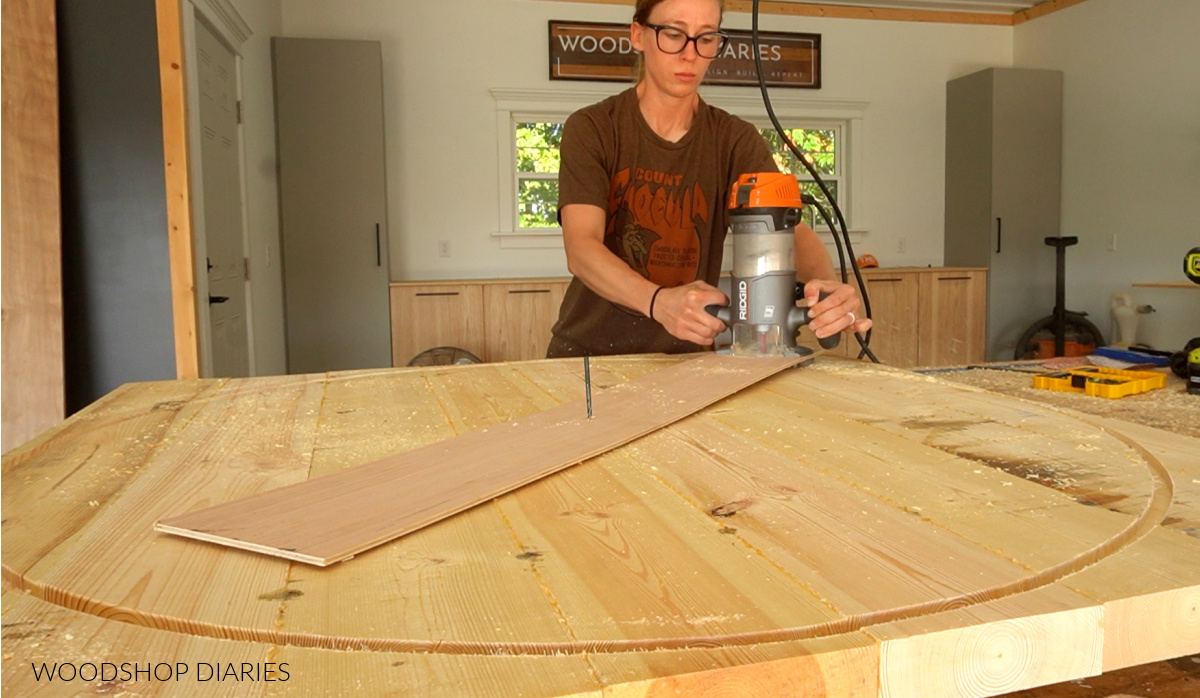
A circle jig is the secret to perfect circles. It holds your router at a set distance from a central pivot point, letting you spin it smoothly.
Store-bought Jigs
Commercial jigs attach to your router’s base and adjust for different sizes. They’re fast, accurate, and often have built-in measurement scales.
- Pros: Quick to set up, repeatable, fits many routers.
- Cons: More expensive, not always customizable.
Homemade Jigs
You can build a simple jig from a piece of plywood or MDF. Drill a hole for your router, then mark pivot points for different circle sizes.
- Pros: Cheap, fully customizable for any size.
- Cons: Takes time to build, can be less precise if not made carefully.
Jig Comparison
| Jig Type | Cost | Accuracy | Setup Time | Flexibility |
|---|---|---|---|---|
| Store-bought | High | Excellent | Fast | Limited by design |
| Homemade | Low | Good-Excellent | Slower | Any size possible |
Non-obvious insight: For very large circles (over 24 inches), homemade jigs are usually more practical and stable.
Setting Up Your Workspace
Good results start with a smart setup. A shaky table or loose workpiece will ruin even the best plan.
Step-by-step Setup
- Clear your bench. Remove clutter and sweep away dust.
- Secure your wood. Clamp it down tight. If you’re cutting all the way through, raise it on scrap blocks so you don’t damage your bench.
- Check your router bit. Make sure it’s tight in the collet and extends the right amount—too short and it won’t cut through, too long and it might flex.
- Wear safety gear. Glasses, hearing protection, and a dust mask if needed.
Pro tip: Mark your circle’s center clearly. Losing track of this point means your circle won’t be accurate.
Marking And Measuring The Circle
Accuracy begins with the right measurements. Small mistakes here multiply as you cut.
Finding The Center
- Measure your wood, mark the exact middle with a pencil.
- For rectangles, draw diagonals from corner to corner. Where they cross is the center.
- For plywood sheets, use a tape measure to find half of each side.
Drawing The Circle
- Use a compass or string tied to a pencil.
- Double-check your radius (half the diameter) before making any marks.
Pro tip: If you’re making a cutout (like a speaker hole), mark both the outer and inner circles—one for the cut, one for where to stop.
Attaching The Circle Jig
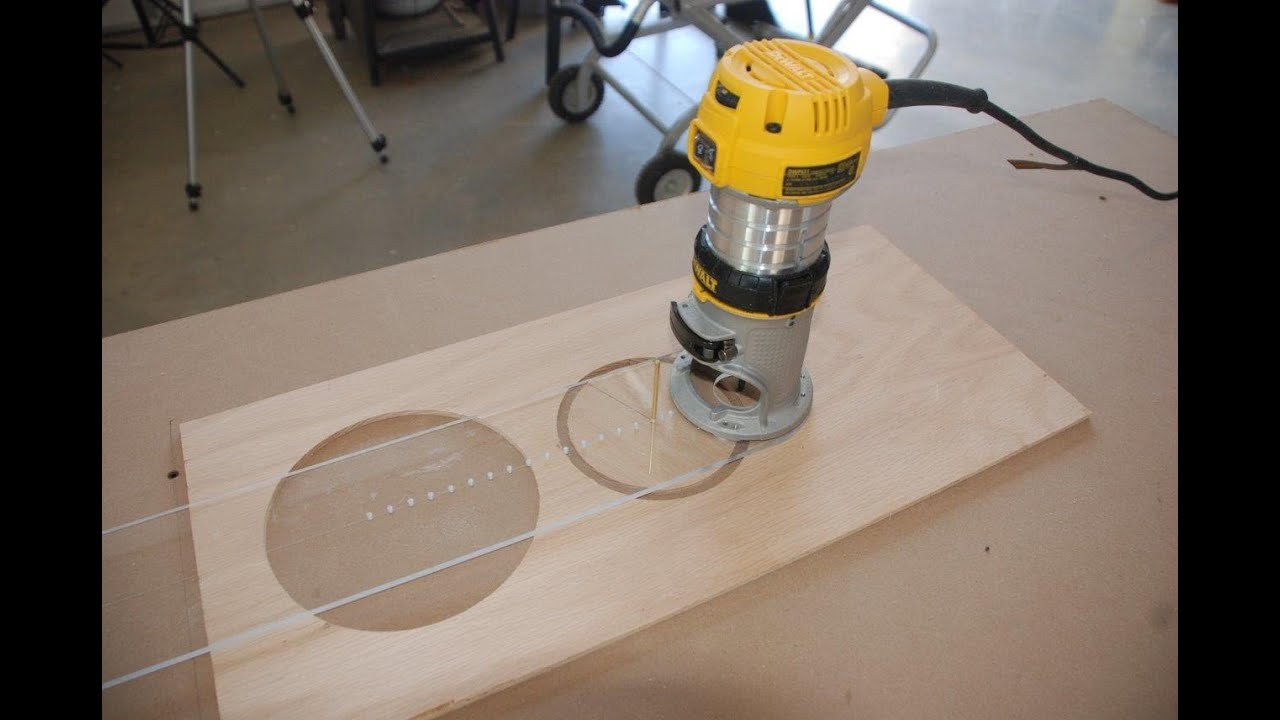
Whether you use a store-bought or homemade jig, attaching it correctly is essential for a perfect circle.
Pivot Point
- Drill a small pilot hole at the center mark. Use a nail, screw, or dowel as the pivot.
- Attach the jig’s arm so the router bit lines up with your circle’s radius.
Securing The Jig
- Tighten all screws or knobs.
- Move the router in a dry run (power off) to check for smooth movement.
- Make sure the router can rotate fully around the circle without hitting clamps or cords.
Non-obvious insight: If your wood is thin or fragile, use painter’s tape to reinforce the center before drilling the pivot hole.
Making The Cut: Step-by-step Instructions
Now comes the moment of truth. Cutting a circle with a router is not hard, but it rewards patience.
1. Set Your Depth
Routers work best with shallow cuts. Set your bit to remove 1/8 to 1/4 inch per pass. For thick wood, plan to make several passes.
2. Test On Scrap
Before cutting your real piece, try the jig and router on a scrap board. This checks your setup and gives you a feel for the process.
3. Make The First Pass
- Start the router before it touches the wood.
- Lower the bit (if using a plunge router) or start at the edge (fixed base).
- Move the router slowly and steadily around the circle.
- Don’t force it—let the bit do the work.
4. Complete Multiple Passes
- After each pass, raise the router, reset the depth, and repeat.
- Remove dust and chips between passes to see your progress.
5. Finish The Cut
- As you near the final depth, slow down. The last pass should be shallow for the cleanest edge.
- If the center becomes loose, hold the waste piece so it doesn’t break away and tear the edge.
6. Remove The Jig
- Power off and unplug the router before removing the jig.
- Carefully lift away the finished circle.
Pro tip: For large circles, cut halfway through from one side, then flip the wood and finish from the other side. This avoids tear-out.
:max_bytes(150000):strip_icc()/largecircle-fe271616be074b67b4ca63f3cc8da4ba.jpg)
Common Mistakes And How To Avoid Them
Even experienced woodworkers make mistakes. Here are some common problems and how to fix them.
1. Off-center Circles
Cause: Misplaced pivot point or inaccurate measurements.
Solution: Double-check measurements and test the jig before cutting.
2. Burn Marks
Cause: Moving too slowly, dull bit, or dirty wood.
Solution: Use a sharp bit, keep the router moving, and clean the wood before cutting.
3. Tear-out
Cause: Cutting too deep in one pass or using the wrong bit.
Solution: Take shallow passes and use a down-cut spiral bit for clean edges.
4. Bit Wanders Off Track
Cause: Jig not secured, or flexing arm.
Solution: Make sure all parts are tight and the jig arm is sturdy.
5. Uneven Edges
Cause: Tilting the router or uneven pressure.
Solution: Keep the router flat and use both hands for control.
Non-obvious insight: Sometimes, vibration from the router can loosen the pivot. Pause after each pass to check everything is still tight.
Advanced Techniques For Perfect Circles
Once you’ve mastered the basics, try these methods for even better results.
Cutting Large Circles
For circles larger than your jig, extend the arm with a longer piece of wood. Support the jig carefully so it doesn’t flex.
Making Partial Circles Or Arcs
Remove the waste outside your arc with a jigsaw first. Then use the router to finish the edge perfectly.
Layered Circles
For projects like round tabletops with inlays, cut circles in different woods, then glue them together.
Using Templates
If you make the same size circle often, create a reusable template. Use a flush-trim bit to copy the template onto new pieces.
Non-obvious insight: For thick wood, drill relief holes just inside the waste area. This gives chips somewhere to go and reduces burning.
Safety Tips When Using A Router
Routers are powerful tools. Respect them for safe, accident-free results.
- Always wear safety glasses and hearing protection.
- Keep your hands away from the spinning bit.
- Unplug the router when changing bits or adjusting the jig.
- Never force the router. Let the bit cut at its own pace.
- Be careful with the power cord—keep it clear of the cutting area.
- Work in a well-lit area so you can see clearly.
Pro tip: If you feel the router getting hot or the bit starts to smoke, stop and let it cool. Overheating dulls bits fast.
Finishing Your Cut Circle
A fresh-cut circle will have a smooth edge, but a little extra work makes it perfect.
Sanding
Start with medium-grit sandpaper (like 120), then move to finer grits (180-220). A sanding block or flexible sanding sponge helps keep the edge round.
Cleaning Up The Center
Fill the small pivot hole with wood filler if appearance matters. Sand it flush when dry.
Sealing And Finishing
Apply your favorite finish: oil, varnish, paint, or stain. This protects the edge and brings out the wood’s beauty.
Pro tip: Wipe off dust with a damp cloth before finishing for the cleanest surface.
Practical Examples And Applications
Knowing how to cut perfect circles opens up new project ideas.
- Speaker boxes: Cut precise holes for drivers and ports.
- Tabletops: Round coffee tables or outdoor tables with flawless edges.
- Decor: Wooden clocks, mirrors, wall art, and tray bases.
- Furniture: Curved shelves, stools, and lazy Susans.
Example: If you want to make a clock, cut a 12-inch circle from 1/2-inch plywood, sand smooth, drill a small center hole for the clock movement, then finish as you like.
When Not To Use A Router For Circles
Routers are amazing, but sometimes another tool is better.
- Very small circles: Use a hole saw for sizes under 2 inches.
- Metal or plastic: Routers are for wood and some plastics, not metal.
- Noisy environment: Routers are loud; use hand tools if noise is a problem.
Pro tip: For thin materials, a scroll saw or jigsaw can work well if you don’t need a perfect edge.
Alternatives To Router-cut Circles
While routers are best for most circles, here are other options:
Jigsaw
Quick but less precise. Good for rough circles or when edge quality is not critical.
Hole Saw
Fast for small circles (up to 6 inches). Limited to set sizes.
Bandsaw With Circle Jig
Great for thicker wood and fast production, but needs a bandsaw and jig.
Cnc Router
For repeatable, complex shapes and large quantities. Expensive and needs a computer design.
Non-obvious insight: If you need dozens of identical circles, a CNC or template router is faster in the long run.
Troubleshooting: Fixing Common Problems
If your cut didn’t go as planned, don’t panic. Here’s how to fix common issues.
The Circle Isn’t Perfect
- Sand high spots with a block and check with a template.
- For big errors, recut the circle slightly smaller.
The Edge Is Fuzzy Or Burned
- Sand gently, but don’t overdo it.
- If the edge is badly burned, recut with a sharp bit and take lighter passes.
The Center Hole Shows
- Fill with matching wood putty or hide with a decorative plug.
Real-world Tips From Experienced Woodworkers
- Always do a test run on scrap wood. This checks your jig and router setup.
- For large circles, use two people—one to hold the work steady and one to guide the router.
- If your circle must fit a certain part (like a speaker), cut slightly undersized, then sneak up on the final size with light sanding or trimming.
- Save your homemade jigs. Label them with the circle size for future use.
External resource: For more advanced jig designs and router techniques, see this guide from Popular Woodworking.
Frequently Asked Questions
How Do I Cut A Perfect Circle With A Router?
Use a circle cutting jig attached to your router. Measure and mark the circle’s center, set the jig’s arm to the correct radius, then cut in shallow passes until you’re through the wood. Go slowly and check your setup before starting.
What Router Bit Should I Use For Cutting Circles?
A straight or spiral bit works best. For clean edges, especially in plywood, use a sharp up-cut or down-cut spiral bit. Choose a bit size based on your wood’s thickness—a 1/4-inch bit is common for most jobs.
Can I Cut A Circle Without A Circle Jig?
It’s possible, but much harder. Freehand routing is risky and usually gives poor results. If you don’t have a jig, make a simple one from plywood or MDF—it’s worth the extra effort for accuracy.
How Do I Avoid Burning The Wood When Cutting?
Take shallow cuts (1/8 to 1/4 inch per pass), use a sharp bit, and keep the router moving. Clean chips away between passes and don’t let the router sit in one spot.
Is It Safe To Cut Circles With A Router?
Yes, if you follow safety rules: wear glasses and hearing protection, keep hands clear, and use clamps. Always unplug the router when changing bits. Respect the tool, and you’ll get safe, clean results.
Cutting a circle with a router is a skill that pays off in every project. With the right setup, patience, and a little practice, you’ll get results you’re proud of—circles that are smooth, accurate, and ready for whatever you dream up.